
Down-Plunge Continuity: What Follow-Up Drill Holes Prove in Gold Exploration
June 17, 2026
Vanadium Electrolyte: How Junior Miners Are Powering AI Data Centers
June 17, 2026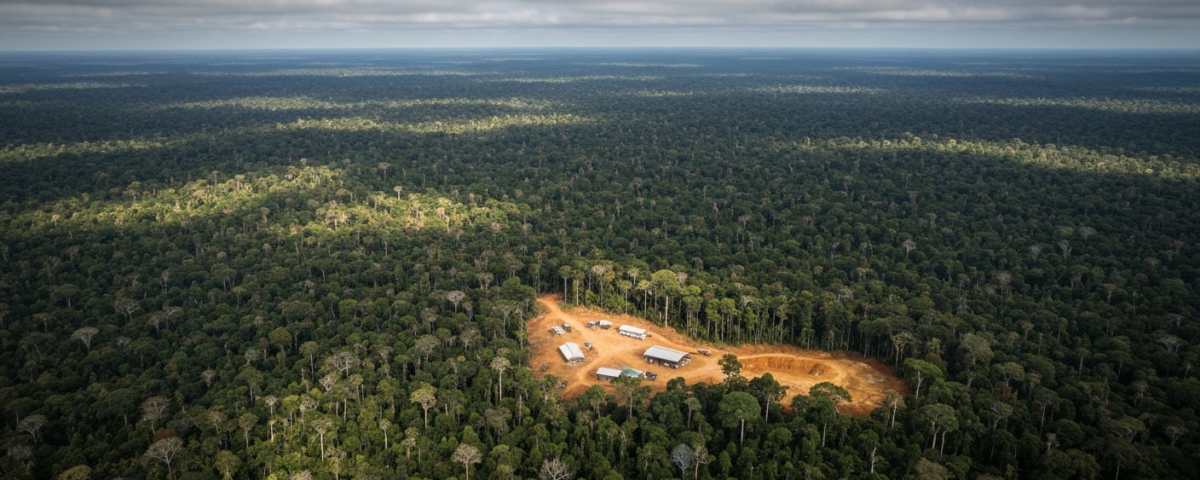
When classic gold districts become too expensive
Canada and Australia have long been considered safe ground for gold exploration: stable legal systems and trained professionals come with the territory. But that comfort has a price. Properties in mature districts like the Red Lake Camp in Ontario or the Goldfields Belt in Western Australia were carved up long ago among well-capitalized players. Anyone trying to enter those areas today pays a premium that already bakes in the expected exploration upside.
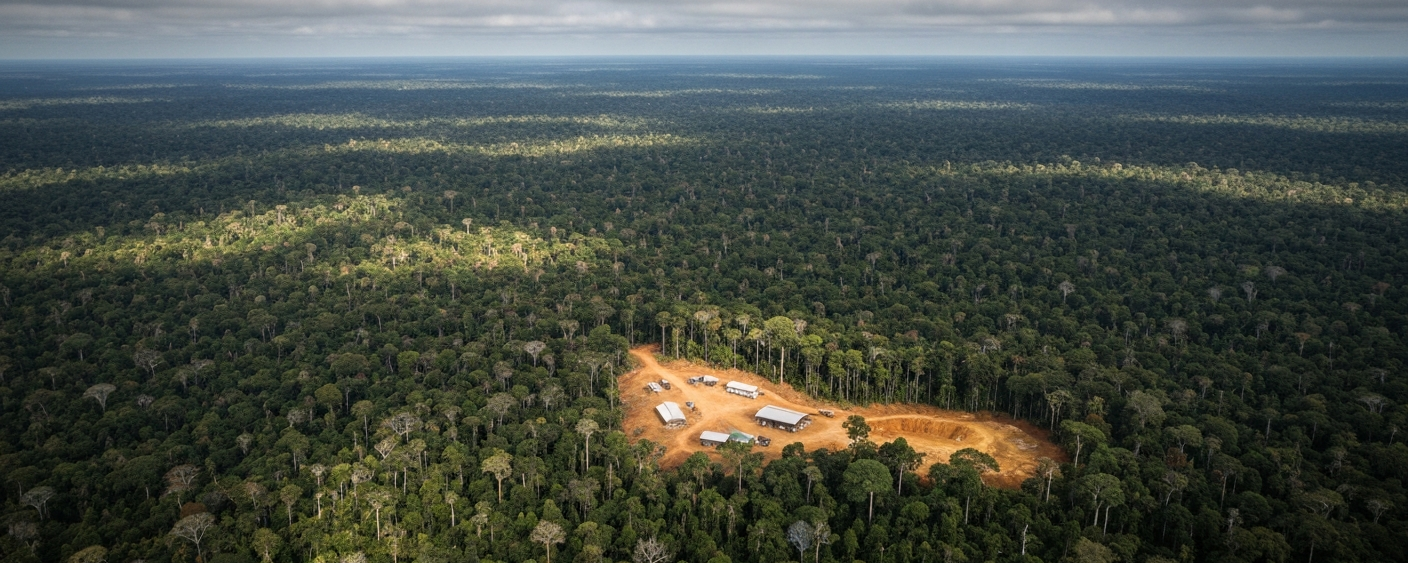
That reality is pushing junior explorers to look elsewhere. A number of companies are now moving into frontier jurisdictions — regions where the geology is interesting but infrastructure is thin, permitting is opaque, and political risk is real. Two areas are drawing particular attention right now: Guyana’s Oko District in northeastern South America and the porphyry zones of Papua New Guinea in the South Pacific.
What makes frontier regions worth the risk
Frontier jurisdictions are defined by the gap between geological potential and how thoroughly the ground has actually been drilled. Entry positions of the kind that disappeared from mature districts years ago can still be had here, though at correspondingly higher risk.
Guyana sits on the Guiana Shield, an ancient geological formation broadly comparable in structure to the West African Shield, where meaningful gold discoveries were made over the past three decades. The Oko District in the west is drawing attention because early drilling has returned gold mineralization at depths and strike lengths that make for plausible junior-company targets. Guyana has also posted sharply higher government revenues from its offshore oil boom, which in theory creates room for infrastructure spending — though the mining sector has so far seen little of that money.
Papua New Guinea (PNG) has a longer mining track record: the country has hosted large gold mines for decades alongside significant copper-porphyry systems. Active exploration belts, including zones with geomorphological similarities to well-known porphyry provinces in the Tethys region, give junior explorers a specific angle: identifying satellite deposits near producing majors. The idea that a known large deposit may have undiscovered sister systems nearby — what the industry calls district-scale thinking — is a central valuation argument in PNG.

How frontier risks feed into junior project valuations
The higher potential of frontier jurisdictions comes with a wider risk profile. The table below lays out the main differences compared to established mining countries:
| Risk Category | Classic Jurisdiction (e.g., Canada) | Frontier Jurisdiction (e.g., PNG, Guyana) |
|---|---|---|
| Political Risk | Low, stable regulatory frameworks | Medium to high, shifting government priorities |
| Infrastructure | Roads, power, ports available | Often rudimentary, logistics cost-intensive |
| Permitting Process | Clearly defined, if slow | Less transparent, local consent critical |
| Valuation Discount | Low discount due to stability | Higher risk discount reflected in market price |
| Entry Valuation | Higher, upside already priced in | Lower, discovery bonus still possible |
One factor that gets routinely underpriced in frontier regions is community consent — whether local communities will actually allow access to an exploration area. In Papua New Guinea, land rights and tribal structures can determine whether a project moves forward at all. A geologically interesting property can be stopped dead without secured community relations. The same applies in remote parts of Guyana, where proximity to indigenous communities brings specific due diligence obligations that take time and money to satisfy.
For investors, drill results alone are not a sufficient basis for valuation. A strong intercept — say, several meters grading in the mid-grams-per-tonne range, as some PNG programs have reported — has to be read against the operational environment. Resource categories in technical reports (Inferred, Indicated, Measured) tell you how well a mineralization is understood, not whether it can be extracted under frontier conditions.
District-scale thinking as an analytical tool
When analysts evaluate frontier projects, they frequently apply the district-scale model: rather than assessing an exploration company on a single property, they ask how large the surrounding geological system is, whether known producers operate nearby, and how densely the surrounding ground has already been drilled.
In PNG this approach has direct relevance because several junior explorers have deliberately positioned their projects close to active mining operations. The logic is straightforward: where a major has already invested in infrastructure, workforce, and processing capacity, satellite deposits can be developed more efficiently — either independently or through acquisition. In established jurisdictions like Quebec or the Pilbara Basin, this “proximity premium” is already embedded in market prices. In frontier regions, it often is not.
A similar pattern is visible in Guyana’s Oko District: an established deposit in the area draws followers who suspect comparable mineralization on unexplored neighboring properties. This mechanism — known as district clustering — explains why capital sometimes flows into several adjacent junior projects within the same region at roughly the same time.
What changes in project assessment for frontier regions
The move by gold juniors into Guyana and Papua New Guinea follows a pattern that recurs across the commodities sector: when safe-jurisdiction properties become expensive, exploration capital shifts toward less developed areas. West African countries like Ghana and Mali went through a comparable process in the 1990s and 2000s before becoming meaningful gold-producing regions.
For investors tracking frontier projects, a few concrete distinctions matter. The gap between a first Inferred Resource (estimated from individual drill holes) and an Indicated Resource (better constrained through a tighter drill pattern) is more consequential in frontier settings than in districts with nearby infrastructure — the path from early assumption to confirmed tonnage is longer and more expensive in difficult terrain. Logistics, community relations, and permitting clarity deserve at least as much attention as drill results. The question that actually determines investment merit is not whether a project sits in a frontier jurisdiction, but whether this particular team, with its current capital base, can realistically fund the next steps.
Key terms for getting started with frontier analysis
- Frontier jurisdiction
- A mining region with largely undeveloped geological potential and an elevated political or operational risk profile compared to established mining countries such as Canada or Australia.
- District-scale model
- An analytical approach that evaluates an exploration project not in isolation but in the context of a broader geological district, including neighboring producers and known mineralization trends.
- Inferred resource
- The lowest resource category under international standards (including NI 43-101). Based on limited drill data; geological continuity is assumed but not sufficiently demonstrated. Must not be confused with a reserve.
- Indicated resource
- A mid-tier resource category that is better constrained than an Inferred Resource through a tighter drill pattern. Forms the basis for economic preliminary studies (PEA, PFS).
- Community consent
- The formal or informal agreement of local communities (often including indigenous groups) to access and operate on an exploration property. In frontier jurisdictions, securing this agreement is frequently where projects stall.
- Porphyry system
- A geological ore deposit in which metals (commonly copper and gold) have been concentrated by rising hydrothermal fluids within a large-volume, low-grade body. Typical of PNG and other Pacific Arc settings.
- Proximity premium
- The valuation premium an exploration project receives because of its location near an active mining operation, with potential synergies in infrastructure or acquisition interest from the major.
- First-mover position
- Early property access in a still largely unexplored region; offers the potential to identify mineralization ahead of the competition, but carries the highest exploration risk.
⚠️ Important notice: This article is for informational and educational purposes only. It does not constitute investment advice, a recommendation, or a solicitation to buy or sell any security. Investments in small-cap exploration and mining companies carry a high risk, including the potential total loss of capital. Before making any investment decision, consult a registered financial advisor and conduct your own analysis. Boersen Post Team is not responsible for decisions taken based on the content published here.