District Portfolios in Uranium Juniors: Diversification as a Valuation Factor
June 20, 2026
Letters of Intent: How Government Pledges Make Lithium Projects Financeable
June 20, 2026
Before the drill touches ground
A small uranium explorer on the ASX publishes geophysical survey results, and the share price jumps by double digits. For anyone watching from outside, this is genuinely difficult to follow. No drill holes have been completed, no resources calculated, no feasibility study anywhere near submission. And yet these early data points shift millions of dollars in market capitalization.
This is not irrational speculation. Geophysics almost always precedes drilling in the exploration sequence, and that sequencing explains both why the market reacts so sharply to survey data and which risks tend to get lost in the excitement.
What the surveys actually measure
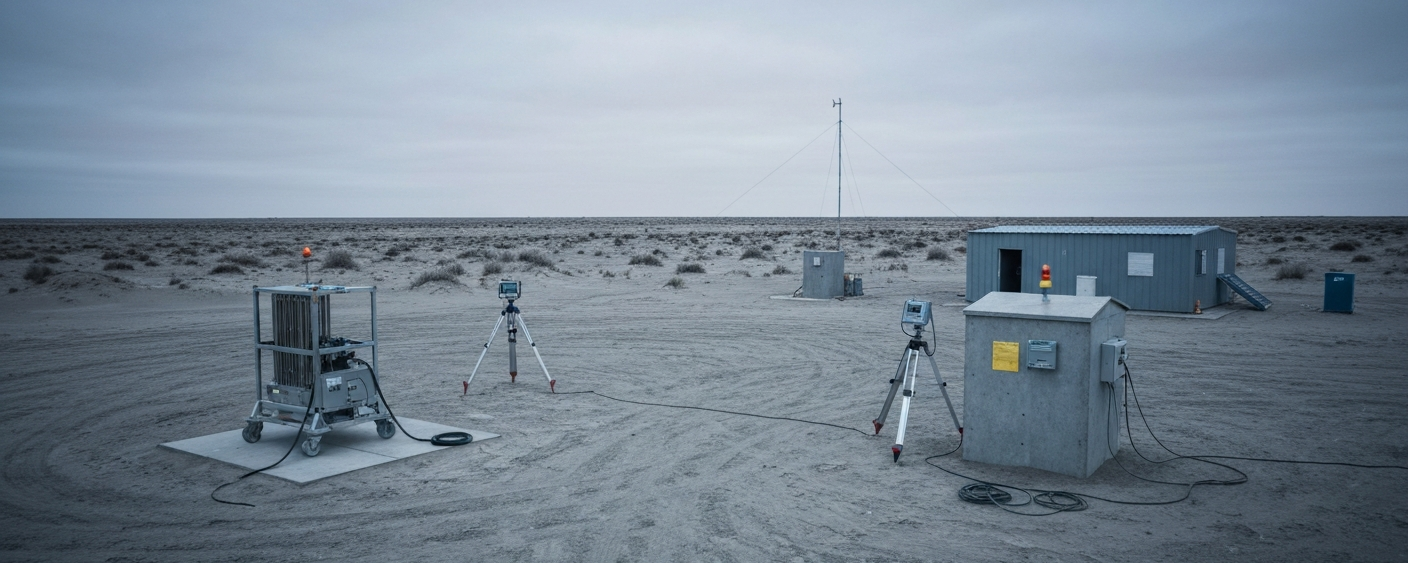
Uranium deposits frequently occur at depths and within structures that surface traversing cannot detect. Geophysical surveys are the tool exploration geologists use to interrogate the earth before committing to costly drilling programs.
In the uranium sector, electromagnetic surveys (EM) measure the electrical conductivity of the subsurface. Fault zones and structural discontinuities — classic host rocks for unconformity-type uranium mineralization — often appear as conductive anomalies. Magnetic surveys help map structural features such as intrusions or fracture zones. Radiometric surveys measure natural gamma radiation at the surface and give direct indications of elevated uranium, thorium, or potassium concentrations in near-surface rock. None of these methods is sufficient on its own.
Only by combining airborne and ground-based data can geologists define prioritized drill targets. A strong radiometric surface signal that overlaps with a deeper electromagnetic anomaly is meaningful in uranium exploration. Each method alone delivers only part of the picture.

Why share prices move on pre-drilling data
The share price reaction to survey results has a logic borrowed from options pricing: the value of an exploration license depends not only on what is known today, but on how large the upside could be if results go the right way. Survey data cut uncertainty, and that reduction changes how the market prices a project.
A rough analogy: a property developer buys an undeveloped lot in an unfamiliar area. The moment a soil assessment confirms the ground can support high-rise construction, the market value rises before a single stone has been laid. The information has lowered the risk premium.
In the uranium sector this dynamic is sharper than in most others. Drilling in remote terrain is extremely capital-intensive; a single hole can cost several hundred thousand dollars. Survey data that define multiple drill targets at once suggest more efficient capital allocation. Beyond that, the uranium market is already charged by geopolitical pressure around western supply security and nuclear expansion, so positive news finds a ready audience. For a company with a market cap below AUD 50 million, a single announcement can reprice an entire project.
In a bullish uranium environment, survey announcements often trigger stronger share price moves than the same data would produce in other sectors, even when the geological finding is, viewed plainly, just the opening act of a very long process.
| Survey method | What it measures | Relevance for uranium |
|---|---|---|
| Electromagnetic (EM) | Electrical conductivity of the subsurface | High — identifies fault zones and unconformities |
| Magnetic | Magnetic field variations | Medium — maps structural control zones |
| Radiometric | Natural gamma radiation | Direct — measures uranium/thorium concentration at surface |
Reading a survey announcement critically
Not every survey announcement carries equal weight. A few questions help separate useful data from noise.
Methodological depth: Has the company used multiple complementary methods, or does the announcement rest on a single technique? Multi-method surveys produce stronger geological arguments for any drill target.
Follow-up program: Does the explorer commit to concrete next steps, such as ground-truthing traverses or a defined drilling program? Without a clear follow-up, an anomaly stays a data point with no commercial implication.
Jurisdiction and project type: Australian uranium projects operate under permitting regimes that vary by state. The Yanrey Basin in Western Australia is a sedimentary basin system, structurally different from the unconformity deposits of Canada’s Athabasca Basin, and the two exhibit quite different geophysical signal profiles.
Qualified expertise: Reports must be signed off by a Qualified Person (QP). This is a regulatory minimum requirement that underpins the integrity of data interpretation, not a formality.
A common beginner’s mistake is treating a “strong anomaly” as equivalent to a “deposit.” From anomaly to drill results to a JORC-compliant resource estimate, the process typically takes years and multiple rounds of capital raising.
Keeping early-stage data in perspective
Geophysical hits that initially appeared significant have, after drilling, often turned out to be structural artifacts with no economic mineralization. The opposite has also occurred: modest early surveys have preceded substantial discoveries. Neither outcome is readable from the survey stage alone, which is why experienced geologists treat a strong anomaly as a question worth asking, not an answer.
Share price reactions to these announcements reflect a shift in probabilities. The exploration pyramid, which narrows from thousands of projects down to a handful of economic mines, does not change shape because of a survey result. Investors who understand what the geophysical methods actually measure are at least better placed to judge whether an announcement contains real geological information or whether a price jump is running ahead of the evidence.
Key terms from geophysics and exploration
- Electromagnetic survey (EM survey)
- A geophysical method that measures the electrical conductivity of the subsurface by transmitting electromagnetic fields. In the uranium sector, it is commonly used to identify fault zones or conductive alteration.
- Radiometric survey
- Measurement of natural gamma radiation at the earth’s surface. Elevated readings can indicate near-surface concentrations of uranium, thorium, or potassium.
- Anomaly
- A measurement value that deviates significantly from the regional background level. An anomaly points to possible geological features, but does not constitute proof of mineralization.
- Ground-truthing
- Field traversing and sampling to verify geophysical anomalies directly at the surface. An anomaly only becomes a prioritized drill candidate after ground-truthing.
- JORC Code
- The Australian and internationally recognized standard for reporting mineral resources and reserves (Joint Ore Reserves Committee). Like Canada’s NI 43-101, it draws strict distinctions between resource categories (Inferred, Indicated, Measured) and reserves (Probable, Proven).
- Qualified Person (QP)
- A competent professional with at least five years of relevant experience who signs technical reports and results announcements in accordance with regulatory standards, thereby assuming content responsibility.
- Unconformity deposit
- A uranium occurrence that formed along a geological unconformity, a boundary surface between rock units of different ages. Typical of Canada’s Athabasca Basin; exhibits specific geophysical signatures.
- Airborne survey
- A geophysical survey conducted from an aircraft or helicopter that covers large areas cost-effectively and serves as the basis for more detailed ground-based investigations.
⚠️ Important notice: This article is for informational and educational purposes only. It does not constitute investment advice, a recommendation, or a solicitation to buy or sell any security. Investments in small-cap exploration and mining companies carry a high risk, including the potential total loss of capital. Before making any investment decision, consult a registered financial advisor and conduct your own analysis. Boersen Post Team is not responsible for decisions taken based on the content published here.