Mining Conferences as Gatekeepers: Africa’s Role in Critical Metals
June 27, 2026
LIFE Offerings in Copper Juniors: Understanding Capital Structure
June 27, 2026
When numbers on paper determine millions
In the commodities sector, what often matters most is not what lies in the ground but what a report says about it, and whether anyone credible has signed off on that report. For junior explorers seeking capital for the next project phase, a resource estimate prepared under the Canadian standard NI 43-101 is frequently the first serious hurdle before any financing conversation can happen. This is particularly true for multi-metal deposits — those containing several economically relevant metals at once, such as copper, zinc, and gold alongside silver.
A current example: a Canadian junior explorer has filed an NI 43-101-compliant resource report for its copper-zinc-gold-silver project in Manitoba. The sequence is familiar. Juniors consolidate their geological data, have it reviewed by independent experts, and use the resulting report to open discussions with institutional investors, royalty companies, or potential acquirers. For small-cap investors, it is worth understanding why this step carries the weight it does, and what to look for when reading such reports.
The NI 43-101 standard in the commodity cycle
NI 43-101 is a Canadian regulatory instrument (National Instrument 43-101) that sets binding requirements for how mineral resources may be communicated publicly. It applies to all companies listed on Canadian stock exchanges and has become an international quality benchmark that many investors outside Canada also treat as a reference point.
The standard requires that resource estimates be prepared or reviewed by a so-called Qualified Person (QP): an independent, certified technical expert. Without that sign-off, public statements about the quantity and grade of a deposit are simply not permitted. This may sound like bureaucracy, but it has a practical economic rationale — it protects investors from speculative or misleading claims and gives credible projects a way to separate themselves from pure hope stories through documented data.
Demand from the energy transition, electric mobility, and geopolitical supply-chain concerns has pushed institutional investors and royalty companies to scrutinize projects far more closely than they did a decade ago. An NI 43-101 report is no longer optional in that environment; it is a baseline requirement for any serious financing round.

Three resource categories, three different risk levels
The analytical core of every NI 43-101 report is the classification of resources into three categories, each reflecting a different degree of geological confidence:
| Category | Data basis | Investor relevance |
|---|---|---|
| Inferred | Limited drill data, geological interpretation | Highest risk — suitable only for speculative stages |
| Indicated | Sufficient drill points for a reasoned estimate | Basis for preliminary economic studies (PEA) |
| Measured | Dense drill spacing, high statistical confidence | Foundation for reserve classification and bank financing |
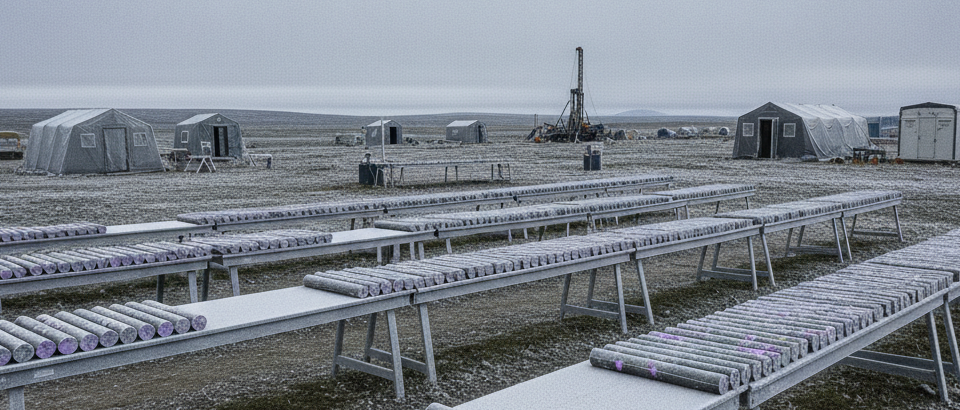
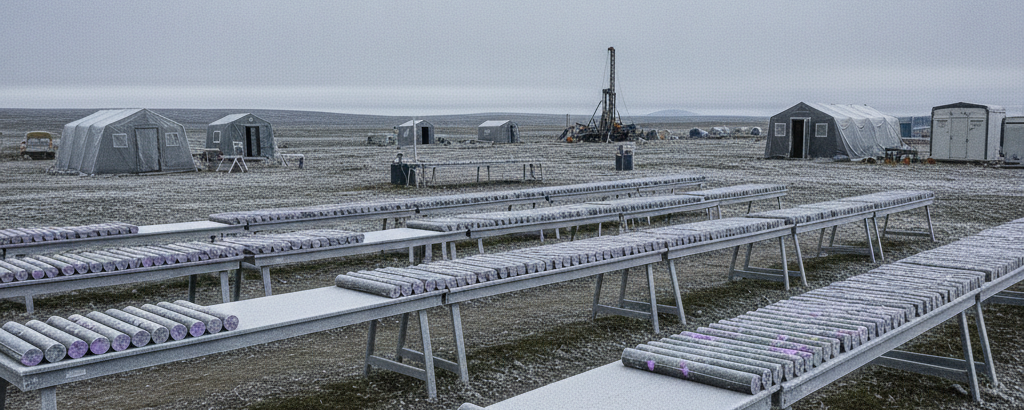
The difference between categories comes down to drill density. An inferred resource rests on scattered drill holes — mineralization is known to be present, but its spatial extent is still uncertain. Indicated means enough data points exist to estimate quantity and grade with reasonable accuracy. Measured requires such tight drill spacing that banks will accept the figures as a basis for lending. Investors who grasp these distinctions can read junior press releases with considerably more skepticism than those who take the headline numbers at face value.
Multi-metal projects such as a copper-zinc-gold-silver system add another layer of complexity: economic assessment depends not only on total tonnage but on the ratio of individual metals within that tonnage. Grades are typically expressed as a “copper equivalent” (CuEq) or “zinc equivalent” (ZnEq) to allow comparisons. Investors should verify in the report which metal prices and recovery rates underlie that conversion, because the assumptions can shift the picture substantially.
What a resource report does for financing
Filing an NI 43-101 report rarely triggers an immediate financing step. What it does first is create a reliable data foundation that institutional investors with their own due-diligence teams can work from. It also makes a Preliminary Economic Assessment (PEA) possible and puts the project on the radar of potential acquirers from the major or mid-tier segment, which need consistent resource data for their valuation models.
Projects in stable mining jurisdictions such as Canada or Australia tend to attract higher valuation multiples for comparable resource quantities than similar projects in politically riskier regions. Manitoba has been an established mining location for decades, with existing infrastructure, and financing partners typically factor that in. Whether they factor it in enough is a separate question worth asking.
A first-time resource report filing signals that a project has reached a defined stage of development. It does not automatically reduce investment risk; geological uncertainty gives way to technical, economic, and regulatory questions. The actual valuation work starts with reading the report, not before.
A snapshot, not a forecast
An NI 43-101 resource report captures the state of knowledge at a specific point in time. Resources can grow through additional drilling, but they can also shrink or be reclassified when new data arrives. Treating the filing of such a report as a buy signal, without reading what is inside it, ignores that possibility entirely.
That said, the step from an unquantified exploration property to an NI 43-101-compliant resource is real, and the market tends to price it in — not because the resource has suddenly become more valuable, but because uncertainty about its existence and scale has decreased. Every exploration project goes through this process on the path toward a feasibility study. Knowing where a project sits in that sequence matters more than the headline tonnage figure.
Check the equivalency assumptions, read the QP statements, and keep the resource categories straight. Press releases are written to attract attention; the report is where the actual information lives.
Key terms at a glance
- NI 43-101
- A Canadian regulatory instrument (National Instrument 43-101) that sets binding standards for the public disclosure of mineral resources and reserves. Widely used as an international quality benchmark.
- Qualified Person (QP)
- An independent, certified technical expert required under NI 43-101 to prepare or review resource estimates. Without a QP signature, public resource disclosures are not permitted.
- Inferred Resource
- The resource category with the lowest confidence level. Quantity is estimated on the basis of limited data and geological interpretation; not suitable as a foundation for economic studies.
- Indicated Resource
- An intermediate confidence level. Sufficient data exists for a reasoned estimate of quantity and grade; may feed into preliminary economic assessments (PEA).
- Measured Resource
- The highest resource category, based on close drill spacing and high statistical confidence. Forms the prerequisite for classification as a reserve.
- Mineral Reserve vs. Mineral Resource
- Reserves are the portion of resources deemed recoverable following economic, technical, and regulatory evaluation. A resource is not yet a reserve, and this distinction is fundamental to project valuation.
- Copper Equivalent (CuEq)
- A calculated metric used in multi-metal projects to convert the grades of various metals into a single unified figure. The metal prices and recovery assumptions used significantly influence the result and should be transparently disclosed in the report.
- Preliminary Economic Assessment (PEA)
- A scoping study that models economic scenarios for a project for the first time. It typically requires indicated resources and is not a substitute for a feasibility study.
⚠️ Important notice: This article is for informational and educational purposes only. It does not constitute investment advice, a recommendation, or a solicitation to buy or sell any security. Investments in small-cap exploration and mining companies carry a high risk, including the potential total loss of capital. Before making any investment decision, consult a registered financial advisor and conduct your own analysis. Boersen Post Team is not responsible for decisions taken based on the content published here.