LIFE Offerings in Copper Juniors: Understanding Capital Structure
June 27, 2026
Geophysics as the Key: How New Porphyry Targets Are Born
June 27, 2026
When an algorithm decides where to drill
For decades, one principle governed commodity exploration: experienced geologists interpret data, draw conclusions, and decide where to place the next drill hole. The process was slow, expensive, and tied to individual expertise in ways that made scaling difficult. Now algorithm-based target selection is working its way into the exploration cycle.
In practice, this means specialized software systems simultaneously analyze large volumes of geological, geophysical, and geochemical data and propose drill targets that a human team might have missed entirely or identified only much later. For investors watching junior copper companies, that has a direct consequence: it affects how much geological insight is generated per dollar invested.
The real problem is the volume of data
A single copper project in Nevada can encompass thousands of historical drill holes, multiple seismic surveys, induced polarization (IP) geophysical datasets, geochemical soil samples, and satellite multispectral imagery. This is not the exception — it is standard practice in a well-explored mining district.
The human brain handles pattern recognition well when datasets stay manageable. But when variables number in the hundreds and interact in nonlinear ways, classical interpretation methods hit their limits. Machine learning was built for exactly these kinds of problems. Models can learn, for example, which combination of magnetic anomaly, alteration, and structural geology has historically coincided with economic mineralization in comparable copper porphyry districts, then transfer that pattern to new areas.
In practice, specialized exploration technology companies work closely with junior miners. They handle data integration, train models on historical data from geologically comparable settings, and deliver prioritized target lists for the drilling campaign. The final geological decision stays with the explorer’s own team.
What drill costs mean for junior miners
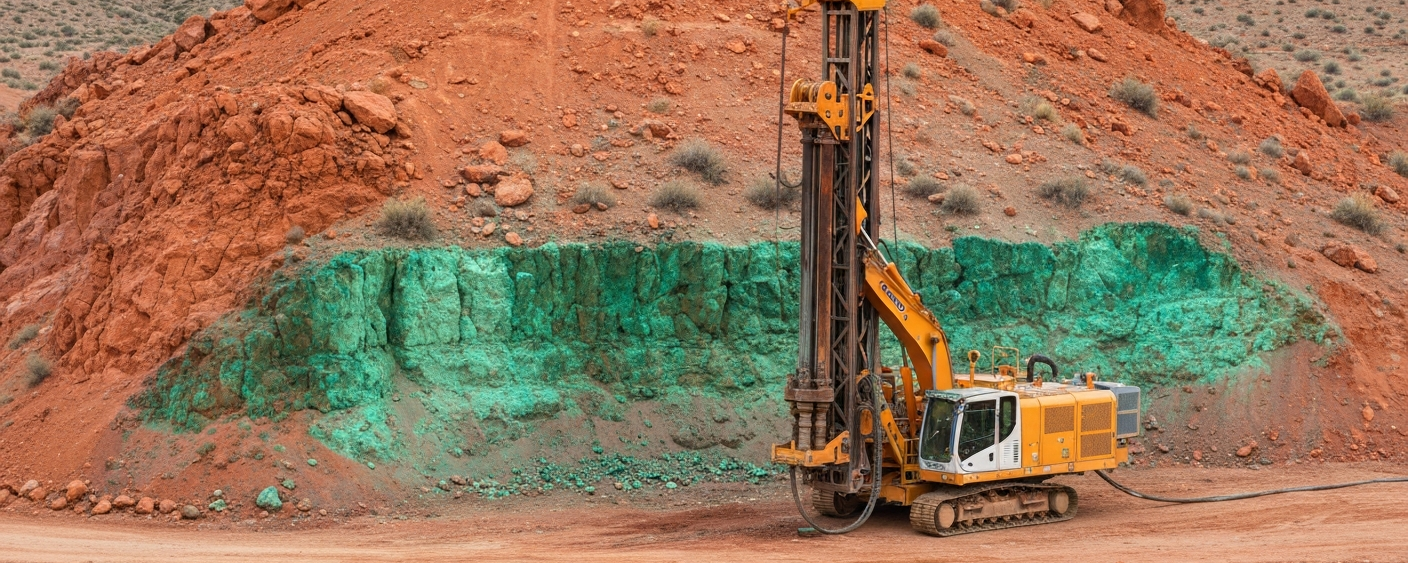
For publicly listed junior copper companies operating with limited capital, every drill hole represents a significant commitment. A single diamond drill hole can cost anywhere from $150,000 to more than $500,000, depending on depth, geology, and location. Campaigns covering roughly 10,000 feet (approximately 3,000 meters) can therefore easily consume several million dollars.
If AI models improve the proportion of holes that intersect meaningful mineralization, that directly improves what the capital produces. Instead of drilling eight holes to get three positive results, five might suffice. For companies running tight cash reserves, that is far from theoretical.
The pharmaceutical industry offers a rough parallel: AI is used there to prioritize drug candidates before costly clinical trials begin, with better pre-selection lowering the failure rate in expensive downstream steps. Whether exploration geology behaves similarly will only become clear as more completed drilling programs produce actual evidence.
| Exploration method | Strengths | Limitations |
|---|---|---|
| Traditional geological interpretation | Experience-based, context-sensitive | Time-consuming, subjective with large datasets |
| AI-assisted target selection | Processes high-dimensional datasets, pattern recognition | Dependent on data quality, no substitute for field knowledge |
| Combined approach | Each method can cross-check the other | Higher coordination effort, specialized expertise required |
Reading AI exploration announcements critically
The technology has real potential. Even so, related announcements from small caps are worth reading carefully. Two questions cut through most of the noise.
What data feeds the model? A model is only as good as its training data. Does the project have extensive historical drill data and geophysical datasets, or is the available information thin? Projects in established mining districts like Nevada have an advantage here, because historical industry data is often accessible.
When will drill results be available? AI target selection is a hypothesis, confirmed or refuted only by actual drilling. There is a meaningful difference between launching an algorithmically planned drilling program and receiving assay results. The first is a methodological choice; the second delivers the geological finding.
When 3D seismic technology entered oil exploration in the 1980s, it improved success rates for exploratory drilling considerably. But even the best seismic survey guaranteed no discovery — it reduced risk. AI-assisted target selection belongs in that same history.
Cost pressure, not novelty, is driving adoption
The declining number of easily discoverable near-surface deposits is pushing explorers to work deeper and more cost-consciously. At the same time, the volume of data generated by modern geophysical methods is growing faster than traditional interpretation workflows can absorb. Neither of these conditions is temporary.
Bringing in exploration technology service providers can signal that a junior company is working at the current methodological edge. It is not, however, a guarantee of exploration success, nor a substitute for solid project fundamentals, adequate capital, and an experienced management team.
As AI exploration methods become more common among junior copper companies, the advantage will shift away from data access and toward the quality of the geological hypotheses fed into the models. Assay results will settle that question, not press releases.
Key terms in AI-assisted exploration
- Machine Learning (ML)
- A subset of artificial intelligence in which algorithms learn patterns from example data without being explicitly programmed. In exploration, ML is used to identify geological anomalies and prioritize drill targets.
- Target generation
- The process of identifying and prioritizing areas within a project that appear promising for drilling. Based on the integration of multiple geological datasets.
- Induced Polarization (IP)
- A geophysical method that measures electrical charge effects in the subsurface. It provides indications of sulfide mineralization and is particularly relevant in copper exploration, since copper sulfides such as chalcopyrite produce a characteristic IP signature.
- Diamond drill core
- A cylindrical rock sample obtained using diamond-tipped drill bits. Provides continuous rock samples for geological and geochemical analysis (assay).
- Assay
- A laboratory analysis of a drill core interval to determine metal content. Results are reported in grams per tonne (g/t) for precious metals or as a percentage (%) for base metals such as copper.
- Capital efficiency in exploration
- The ratio between capital deployed (e.g., for drilling) and the geological insight or resource growth achieved. High capital efficiency means more knowledge gained per dollar spent.
- Copper porphyry
- The most common economic copper deposit type. Formed through magmatic processes, porphyry deposits are characterized by large-volume but low-grade mineralization. Their economic significance lies in bulk minability: low grades, but very large tonnages.
⚠️ Important notice: This article is for informational and educational purposes only. It does not constitute investment advice, a recommendation, or a solicitation to buy or sell any security. Investments in small-cap exploration and mining companies carry a high risk, including the potential total loss of capital. Before making any investment decision, consult a registered financial advisor and conduct your own analysis. Boersen Post Team is not responsible for decisions taken based on the content published here.