Caesium and Lithium in Pegmatite: Two Metals, One Project
August 7, 2026
Monazite as a REE Host Mineral: What Early-Stage Drill Results Really Prove
August 8, 2026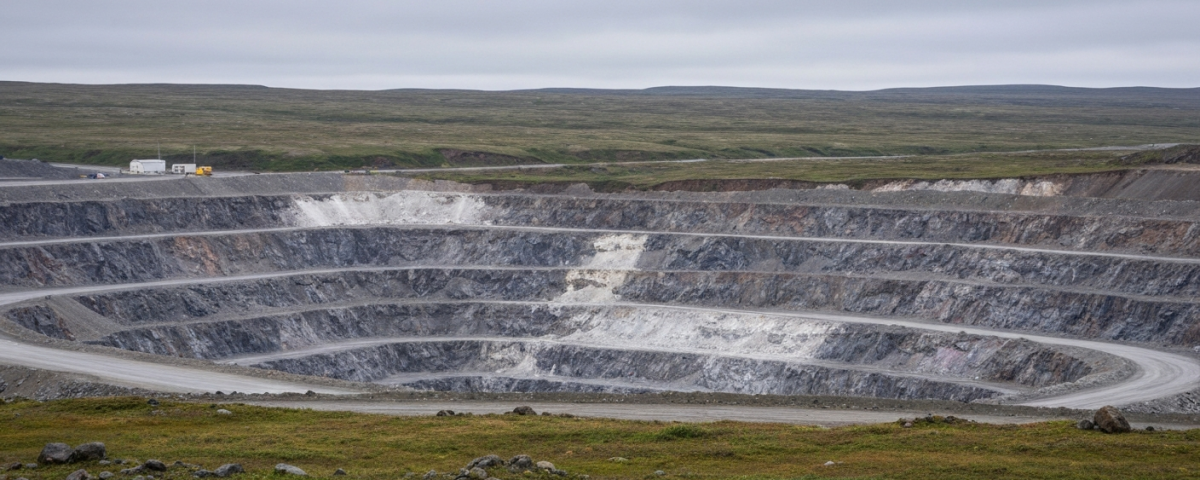

When archive data suddenly becomes relevant again
In commodity exploration, there is a pattern that tends to catch newcomers off guard: a project can sit dormant for over a decade and then reappear on institutional investors’ radar without a new drill hole or a price surge. Sometimes all it takes is old data recalculated to current standards.
That is what has happened recently in the rare earth elements (REE) sector. A Canadian company has released the first comprehensive revision of the mineral resource estimate for one of its large REE projects in the Northwest Territories since 2013. The result is 58.6 million tonnes in the Measured & Indicated categories at a grade of 1.49% TREO, and 130.6 million tonnes in the Inferred category at 1.31% TREO. Total contained resource is up 42%. For investors in junior explorers in the critical metals space, those numbers say something specific about project maturity, reporting standards, and why jurisdiction still matters.
Technical standards shape valuations more than drill results
The commodities industry runs on numbers, but not all numbers are equally usable. Mineral resource estimates are subject to reporting standards that have changed considerably over time. In the United States, the SEC’s S-K 1300 reporting standard has been in effect since 2018, imposing stricter requirements on economic assumptions, cutoff calculations, and disclosure than its predecessor.
A resource estimate from 2013, prepared under the metal price assumptions and conventions of that era, is effectively unusable for today’s capital markets. Project financiers and institutional investors require up-to-date technical reports that demonstrate economic viability under current conditions. Without that update, a project stalls: potentially significant, but impossible to finance.
A bank will not accept a property appraisal from 2013, not because the building has deteriorated, but because market conditions and valuation methodology have moved on. Mineral resources work the same way.

Why the resource grew by 42 percent without a single new drill core
Resource estimates can grow in a recalculation even when no new material has been drilled. This comes down to how cutoff values, geological models, and statistical methods interact.
| Factor | Explanation |
|---|---|
| Updated cutoff values | The minimum economic grade (cutoff) is recalculated using current metal prices and processing costs. Lower cutoffs pull more material into the estimate. |
| Improved geological models | Modern 3D modeling software can interpolate older drill hole data more accurately and define mineralization boundaries more precisely. |
| Revised statistical methods | Geostatistical techniques such as kriging have been refined; this affects how much material is assigned to each category (Inferred vs. Indicated). |
In this case, a Net Metal Revenue (NMR) cutoff of USD 366.40 per tonne was applied, based on current rare earth prices and realistic processing costs. That figure directly addresses economic viability under present conditions rather than those of a decade ago, which is what any financing discussion will require first.
The ratio between Inferred tonnage (130.6 million tonnes) and Measured & Indicated (58.6 million tonnes) is not a minor detail. Inferred resources are geologically less well-constrained and cannot serve as the basis for feasibility studies or mine plans. They indicate geological scale, but substantial drilling and study work lies ahead before any lender will take the project seriously.
Jurisdiction and product mix
Not every rare earth resource is worth the same, even at an identical overall grade. Where a deposit sits and what it contains are the two things that drive its commercial relevance.
Canada is one of the more stable mining jurisdictions available. The Northwest Territories have well-established permitting processes, legally secure ownership structures, and none of the political risk attached to projects in countries with inconsistent regulatory histories. Given that China controls roughly 85 to 90 percent of global rare earth processing capacity, North American manufacturers in the electric vehicle and defense sectors have a genuine interest in domestic sources.
The element mix is the second factor. This project contains both light and heavy rare earths, including neodymium and praseodymium (collectively “NdPr”), which are core feedstocks for permanent magnets used in electric motors and wind turbines. Heavy rare earths such as dysprosium and terbium are present in much smaller quantities but command significantly higher prices per kilogram. A mixed element spectrum can attract a broader range of offtake partners, though it is also metallurgically harder to process than a pure light rare earth deposit.
What a resource update actually means for small-cap investors
A resource update is, first and foremost, a signal that management is spending capital on technical credibility. An outdated technical report usually means a project is not actively pursuing financing or partnership discussions. An updated one opens those conversations.
That said, an update is not a confirmation of economic viability. The path from resource to reserve still requires feasibility studies, metallurgical test work, and regulatory permits, and for a project that has been in the development stage for over a decade, none of those are trivial. Geopolitically, projects like this have wind behind them. But demand for a metal and an operating mine are two different things.
Key terms for getting started with REE analysis
- TREO (Total Rare Earth Oxide)
- The unit of measurement for rare earth content in an ore, expressed as the percentage of all rare earth oxides relative to total rock mass. Comparable to gold grade in grams per tonne in precious metals projects.
- Inferred Resource
- The lowest resource category under NI 43-101/S-K 1300. Based on limited geological data; cannot be used in feasibility studies or mine plans. It indicates potential, not certainty.
- Measured & Indicated Resource
- Higher resource categories supported by a denser drill data base. Indicated material can feed into Preliminary Economic Assessments (PEAs); Measured material can be converted into reserves.
- Net Metal Revenue (NMR)
- A calculation of the economic value of all metallic components in an ore after deducting processing and transportation costs. Used as a cutoff criterion: only material above the NMR cutoff is considered economically recoverable.
- S-K 1300
- The U.S. SEC standard for reporting mineral resources and reserves, in effect since 2018. It imposes stricter economic assumption requirements than its predecessor, S-K 1600, and partially aligns with NI 43-101.
- NdPr (Neodymium-Praseodymium)
- A light rare earth element pair central to the production of permanent magnets in electric motors and wind turbines. Supply is a known bottleneck in the energy transition.
- Technical Report
- A formal document prepared by a qualified person (QP) that documents resource estimates, exploration data, and economic parameters according to standardized rules. The foundation for regulatory filings and financing processes.
⚠️ Important notice: This article is for informational and educational purposes only. It does not constitute investment advice, a recommendation, or a solicitation to buy or sell any security. Investments in small-cap exploration and mining companies carry a high risk, including the potential total loss of capital. Before making any investment decision, consult a registered financial advisor and conduct your own analysis. Boersen Post Team is not responsible for decisions taken based on the content published here.