Drill Permit as Supply Chain Signal: Gallium in the West
June 16, 2026
Porphyry Maturity: What PFS Results Really Measure for Copper Juniors
June 16, 2026
Summer in the Athabasca: why multiple juniors set up their drill rigs at the same time
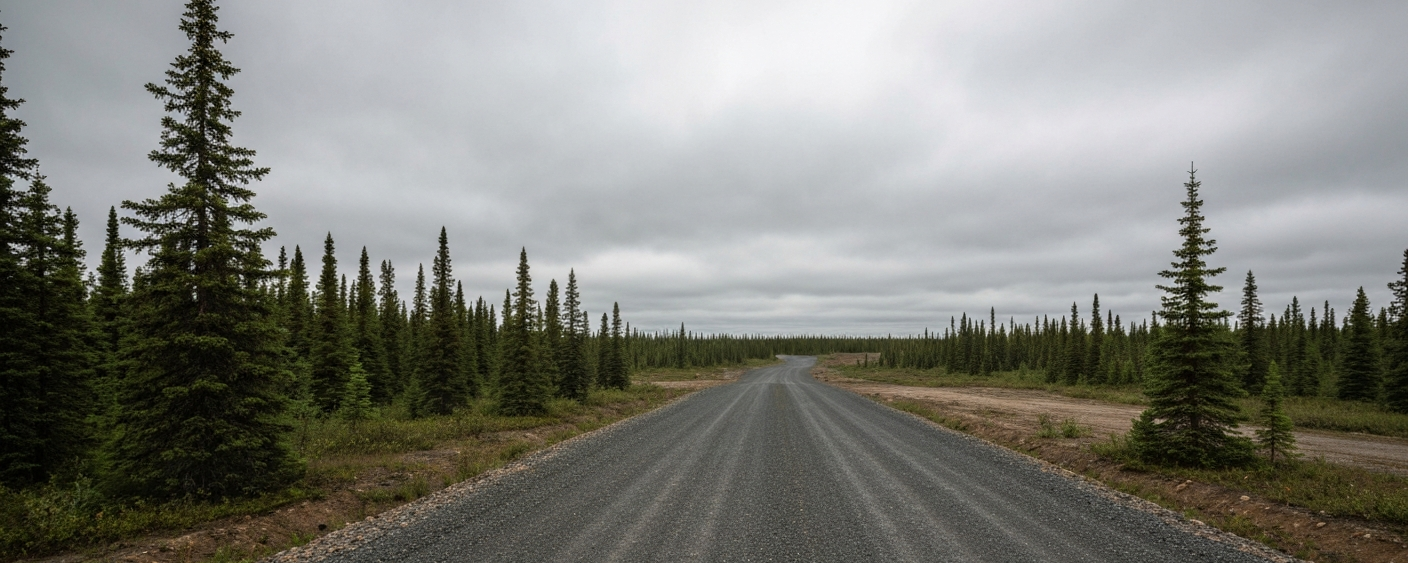
When the spring thaw clears the access roads into the Athabasca Basin, several small exploration companies move in with their drill rigs within weeks of each other. This is not coincidence. It follows a logic rooted in geography and capital market timing that shapes how individual press releases should be read.
In the summer of 2026, the pattern is unusually visible. In the southwestern part of the basin, one junior explorer is testing corridors on its flagship project and has already reported elevated radioactivity in the first drill hole. About 400 kilometers to the east, another company is running a joint venture near the Cigar Lake mine complex and has announced summer drilling as well. Two projects, two regions, the same narrow operating window — because at these latitudes the season simply does not allow much else.
Why the Athabasca Basin is considered a reference district
The Athabasca Basin in Saskatchewan hosts the highest-grade uranium deposits in the world. What makes it geochemically distinctive is the deposit type: uranium concentrates here in unconformity deposits, along geological boundaries between ancient basement rock units and overlying sandstones. These structures produce grades that are rarely matched anywhere else on Earth.
For junior explorers, this has two practical consequences. Decades of exploration data are available, which makes geological models more precise. And proximity to producers such as the Cigar Lake complex gives new projects a point of comparison. In capital markets, this gets called a district play: a junior trades at a premium because it operates in a geologically proven area. That is confidence in the address, not in the project itself — every project still has to prove its own geology.

Uranium as a strategic commodity: between energy policy and defense infrastructure
Uranium is not only fuel for conventional nuclear power plants. For several years it has also been at the center of discussions about Small Modular Reactors (SMRs), which are being evaluated as compact, decentralized power sources for military installations and remote industrial sites.
For Western governments, this has created a supply chain problem: a large share of globally processed uranium passes through enrichment and conversion facilities in countries considered geopolitically unreliable. North American and European policy has responded by pushing domestic supply chains, from exploration through to conversion. That gives juniors in the Athabasca Basin a degree of policy support that sits alongside the uranium spot price rather than replacing it.
None of that translates directly into project value, though. Between a positive drill hole and a producing mine, there are typically ten to fifteen years of work: resource estimation, permitting, multiple study phases, and additional financing rounds that can dilute early shareholders considerably.
| Project phase | Typical duration | Key output |
|---|---|---|
| Geophysics & target generation | 1–2 years | Drill target list |
| Initial drilling (grassroots) | 2–4 years | Anomaly or first indication of mineralization |
| Resource definition (NI 43-101) | 3–5 years | Inferred / Indicated Resource |
| Preliminary studies (PEA → PFS → FS) | 3–6 years | Economic viability assessment |
| Permitting & construction | 3–7 years | Mine permit, capital investment |
Reading parallel drilling seasons as a market signal
What does it mean when several junior miners drill in the same district in the same summer? The straightforward part: drilling programs get planned when capital is available. Multiple programs in one summer mean the companies involved raised enough equity capital beforehand, usually through private placements. That requires investor demand for sector exposure. It says nothing about the geology.
On the geological side, every drill hole in the region adds to the regional data set, including holes that come back negative. When multiple teams independently target the same district, that confirms geological interest in the area — nothing more.
Worth keeping in mind: concurrent drilling announcements compete for investor attention. A report of elevated radioactivity gets more coverage when neighboring projects are also active. The news value of an announcement and its scientific content are two different things, and a busy drilling season tends to blur that line.
What the parallel activity in the Athabasca actually tells us
Drilling announcements and initial radiometry readings are early data points. The numbers that matter arrive with the assay results, usually weeks to months after core extraction. Joint venture structures, such as a 70/30 model, bring an experienced partner into the project who contributes geological expertise and shares the capital burden. And the policy debate around uranium and energy security changes the backdrop for junior miners, but a strong assay result does far more for a share price than any government announcement.
The Athabasca Basin is geologically what it has always been: home to some of the highest-grade uranium deposits on record. Whether individual junior projects will benefit from that address is what the assay results from the 2026 drilling season will eventually show.
Key terms for beginners
- Unconformity deposit
- Uranium mineralization along a geological unconformity, an ancient erosion surface between basement rock and overlying sediments. Characteristic of the Athabasca Basin and the reason grades here are so high.
- Radioactivity anomaly (downhole radiometry)
- A measurement of elevated radiation intensity in a drill hole using a radiometry probe. It is a first indication of uranium mineralization, not a confirmed result. Chemical assays are needed to verify it.
- Assay
- Chemical laboratory analysis of drill core that quantifies the actual metal content, for example uranium in ppm or % U₃O₈. Assay results are what allow reliable conclusions about the quality of a mineralized zone.
- District play
- An investment narrative in which proximity to an established deposit or a geologically proven district lifts the perceived value of a project. Not a substitute for the project’s own geological results.
- Joint venture (JV)
- A partnership between two or more companies for the joint financing and development of a project. A common structure in junior mining: a smaller company operates the project, a larger one provides capital in exchange for a minority interest.
- Inferred resource (NI 43-101)
- The lowest resource category under the Canadian NI 43-101 standard. It rests on limited data and carries high geological uncertainty. It is not the same as a reserve (Proven/Probable).
- Small Modular Reactor (SMR)
- A nuclear power facility with a capacity below 300 MWe, designed to be modular and serially manufactured. Under evaluation as a decentralized energy source for military bases, remote industrial sites, and data centers.
⚠️ Important notice: This article is for informational and educational purposes only. It does not constitute investment advice, a recommendation, or a solicitation to buy or sell any security. Investments in small-cap exploration and mining companies carry a high risk, including the potential total loss of capital. Before making any investment decision, consult a registered financial advisor and conduct your own analysis. Boersen Post Team is not responsible for decisions taken based on the content published here.