Maiden Resource in a Titanium Project: How to Evaluate First Estimates
June 29, 2026
Understanding PEA Metrics: NPV and IRR in Battery Metal Projects
June 30, 2026
Hidden deposits — why some ore bodies stay out of sight
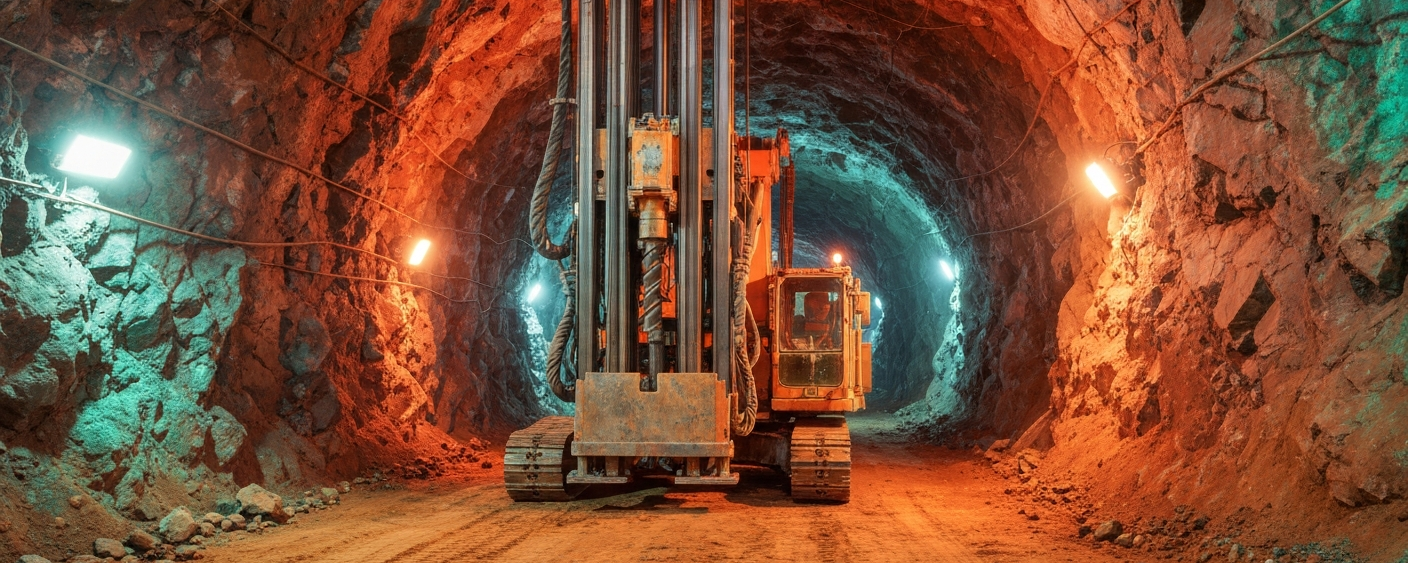
In junior mining, some discoveries announce themselves at the surface: color changes in the rock, gossan fields, oxidized minerals that give an experienced geologist clear hints just by walking the terrain. Then there are deposits that conceal themselves entirely — no surface outcrop, no anomaly that conventional prospecting can detect. These are called blind ore bodies or, in massive sulfide systems, blind lenses.
Finding a blind lens within an already known project can shift its valuation considerably. The reason is simple: resource potential grows without the company needing to acquire new claims or open an entirely new area. For copper and base-metal junior explorers working with limited capital, that is a materially different situation from yet another near-surface confirmation of known mineralization.
Massive sulfide systems and how they form
Massive sulfide deposits — commonly referred to as VMS systems (Volcanogenic Massive Sulfide) — form primarily in near-marine volcanic environments. Hydrothermal fluids carry metals such as copper and zinc through the host rock over millions of years, depositing them in highly concentrated lenses. These systems tend to have a lens-shaped or stratabound geometry: compact, metal-rich bodies that run horizontally or at a slight angle through the surrounding rock.
A classic example is the Iberian Pyrite Belt, which stretches across Portugal and Spain and ranks among the most metal-rich VMS provinces in the world, mined for centuries. Canada’s Flin Flon Belt in Manitoba and Saskatchewan is another defining case: dozens of known VMS deposits, many once in production, and recurring deep discoveries that have repeatedly redrawn what the district actually looks like.
What makes these systems especially difficult for exploration geologists is that individual lenses within a VMS field do not have to outcrop at the surface. They can sit fully concealed beneath unmineralized rock, deep enough that no conventional surface geochemistry delivers a signal. Those are the lenses referred to as blind.

Why blind lenses can redefine a project’s valuation
When a company holds an exploration project, the market generally prices in what is already known: the mapped extent of mineralization zones, existing historical resources, or initial NI 43-101-compliant estimates. That known potential is already in the share price, at least partially.
A blind lens represents unknown potential within known terrain. The company needs no new claims, faces no stakeholder consultation for an unfamiliar area, and already has drill access, a working geological model, and accumulated datasets. Follow-up drilling is therefore cheaper than it would be on a fresh target elsewhere.
The ore body grows vertically or laterally beneath known zones rather than into new license areas, which can substantially alter the overall project estimate. For a junior with a small market cap, that effect on valuation can be disproportionately large — provided further drilling confirms the discovery and it eventually matures into a resource estimate. The lens’s geometry and continuity have to be defined across a sufficient number of holes before any resource calculation means anything.
| Discovery phase | Status / significance for investors |
|---|---|
| First drill intercepts with sulfide mineralization | Early indication — no resource, high risk |
| Multiple converging drill holes confirm lens | Geometry becomes visible — resource potential increases |
| Inferred Resource (NI 43-101) | First quantifiable category — still limited data density |
| Indicated / Measured Resource | Higher data density, more suitable for economic assessment |
| Reserve (Proven / Probable) | Requires feasibility study — basis for financing and mining |
Geophysical methods: making the invisible visible
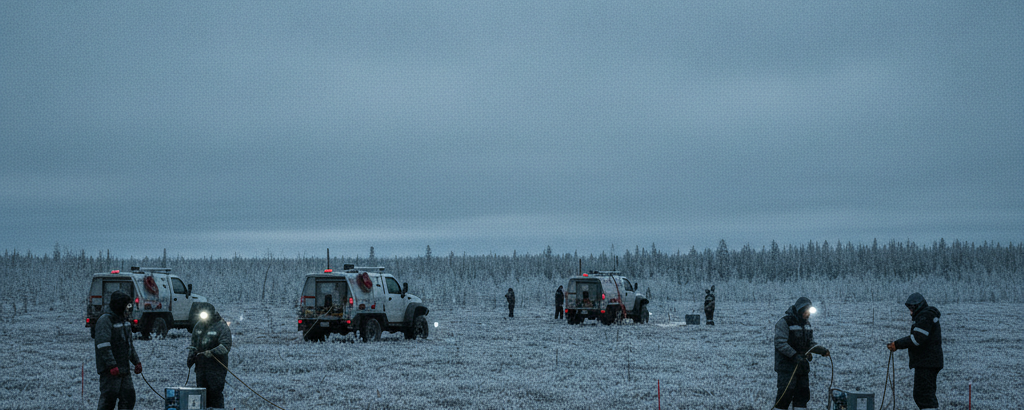
The core problem with blind lenses is locating something that leaves no surface trace. Massive sulfides have significantly higher electrical conductivity and density than the surrounding host rock, which makes them responsive to certain physical measurement techniques.
The most common approaches are electromagnetic methods such as Time-Domain EM (TDEM) and Induced Polarization (IP). Both measure how quickly electrical charges decay in the subsurface. Massive sulfide bodies produce characteristic anomalies that point to their location and depth. Gravimetric surveys add a further layer, since sulfide-rich bodies are denser than the rock around them.
A geophysical anomaly is a drill target, not a deposit. Only the core tells you whether sulfides are actually present, what the metal grades are, and whether the geometry makes economic sense. Published grades from technical reports — copper or zinc mineralization expressed in weight percent — are the only objective evidence worth analyzing seriously.
What remains after the initial excitement
Blind lens discoveries often trigger an immediate share price reaction. The story writes itself: a company finds something unexpected inside its existing project. News like that moves prices quickly and sometimes well ahead of the facts.
The more useful question is what comes next. Does a properly funded drilling program for resource definition actually follow? Does the company have the capital to explore the lens fully? Is the jurisdiction stable enough to carry the project from exploration through to a resource estimate without political or permitting disruption?
Investors who treat a first-hole press release as confirmation of something economic are reacting to the narrative rather than the data. Early intercepts open questions; they don’t answer them. The gap between an early intercept and a classified resource has cost this sector an enormous amount of money.
Key technical terms at a glance
- Blind lens
- An ore body with no surface outcrop that conventional surface prospecting cannot directly detect. Finding one requires geophysical surveys or deep drilling.
- VMS deposit (Volcanogenic Massive Sulfide)
- A deposit formed by hydrothermal activity in volcanic environments, concentrating metals such as copper and zinc in compact, sulfide-rich lenses.
- Inferred resource
- The least constrained resource category under NI 43-101. Based on limited drill data; carries higher geological uncertainty than Indicated or Measured Resources.
- Reserve vs. resource
- A resource is a geological estimate of ore content (Inferred, Indicated, or Measured). A reserve (Proven or Probable) additionally requires an economic viability assessment and represents mineable inventory. The two terms are not interchangeable.
- Induced Polarization (IP)
- A geophysical survey technique that measures the time-delayed discharge of electrical charges in the subsurface. Sulfide minerals produce characteristic IP anomalies and can therefore be detected geophysically.
- Time-Domain EM (TDEM)
- An electromagnetic method in which a primary magnetic field is generated and the decay behavior of the induced secondary fields is measured. Effective for detecting conductive sulfide bodies at depth.
- Resource growth from depth
- The expansion of a known resource through laterally or vertically adjacent new ore bodies, without any geographic expansion of the license area. In the context of blind lenses, this is a central argument for why they attract investor attention.
⚠️ Important notice: This article is for informational and educational purposes only. It does not constitute investment advice, a recommendation, or a solicitation to buy or sell any security. Investments in small-cap exploration and mining companies carry a high risk, including the potential total loss of capital. Before making any investment decision, consult a registered financial advisor and conduct your own analysis. Boersen Post Team is not responsible for decisions taken based on the content published here.