IP Surveys: How Geophysics Paves the Way to the Drill Hole
July 8, 2026
ETF Rebalancing in the Uranium Sector: How Mechanical Flows Move Small Caps
July 9, 2026
When a drill hole delivers more than a number
In uranium exploration, most drill results are just data points. Occasionally, one changes how a project reads on a map. The difference often comes down to strike length: how far a mineralization extends horizontally along its principal geological direction, and one of the more telling parameters for sizing up a deposit system.
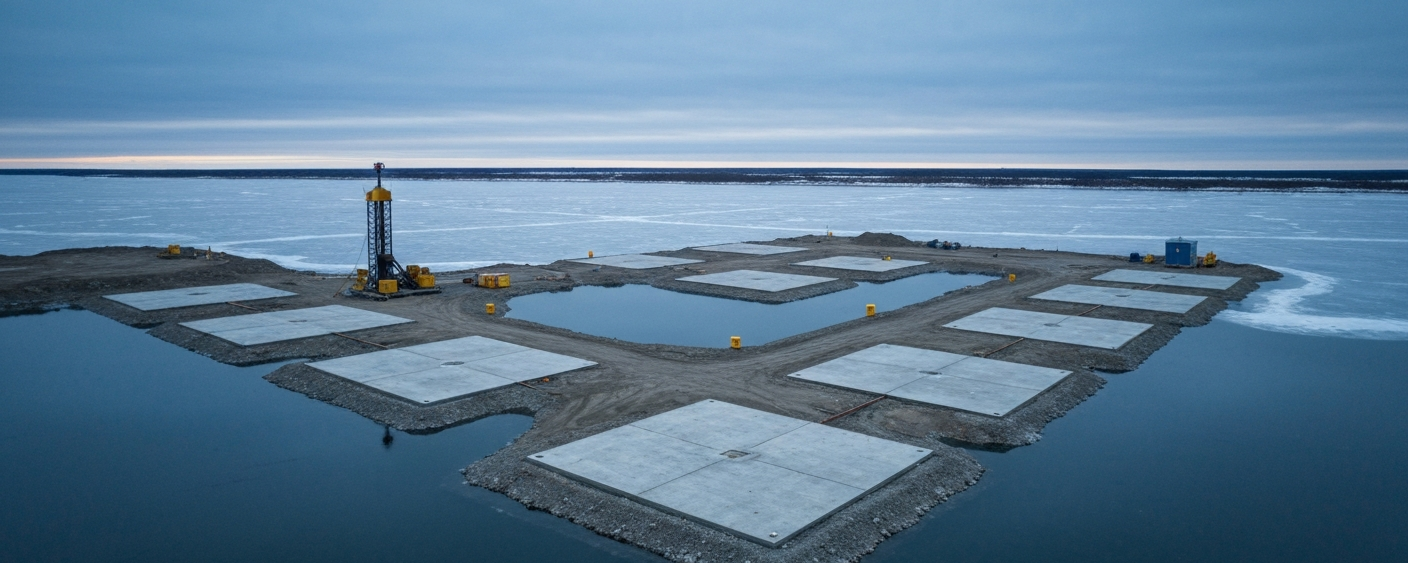
In the Athabasca Basin in Saskatchewan, a junior explorer recently confirmed new high-grade uranium mineralization roughly 4 km along strike from a known deposit area. The press release is dry reading. What lies behind it is a question of deposit geology — and of how small-cap stocks price exploration results before the subsurface is properly understood.
The Athabasca Basin and its geological significance
The Athabasca Basin is not a routine exploration address. It holds some of the highest-grade uranium deposits on Earth. The geology explains why: at the contact zone between Proterozoic basement rock and overlying sandstone sediments, uranium-rich fluids can concentrate over millions of years, producing grades that have little parallel elsewhere.
That context matters for investors because not every uranium project is comparable to what Saskatchewan offers. High-grade intercepts here carry a different market weight than similar numbers from less established jurisdictions. The province also has decades of tested mining infrastructure and a regulatory framework that many other uranium regions simply lack.
Anyone reading a press release with fresh drill data should therefore not treat the numbers as a confirmed resource. An exploration result and a certified resource are different stages on a long road.

Why 4 km of strike length moves the market
Strike length is one of the primary factors shaping how large a system’s potential tonnage could be. A new mineralization point confirmed 4 km from a known core area suggests the project is considerably larger than previously assumed — and possibly not an extension of the known body at all, but something structurally separate.
In the Athabasca case in question, 11.5 m of composite uranium mineralization was intersected, including 1.6 m of near-continuous high-grade material. What makes those numbers worth examining?
| Parameter | Significance for valuation |
|---|---|
| Thickness (m) | Shows how wide the ore body was intersected in the drill hole — greater thickness can mean more tonnes |
| High-grade interval | Continuous high-grade sections point to concentrated, economically relevant zones |
| Strike length (km) | Horizontal extent of the system — critical for assessing overall potential |
| Distance from deposit | Greater distance at equivalent grade suggests a district-scale rather than local system |
Distance is what separates a peripheral zone from something more significant. A new intercept a few hundred metres from the known deposit area may simply be the same body, hit at an angle. At 4 km, with similar mineralogical characteristics, the more reasonable interpretation is an independent mineralization — what the industry calls a district-scale system.
In the junior sector, that label carries weight. It signals that the exploration potential of a license area extends beyond a single deposit. Institutions that hold back on early single results often become more active at that point, because the underlying arithmetic looks different from a straightforward deposit extension.
First-discovery hits as share price catalysts — and their limits
A first-discovery hit — the first intercept at a completely new target — is among the rarer events in exploration. Unlike step-out drilling that extends what is already known, it is proof that a geological concept actually works in the ground.
The market reaction tends to follow a recognizable pattern: a sharp share price rise driven by speculative capital, then a consolidation phase while the market waits for follow-up holes. A single drill hole does not prove an economic deposit. Only when multiple holes deliver consistent results and a technical report compliant with NI 43-101 is prepared does a more durable valuation shift typically follow.
For small-cap investors, that timing creates a real problem. The largest share price moves often come in the early phase, when risk is highest. Anyone who enters after the first announcement generally pays a substantial premium and has to judge whether the remaining upside justifies it — and the honest answer is that it often does not.
Reading press releases more carefully
The value of an exploration project changes with every drill hole and every revised geological interpretation. That is not a disclaimer — it is what makes reading these announcements harder than it looks.
A few questions are worth applying to any exploration announcement: How many holes actually confirm the result, or is this still a single intercept? How do the reported thickness and grade compare to what is known to be economic in the region? Does the company hold enough capital to run a meaningful follow-up program, or will it need to raise more at exactly the moment sentiment softens?
The Athabasca Basin has surprised geologists in both directions — ground that looked straightforward turned complicated, and ground that looked unprospective turned out to hold something. That unpredictability is precisely what makes it a demanding place for risk capital, and why the numbers in any press release deserve a careful second read before they become a trade.
Key terms
- Strike length
- The horizontal extent of a mineralization along its principal geological direction; a central parameter for assessing deposit volume.
- District-scale system
- An exploration project whose mineralization potential extends beyond a single deposit and encompasses multiple, spatially separate occurrences within a large license area.
- First-discovery hit
- The first drill-confirmed uranium mineralization at a previously untested target; considered a strong share price catalyst, but requires confirmation through follow-up work.
- NI 43-101
- The Canadian regulatory standard for reporting on mineral resources and reserves. It strictly distinguishes between resources (Inferred, Indicated, Measured) and reserves (Probable, Proven).
- Composite mineralization
- The total interval of multiple mineralized sections within a drill core, summed into a combined thickness; includes weakly mineralized intervals between higher-grade sections.
- High-grade interval
- A section within a drill core with an above-average metal content; in the uranium sector, often the key indicator of the economic relevance of a zone.
- Step-out drilling
- Drilling conducted from a known mineralization point in a new direction to test the extent of a deposit — distinct from a first-discovery hit at an entirely new target.
⚠️ Important notice: This article is for informational and educational purposes only. It does not constitute investment advice, a recommendation, or a solicitation to buy or sell any security. Investments in small-cap exploration and mining companies carry a high risk, including the potential total loss of capital. Before making any investment decision, consult a registered financial advisor and conduct your own analysis. Boersen Post Team is not responsible for decisions taken based on the content published here.