Greenland as a Raw Materials Source: Why Arctic Jurisdictions Matter
August 26, 2026
Copper Sector Takeover Targets: How Investors Spot M&A Signals
August 27, 2026
Scandium: the industrial metal nobody knows, but everyone needs
Some commodities sit in plain sight for decades while everyone ignores them. Scandium is a good example. With atomic number 21, it belongs to the transition metals and is used in very small quantities — yet those quantities matter. Aluminum alloys for the aerospace industry become significantly stronger with scandium additions, without any weight penalty. Solid-state batteries, widely seen as the next generation of energy storage, may depend on it too. Even so, the global scandium market remains tiny, which makes it simultaneously interesting and risky for investors.
Two recent announcements have brought the metal back into view: an Australian explorer disclosed a very large mineral resource, and a Canadian scandium company appointed a former head of critical materials at one of the world’s largest automakers as its new CEO. The two events illuminate different sides of the same question and give investors a practical reason to examine how valuation actually works in this sector.
A tiny market with a real industrial role
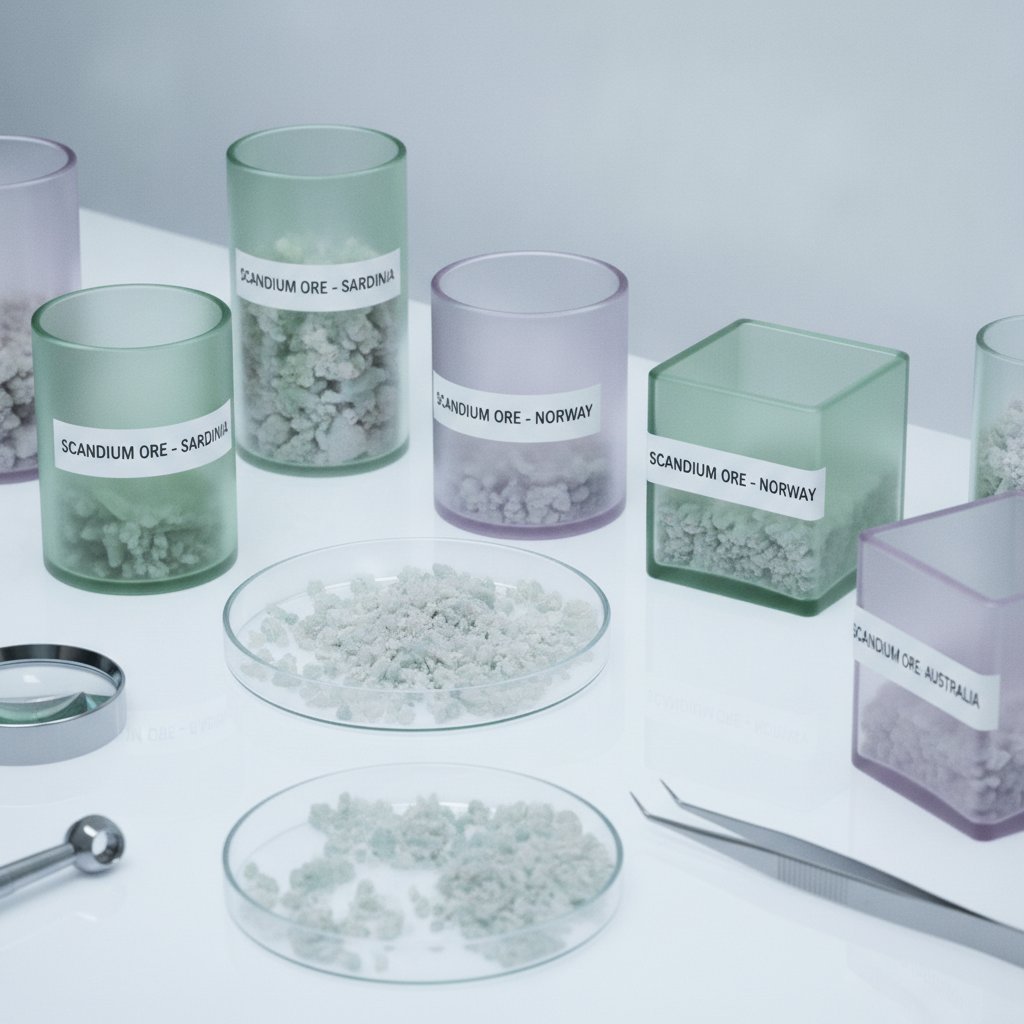
The global scandium market is, by volume and revenue, one of the smallest commodity markets around. Only a few hundred tonnes of scandium oxide change hands worldwide each year; lithium trades in the hundreds of thousands of tonnes. The scarcity has a geological explanation: although scandium is relatively common in Earth’s crust, it almost never concentrates into economically mineable quantities. It typically turns up as a byproduct during bauxite, titanium, or uranium processing, and only rarely from primary deposits.
For investors, that structure has a direct consequence. Unlike copper or gold, there is no liquid, well-established market with daily price transparency. Scandium prices are negotiated bilaterally, are rarely public, and can move sharply. Anyone reading resource estimates in this sector should therefore ask whether buyers exist for the material, and at what price they would actually commit.
What a very large resource really means
The announcement by an Australian explorer of a mineral resource of just under one billion tonnes of rock averaging approximately 50 ppm scandium sounds impressive. Contained metal tonnages at that scale are rare in the scandium sector. But size alone does not carry a valuation. Investors should ask a few concrete questions:
- Grade vs. tonnage: 50 ppm means one tonne of rock contains an average of 50 grams of scandium. That is geologically significant, but economic viability depends heavily on how complex extraction and processing are. Nickel-cobalt laterites, from which scandium is often recovered as a byproduct, typically carry grades in the double-digit ppm range. A higher concentration has to be read alongside the processing route, not separately from it.
- Classification: Where the resource sits at the Inferred level, substantial additional drilling and modeling work remains before it could become economically exploitable reserves. That is not a flaw, but it is a clear marker of early-stage maturity.
- Market absorption: Even if the entire metal could be mined, the existing global scandium market would need decades to absorb such volumes. The question is whether demand will grow fast enough to change that arithmetic.
The path from rock in the ground to a functioning business model is long and expensive.
| Valuation criterion | What it means |
|---|---|
| Resource size (tonnage) | Demonstrates potential; says nothing about economic viability |
| Grade (ppm scandium) | Higher is generally better, but depends on the processing route |
| Resource classification (Inferred/Indicated/Measured) | Early-stage classifications carry high uncertainty |
| Market size and offtake agreements | Often the weakest link for metals with thin markets such as scandium |
| CEO profile and network | Can signal credibility and access to industry partners |
CEO changes as a market signal: when industry knowledge counts
The second part of the recent scandium headlines involves a leadership change: a Canadian exploration company has appointed a manager who previously oversaw critical materials procurement at one of the world’s largest automakers. What reads like a routine corporate notice is worth a second look.
Junior explorers run into the same problem repeatedly: they develop projects without the industrial contacts needed to secure offtake agreements or strategic partnerships. A CEO who has worked on the purchasing side of a major corporation, and who knows what quality standards and certifications industrial buyers actually require, can close that gap. In scandium, that matters more than in most metals. The potential customer base is narrow: aerospace companies, specialty alloy producers, and possibly battery cell manufacturers if solid-state technology matures at the pace its proponents expect.
There are precedents elsewhere. When lithium explorers in the early 2010s sought access to Asian battery manufacturers, the companies that moved fastest generally had executives with prior experience at chemical groups or automotive suppliers. Industry expertise at the leadership level is not a cure-all, but it does tend to shorten the time between initial contact and a serious commercial conversation.
For investors, the point is simple: a high-profile CEO appointment is a qualitative indicator that belongs in the overall picture, but it does not answer the question of whether the underlying project is economically viable.
What investors can take away from the scandium sector
Scandium is a thin market with its own character: real technological potential, limited liquidity, and almost no public price discovery. The path from resource to commercial production is long. Recent announcements show which kinds of signals move this market and how widely their actual informational value can differ.
Resource size is a starting point. Market structure and offtake logic determine whether a block of rock ever becomes a business. What the scandium example shows, concretely, is how much a single press release can leave out.
Key terms: scandium and junior resource valuation
- Scandium (Sc)
- A lightweight transition metal with atomic number 21. Used as an alloying element in aluminum to improve strength and weldability, and applied in solid oxide fuel cells as well as a potential electrolyte component in solid-state batteries.
- ppm (parts per million)
- The unit of measurement for grade in rock. 50 ppm means 50 grams of the metal per tonne of rock. For metals with high prices and thin markets, even low ppm values can be economically interesting, provided processing costs stay manageable.
- Inferred Resource
- The earliest classification in the three-tier resource system (Inferred / Indicated / Measured). Based on limited geological data and carrying the highest degree of uncertainty. Under NI 43-101 (Canada) and the JORC Code (Australia), inferred resources may not form the basis of feasibility studies.
- Mineral Reserve vs. Mineral Resource
- Resources describe how much metal may be present geologically. Reserves (Proven/Probable) describe how much of that can actually be mined under economic conditions, after a comprehensive feasibility study. The two terms are not interchangeable.
- Niche metal market
- A commodity market with very low trading volume, few participants, and little public price discovery. Scandium, germanium, and indium fall into this category. Price movements are less predictable than in bulk commodities such as copper or zinc.
- Offtake agreement
- A contract between a commodity producer and an industrial buyer that sets delivery volume, quality, and price in advance. For metals with thin markets, offtake agreements function as an important financing signal because they confirm a project’s commercial viability.
- Critical materials
- Raw materials deemed economically significant and at risk of supply disruption. The EU, the United States, and several other governments maintain official lists. Scandium appears on a number of them, which can open the door to policy support and public funding.
⚠️ Important notice: This article is for informational and educational purposes only. It does not constitute investment advice, a recommendation, or a solicitation to buy or sell any security. Investments in small-cap exploration and mining companies carry a high risk, including the potential total loss of capital. Before making any investment decision, consult a registered financial advisor and conduct your own analysis. Boersen Post Team is not responsible for decisions taken based on the content published here.