Tasmania as a Mining Jurisdiction: What Record Spending Reveals
September 8, 2026
Porphyry Copper in Peru: How Resource Definition Creates Project Value
September 8, 2026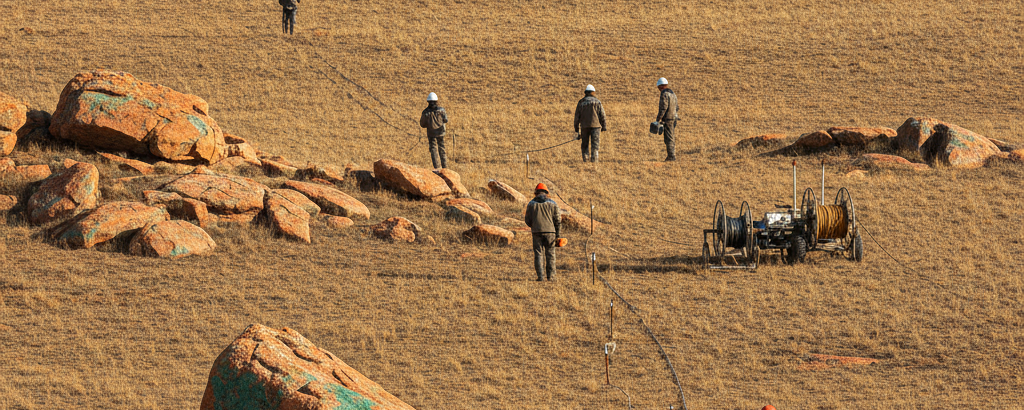
While the drill rig sits idle, the data is already talking
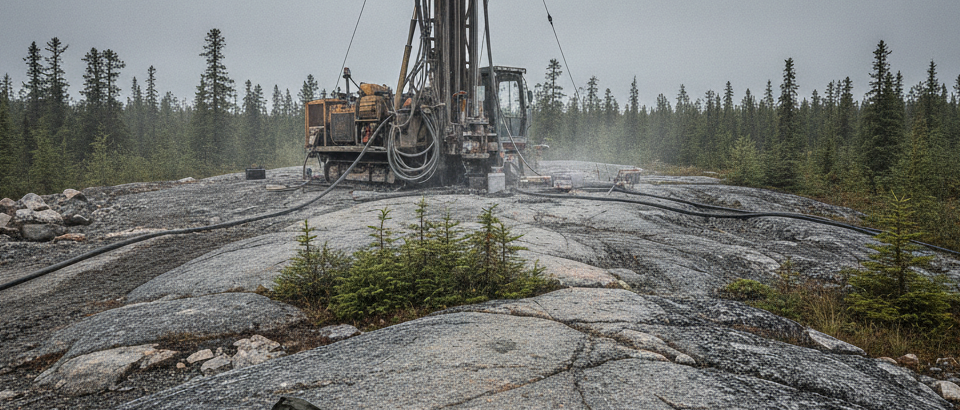
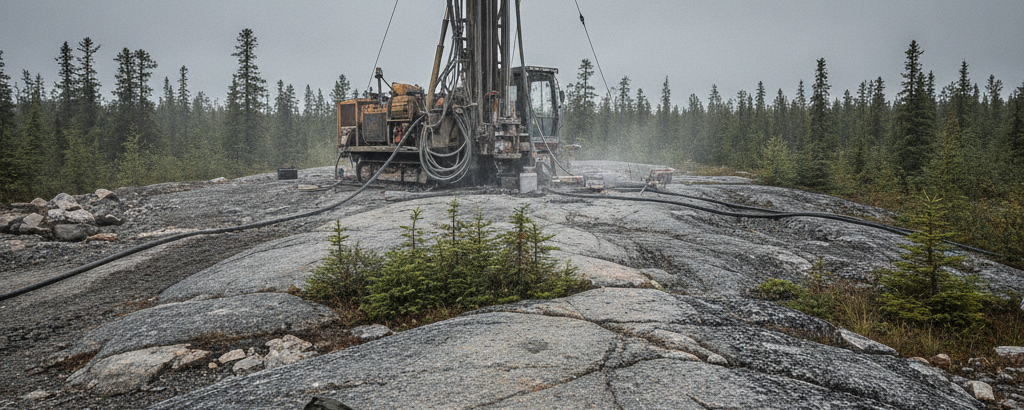
In commodity exploration, one rule tends to hold: drilling is expensive, thinking is cheap. A single diamond drill hole in remote terrain can cost between $200 and $500 per meter, depending on depth and logistics. At target depths of 300 to 600 meters, even a handful of misplaced holes can burn through millions of dollars. For junior explorers working with tight budgets, that shortfall can end a project outright.
This is where geophysical pre-exploration pays off. Methods such as the 3D Induced Polarisation survey (3D-IP) map the electrical properties of the subsurface before a single drill core is pulled, giving exploration teams a much clearer picture of where to drill and where to leave the ground alone. Cu-Ni-PGE projects in Mongolia — targeting copper, nickel, and platinum group elements — offer a useful illustration of how this works in practice for investors.
Electrical resistivity as a geological X-ray
The principle behind Induced Polarisation is close to that of a basic electrical circuit: a pulse is sent into the ground via electrodes anchored at the surface. Metallic sulfides such as chalcopyrite or pentlandite respond to that pulse differently than barren rock. They briefly store a charge and release it with a measurable delay. Geophysicists call this effect “chargeability.”
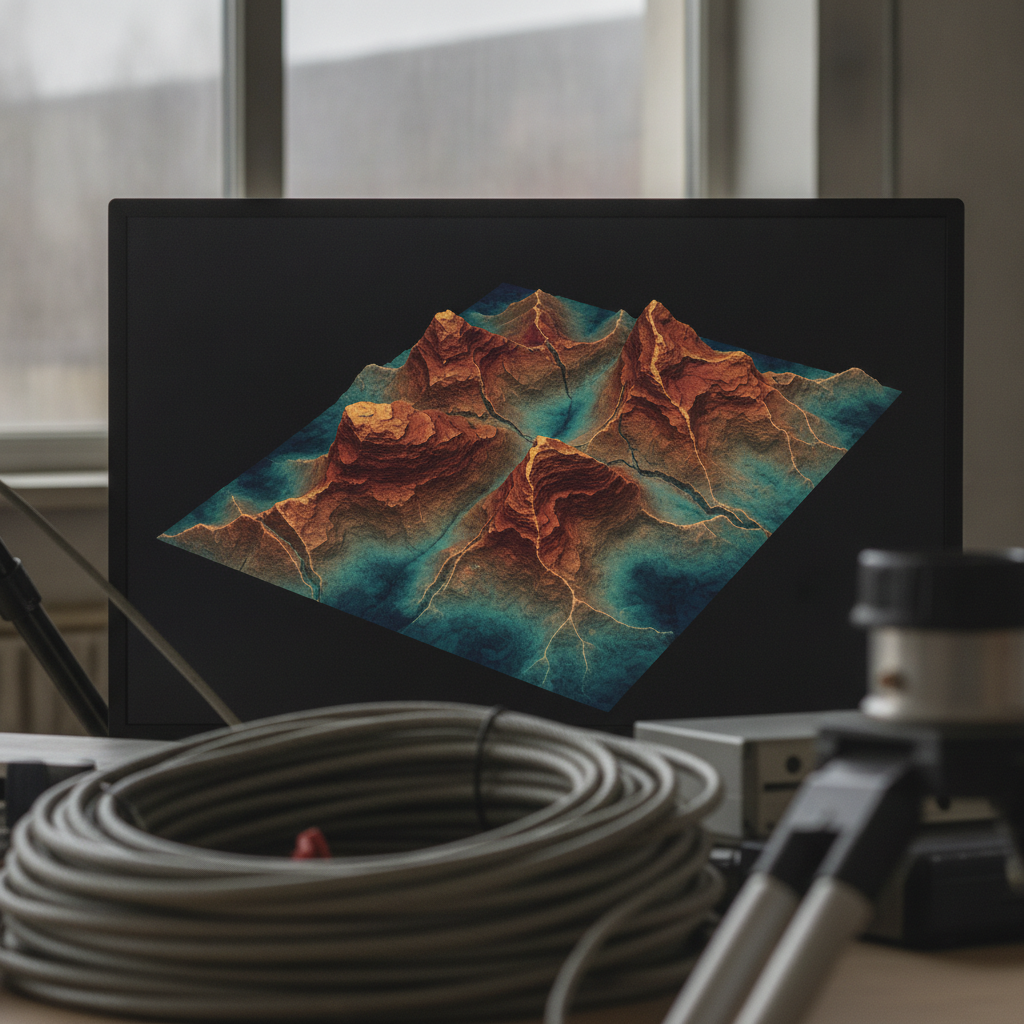
Combined with electrical resistivity measurements, this produces a three-dimensional model of the subsurface. Anomalies with notably high chargeability alongside low resistivity point to possible sulfide mineralization. Such signals are no guarantee of an economic deposit, but they are the first reliable indication that a location is worth drilling.
The method is particularly relevant for magmatic sulfide deposits, the deposit type associated with Cu-Ni-PGE occurrences. These form when sulfidic melts crystallize out of magmatic intrusive bodies, concentrating metals within them. The intrusive body — a norite or gabbro, for example — is often visible at surface; the sulfide concentration inside it is not. Addressing that invisibility is exactly what a 3D-IP survey is designed to do.
From anomaly to drill priority
Electrodes are laid out in grid lines across the target area, with spacing set by the required resolution and depth. A 3D survey delivers spatially denser data points than a conventional 2D profile survey, which makes volumetric modeling possible. The raw data are then processed through inversion modeling, producing voxel models in which every point in space carries a resistivity and chargeability value.
Geological interpretation follows: the geophysical model is overlaid with field data — mapping results, geochemical samples, satellite imagery. Only anomalies that align across multiple datasets receive high drill priority. From that combination, drill targets are defined, including angles and depths oriented toward the modeled anomaly core.
This workflow is running on an active project in southwestern Mongolia, where a junior explorer used a 3D-IP survey to identify several resistivity anomalies around a known intrusive body. These anomalies sit at depths that would be difficult to target systematically without geophysical pre-screening. A first diamond drill hole is running in parallel at a separate copper-gold target on the same ground, making better use of available field time.
| Exploration Method | Typical Benefit | Limitation |
|---|---|---|
| 2D IP Profile | Cost-effective first pass overview | Limited depth resolution, no 3D volume |
| 3D IP Survey | Volumetric subsurface model, precise target definition | Higher cost than 2D, requires geological interpretation |
| Airborne EM | Large-area initial coverage, effective for shallow conductors | Lower detail resolution at depth |
| Diamond Drilling (DDH) | Direct sampling, mineral identification | Point-specific, very costly without prior target definition |
Mongolia as an exploration jurisdiction: opportunity and structural risk
Mongolia sits within the Central Asian Orogenic Belt, a tectonic setting associated with porphyry copper-gold systems and, increasingly, magmatic nickel-copper-PGE occurrences. Compared with Canada or Australia, the volume of exploration data across the country is still thin — which means more risk, and more room for genuine discovery.
For small-cap investors, the translation is fairly direct: projects in Mongolia carry higher jurisdictional risk. Permitting timelines, infrastructure gaps, and local partnership dynamics can stall a project just as effectively as unfavorable geology. That said, early movers in underexplored ground can identify geophysical anomalies at costs that would be hard to replicate in more mature mining countries.
Geophysical anomalies are the starting point, not the result. Many projects stall on logistics or financing long before the geology has a chance to disappoint.
What 3D-IP results mean for exploration investors
A junior explorer that runs geophysical pre-exploration before committing drill meters shows more capital discipline than one deriving targets purely from surface observations. That is worth considering in due diligence, though it is not a buy signal.
Project phase context matters. Identified anomalies are not economic mineralization. They are first-order drill targets, not resources in any technical sense. Until drill cores are in hand, there is no Inferred Resource, let alone an Indicated one. A project with a completed 3D-IP survey sits at the transition from geochemical work to drilling, which is early in the exploration cycle. The risk is correspondingly high.
When an explorer has multiple anomalies in play — a copper-gold target and a Cu-Ni-PGE target within the same tenement, for instance — geological risk is spread across more than one thesis. It does not function as a financial hedge, but it improves the odds that at least one target returns something usable.
Glossary: geophysical exploration
- Induced Polarisation (IP)
- A geophysical measurement method in which electrical pulses are sent into the subsurface. Minerals with a sulfidic composition respond with a measurable charge buildup and delayed discharge, the IP effect.
- Resistivity (electrical resistance)
- A measure of how strongly a body of rock impedes electrical current. Metallic sulfides typically have lower resistivity than barren rock, making them detectable in a survey.
- Chargeability
- The core parameter of an IP survey. The higher the chargeability, the stronger the IP effect, which indicates electrically active minerals such as sulfides.
- Magmatic sulfide deposit
- A deposit type in which sulfidic melts crystallize out of magmatic rocks and concentrate metals within them. The typical formation environment for Cu-Ni-PGE occurrences.
- PGE (Platinum Group Elements)
- A group of rare metals: platinum, palladium, rhodium, ruthenium, iridium, and osmium. Economically significant primarily in catalytic converter technology and the fuel cell industry.
- Inferred Resource
- The lowest confidence category of mineral resources under international classification standards such as JORC or NI 43-101. Based on limited drill points with high geological uncertainty. Not equivalent to reserves.
- Tenement
- A term from Australian and international mining law for an exploration right or prospecting license, the legal instrument that permits a company to search for minerals within a defined area.
- Diamond Drill Core (DDH)
- A drilling technique in which diamond-tipped bits extract a cylindrical core from the subsurface. It enables direct mineral analysis but is costly and yields only point-specific information.
⚠️ Important notice: This article is for informational and educational purposes only. It does not constitute investment advice, a recommendation, or a solicitation to buy or sell any security. Investments in small-cap exploration and mining companies carry a high risk, including the potential total loss of capital. Before making any investment decision, consult a registered financial advisor and conduct your own analysis. Boersen Post Team is not responsible for decisions taken based on the content published here.