From Drill Hole to PFS: What Interval Lengths and Capping Grades Reveal
October 19, 2026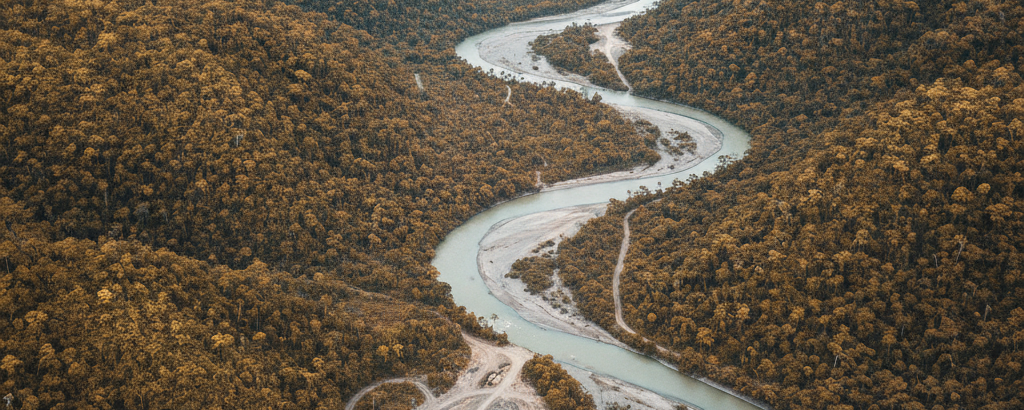
Where gold maps still have blank spots
Nevada, Western Australia, the Abitibi Greenstone Belt — these districts have been picked over for decades. Every hill mapped, every anomaly chased down. For a junior explorer trying to find something that hasn’t been found yet, the practical question becomes: where does genuine surprise potential still exist?
Increasingly, the answer points to frontier jurisdictions — regions that look geologically interesting but have seen comparatively little systematic work. Guyana and Alaska are probably the two most discussed right now. The dynamic is not new: when established districts fill up, attention drifts toward higher-risk ground.
Why Guyana and Alaska are attracting attention now
Frontier jurisdictions don’t come into focus by accident. When gold prices rise, companies can justify higher logistical and regulatory costs because even a moderate discovery starts to make economic sense.
Guyana sits on the Guiana Shield, one of Earth’s oldest crustal formations, structurally related to the West African Leo-Man Shield, where well-documented gold systems exist. That analogy is worth noting — not banking on. Drilling will either confirm or refute it. The region has seen little systematic exploration over recent decades, so land costs stay low, but infrastructure, data coverage, and regulatory processes are all considerably less developed than in established mining countries.
Alaska has the advantage of operating under U.S. law, which provides real legal certainty. But the practical conditions are still frontier: extreme weather, short field seasons, vast roadless areas, and a layered mix of state and indigenous land rights. Compare that to Nevada — developed, connected, predictable — and the actual cost of frontier status becomes clear enough.

How jurisdiction risk gets priced into valuations
Jurisdiction risk is frequently cited and rarely explained with much precision. It bundles together several components that affect company value in different ways:
| Risk Component | Impact on Junior Explorers |
|---|---|
| Political stability | Affects license security and permit renewals |
| Legal system | Determines enforceability of property rights |
| Infrastructure | Drives exploration costs and future operating costs |
| Regulatory framework | Determines permit duration and complexity |
| Tax and royalty regime | Affects the economic feasibility of a mine |
In practice, that bundle translates into valuation discounts. An explorer with an identical resource — same grade, same geometry — will carry a meaningfully lower enterprise value in a frontier jurisdiction than in Australia or Canada. Some call it a “country discount,” others a “jurisdiction premium.” The terminology tells you where the speaker sits.
Concretely: an explorer in Guyana pays significantly more to gather the same geological information as a peer working in Quebec, and gets a lower market valuation in return. The capital market prices not only what lies in the ground, but what it costs to reach it and how securely it can eventually be extracted.
What investors should examine in frontier projects
Anyone looking at frontier projects has to work through a set of structural questions that go well beyond the geology.
Regulatory maturity: Are there clear mining laws, functioning permit systems, and legible approval processes? Countries with long mining histories have generally built these out. Newer mining regions often revise the rules while projects are already underway, with real consequences for timelines and budgets.
Infrastructure: Remote drilling campaigns are expensive. Helicopter transport, satellite communications, mobile laboratories — all of it pushes up the cost per drill meter. A junior with limited capital drills considerably less for the same money in a logistically demanding location than in developed terrain.
Financing: Institutional investors frequently avoid high-risk jurisdictions, or demand heavy return premiums to participate. Frontier explorers end up leaning more on private placements and retail investors, which changes the capital structure and raises dilution risk for existing shareholders.
Early drilling generates attention and share price movement. When larger capital requirements emerge for advanced studies, a valuation correction often follows — institutional money stays away or backs out. Ivanhoe’s Kamoa-Kakula discovery in the DRC is instructive here: even a genuinely world-class deposit in a difficult jurisdiction took years to attract the institutional support that a comparable find in Canada would have drawn quickly. That gap is the country discount made visible.
Frontier jurisdictions in a portfolio context
Outcomes in frontier jurisdictions depend heavily on timing and on which specific risks happen to be live when a discovery is made. Geological potential matters, but so does who is running the project, what the balance sheet looks like, and whether the regulatory environment is moving toward stability or away from it. Several significant gold discoveries over the past two decades — Gabriel Resources in Romania, for instance, or the prolonged difficulties around Lydian International in Armenia — showed that credible deposits in semi-frontier settings can sit stranded for years after regulatory reversals.
Ground that stays difficult to access tends to remain underexplored longer than the geology alone would warrant. When the market eventually takes notice, the upside can be real. But “eventually” carries a lot of weight in that sentence.
Frontier projects are not a portfolio foundation. As a speculative satellite position they are defensible — if the investor has actually looked at the company’s cash position, the regulatory environment, and management’s track record on comparable ground. Without that work, it’s just a bet.
Key terms for beginners
- Frontier jurisdiction
- A region with significant geological potential but limited prior exploration. Often associated with less developed infrastructure or a still-developing regulatory framework.
- Jurisdiction risk
- The overall risk arising from the political, legal, regulatory, and infrastructural conditions of a country or region as they affect a mining project.
- Country discount
- The valuation markdown that markets apply to projects in regions with elevated jurisdiction risk, compared with projects carrying a similar geological profile in more stable countries.
- Guiana Shield
- One of South America’s oldest Precambrian crustal formations, geologically associated with known gold systems. Considered largely underexplored to this day.
- Exploration season
- The period within a year during which field work — drilling, sampling, mapping — is practically feasible. In regions with extreme weather, such as parts of Alaska, this window can be limited to a few months.
- Tier-1 region
- A mining region with high political stability, a clear legal framework, good infrastructure, and proven regulatory standards. Western Australia, Nevada, and Quebec are standard examples.
- Concession system
- The government framework governing how companies acquire the right to explore for or extract commodities on a given property. Mature systems provide legal certainty; weaker ones may permit retroactive changes.
⚠️ Important notice: This article is for informational and educational purposes only. It does not constitute investment advice, a recommendation, or a solicitation to buy or sell any security. Investments in small-cap exploration and mining companies carry a high risk, including the potential total loss of capital. Before making any investment decision, consult a registered financial advisor and conduct your own analysis. Boersen Post Team is not responsible for decisions taken based on the content published here.