Earn-In Agreements for Silver Juniors: Mechanics and Risks
August 18, 2026
PIPE Financing for Silver Juniors: Capital, Costs, and Consequences
August 18, 2026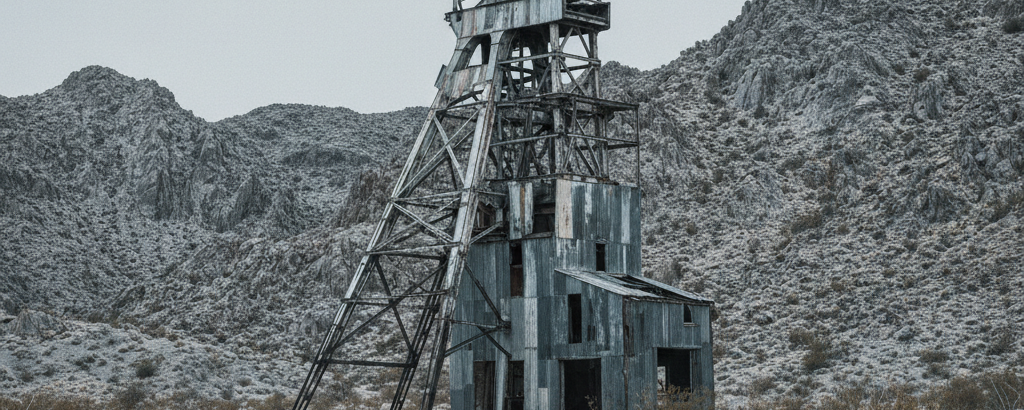
When old mines attract new capital
There is a strategy moving through the junior explorer space that looks odd at first glance: instead of chasing something new, companies go after something old. Former production sites — shuttered for decades, sometimes untouched since the mid-twentieth century — get rolled into a single project. This is happening in the silver sector right now, with smaller mining companies buying up historic high-grade mines across structurally weak mining districts to build a larger, connected resource base.
Anyone following small caps in the commodities space should understand the logic, because behind what reads like a dry acquisition announcement is a value-creation pattern with its own real opportunities and real risks.
Why historic mines are becoming relevant again
Silver mines that operated in the early or mid-twentieth century often shared the same fate: they ran during a period of low metal prices and limited drilling technology. Most closed not because their resources were exhausted, but because the economics no longer worked under the conditions of the time.
Several things have changed since then. Silver prices are higher than in earlier decades, modern drilling allows deeper and more precise work, and industrial demand — particularly from solar panel manufacturing — has grown considerably. This makes certain historic high-grade deposits worth revisiting on a purely mathematical basis.
There is also a practical edge: many old sites hold historical exploration data — drill logs, assay reports, geological maps. Under modern standards such as Canada’s NI 43-101, none of this counts as an official resource, but it can point exploration teams toward ground worth drilling.

Why the whole is worth more than the parts
When a junior explorer acquires several former silver mines within the same geological zone, the result is a project that can be valued as a single entity. This matters for a simple reason: institutional funds generally stay on the sidelines below a certain project size, and a larger, connected land package changes that. Drill rigs and technical staff can be moved across the whole property as needed, which lowers the cost per meter drilled. From a takeover perspective, a project with clear, unified land control is also a cleaner acquisition target for a major than a patchwork of small individual titles, where fragmented ownership can block development entirely.
In historically fragmented mining districts — common across the western United States and parts of Mexico — bringing multiple properties under a single owner can be the step that makes a long-dormant project actually developable. That is what is driving consolidation plays in the silver space right now, at least in theory.
| Characteristic | Single legacy mine | Consolidated project |
|---|---|---|
| Resource base | Small, fragmented | Larger, connected |
| Institutional appeal | Low | Higher |
| Drilling logistics | Complex, inefficient | Flexible, more cost-efficient |
| M&A potential | Limited | Significantly increased |
| Historic data coverage | Isolated | Cross-comparable |
What small-cap investors can take away from this pattern
Consolidation announcements often get a positive short-term market reaction, because they signal that management has a strategy. Whether that reaction holds is another question — one that exploration results will eventually answer.
The most immediate risk is dilution. Junior explorers almost always finance acquisitions through share issuances or private placements, which means existing shareholders lose a percentage of their ownership. Whether a larger resource base compensates for that over time depends on the quality of what was acquired, and that is nearly impossible to judge at the moment the deal is announced.
Then there is the question of resource continuity. Three adjacent mines do not automatically mean the ore body runs through all of them. The geology can be uneven: a high-grade zone sitting next to barren ground. Only a proper drilling campaign will reveal whether the deposits actually connect.
The most frequently underestimated factor is time. From assembling a package of historic properties to producing a resource estimate that satisfies a lender or acquirer, many years pass — often more than investors expect when they buy in early. This is not a space for investors looking for short-term price movement.
Silver between industry and speculation
Silver differs from gold in one important way: roughly half of global demand comes from industrial use. Photovoltaics and electronics account for the bulk of that, with medical applications adding a smaller share. The rest comes from investment and jewelry demand. That split makes the silver market more volatile than gold, but also more reactive to sustained structural shifts on the industrial side.
For high-grade silver projects in the United States, this has a specific implication: long-term demand growth alone may be enough to bring historically uneconomical deposits back into viable territory, even without a sharp price spike. Whether that potential actually materializes in any given project is a different question.
One distinction worth keeping in mind: a primary silver project — where silver is the main product — behaves very differently from a polymetallic project where silver is a by-product. In primary high-grade projects, economics move directly with the silver price, which amplifies both the downside and the upside.
Key terms for getting started
- Consolidation (in the mining context)
- The process of bringing several adjacent properties or former production sites under a single owner to create a larger, connected project.
- Past-producing mine
- A former production site that operated economically at some point but is currently inactive. Historic production data can guide exploration, but does not replace a current technical report.
- High-grade silver
- A deposit with above-average silver content in the rock, measured in grams per tonne (g/t). Higher grades are more economically attractive because less rock needs to be mined to yield the same amount of metal.
- Inferred resource
- The lowest confidence category in an NI 43-101-compliant resource estimate. It is based on limited data and carries high geological uncertainty — it should not be equated with a reserve.
- NI 43-101
- The Canadian reporting standard for mineral resources and reserves. Resource disclosures must be certified by a Qualified Person.
- Dilution
- The reduction in the percentage ownership of existing shareholders that results from issuing new shares, for example to finance an acquisition or a drilling program.
- M&A potential
- The likelihood that a company or project will be acquired by a larger mining company. Projects with clear, unified land control are generally considered more attractive acquisition targets.
⚠️ Important notice: This article is for informational and educational purposes only. It does not constitute investment advice, a recommendation, or a solicitation to buy or sell any security. Investments in small-cap exploration and mining companies carry a high risk, including the potential total loss of capital. Before making any investment decision, consult a registered financial advisor and conduct your own analysis. Boersen Post Team is not responsible for decisions taken based on the content published here.