Porphyry Maturity: What PFS Results Really Measure for Copper Juniors
June 16, 2026
Definitive Feasibility Study: How Niche Metals Become Bankable
June 16, 2026
The invisible part of exploration: what drill targets actually cost
When a junior explorer announces new drill targets, the share price tends to move before anyone has looked closely at what the announcement actually says. The process behind it — known as target generation, the identification of potential mineralization zones before the first meter is drilled — tells you more about an exploration company than most press releases will admit.
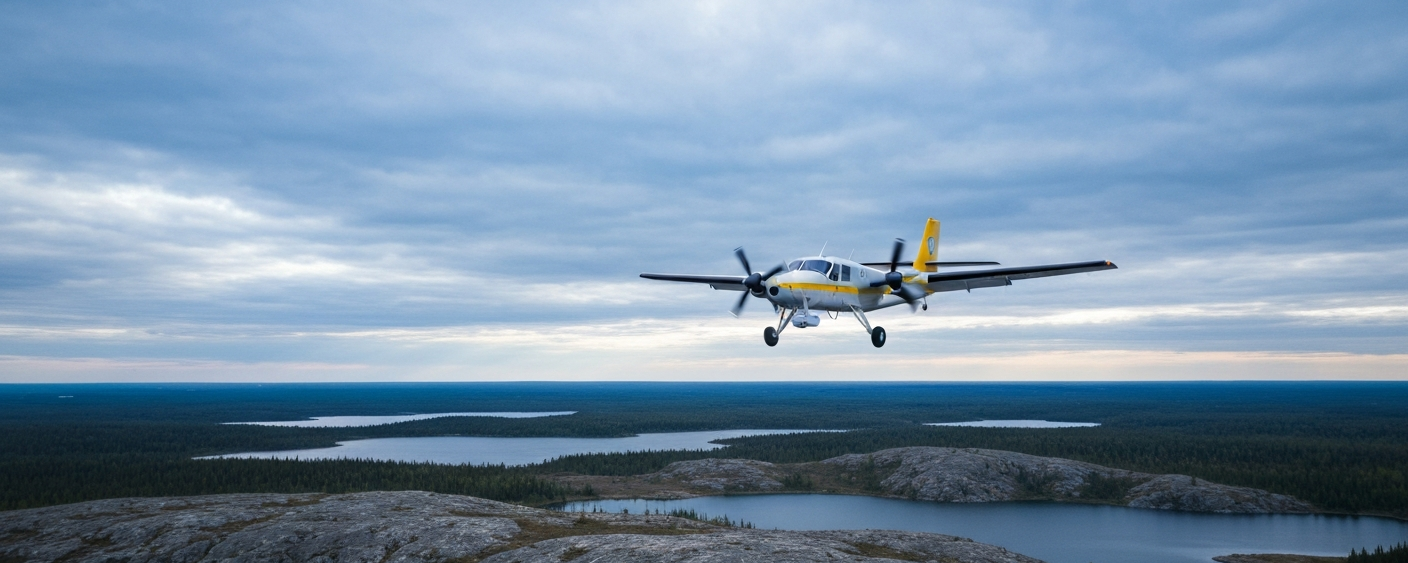
In the Athabasca Basin in western Canada, this work is particularly demanding. Thick sandstone covers large portions of the basin, making direct surface observation largely useless. What you can see at the surface rarely says anything useful about ore hundreds of meters below. Exploration teams therefore depend on indirect methods, and that dependency has real consequences for both spending and project risk.
Geophysics and geochemistry as target-finding tools
Preparation for a drilling campaign typically starts with a combination of geophysical surveys and geochemical sampling. Both are trying to do the same thing: map subsurface anomalies that may indicate uranium mineralization.
Geophysical surveys measure the physical properties of rock using electromagnetic, gravimetric, or seismic techniques. In the Athabasca Basin, mapping fault zones is central to this work. Unconformity-related uranium deposits tend to form at structural discontinuities, where older basement rocks meet the younger sandstone cover. That contact zone, the unconformity, is what most exploration programs are really chasing.
Geochemical sampling fills in the picture. By analyzing soil sediments, lake water, or rock chips, geologists can determine whether elevated radon or pathfinder-element values point to deeper mineralization. In the western Athabasca, lakes are frequently used as natural sample collectors: anomalous sediment patterns in lakes sitting above known structures can indicate what lies beneath.

From survey to drill hole: why management quality matters
Collecting the data is the easy part. Interpreting it is where teams diverge. Geophysical surveys produce raw numbers that mean little without geological expertise to sort signal from noise. Where an experienced team differs from an inexperienced one is not in how many anomalies it finds, but in which ones it decides are worth drilling.
Consider a team that maps twenty electromagnetic anomalies across a new project area. Eight of them also show elevated radon values in lake sediments. Of those eight, four overlap with fault zones identified in historical surveys. Only those four make it into the first drilling campaign. The company puts its money where the geological logic is strongest, not where the next announcement will sound most impressive.
Getting from a broad geophysical dataset to a prioritized drill-target list can take months and requires external geologists, data providers, and specialized software. The costs end up in a junior explorer’s financial statements as “Exploration Expenses” or “Mineral Property Acquisition Costs,” but what those line items actually represent is hard for outsiders to judge.
| Exploration phase | Method | Objective |
|---|---|---|
| Desk study / historical data | Database research, map analysis | Initial structural mapping, known anomalies |
| Airborne survey | EM, magnetics, radiometrics | Large-scale structures, unconformity depth |
| Ground survey | Gravity, TDEM, refraction seismic | Detailed mapping of priority zones |
| Geochemical sampling | Lake sediment, seepage water, rock chips | Pathfinder elements, radon anomalies |
| Target ranking | Multi-criteria analysis | Drill priority, budget allocation |
Multiple target areas simultaneously: diversification or capital dilution?
Many junior explorers pursue several target areas at once within a single project. The upside is obvious: if one target comes up empty, others remain. The risk is equally real. An exploration budget spread too thinly may be insufficient at any single target to produce results that actually answer the geological question.
In the Athabasca Basin, where remoteness and drill depth make each hole expensive, the quality of target prioritization directly affects how far a company’s cash goes. A program that tests four targets with two holes each may end the season having confirmed nothing. The same budget concentrated on one well-supported target at least produces a definitive answer. Investors can ask a straightforward question: does the company justify its target selection with documented geological reasoning, or is it communicating area coverage as a proxy for progress?
What target quality means for uranium small caps
Target generation rarely makes headlines. Drilling results and resource estimates do. The preparatory work stays in the background, but it is what determines whether the subsequent drilling campaign is sensibly designed or simply burns cash.
A company that clearly communicates which data led to which targets gives investors something concrete to evaluate. In the Athabasca Basin, where competition for the best exploration ground has been running for decades, a thin geological foundation costs a company more than money. Programs that skip rigorous target ranking tend to come back the following year asking shareholders for another raise, with little to show for the last one.
Key terms
- Target generation
- The process by which exploration teams derive potential drill targets from geophysical and geochemical data before drilling begins.
- Unconformity-related deposit
- A deposit that forms at the contact zone between older basement rock and the overlying sedimentary cover. In the Athabasca Basin, this is the most common type of high-grade uranium mineralization.
- Pathfinder elements
- Chemical elements enriched near uranium mineralization that serve as geochemical indicators. Nickel, cobalt, and molybdenum are common examples in Athabasca-style deposits.
- Airborne survey
- A geophysical measurement conducted from an aircraft or drone that collects electromagnetic, magnetic, or radiometric data over a project area.
- Inferred resource
- The lowest category of mineral resource under NI 43-101. It is based on limited drilling data and carries the highest degree of geological uncertainty. It is not a reserve.
- Indicated / measured resource
- Higher resource categories under NI 43-101, supported by a denser data network and lower geological uncertainty. Only from measured and indicated resources can probable and proven reserves be derived.
- Multi-criteria analysis (target ranking)
- An evaluation method that combines geological, structural, and geochemical parameters to rank exploration targets by drilling priority.
- Exploration expenses
- Costs recorded in a junior explorer’s financial statements for surveys, sampling, geological interpretations, and preparatory drill planning, incurred before actual drilling begins.
⚠️ Important notice: This article is for informational and educational purposes only. It does not constitute investment advice, a recommendation, or a solicitation to buy or sell any security. Investments in small-cap exploration and mining companies carry a high risk, including the potential total loss of capital. Before making any investment decision, consult a registered financial advisor and conduct your own analysis. Boersen Post Team is not responsible for decisions taken based on the content published here.