Land Package Strategy in Gold Juniors: Capital vs. Control
July 15, 2026
Uranium Exploration in Latin America: What Investors Need to Know
July 16, 2026
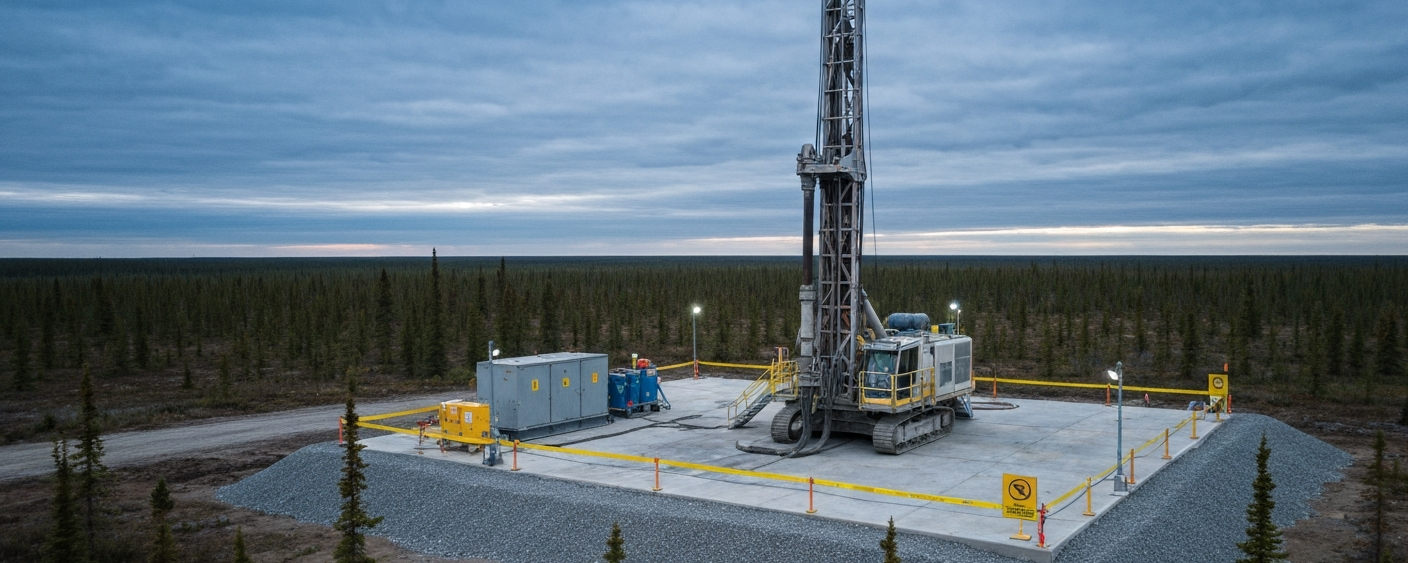
When drill rigs tell you more than spot prices
In the uranium sector, there are stretches when one event changes how the market reads an entire class of projects. A junior explorer launching a large-scale drilling program is often that kind of moment. The drilling itself doesn’t produce value on the spot. What it does is make a strategic choice visible: a company is putting real capital into the ground while uranium prices swing and the small-cap market is, frankly, not being kind to anyone.
For newcomers, the first question is usually: why now? What does a program like this actually mean for a project’s development and its price on the exchange? The answers sit inside the logic of the exploration cycle and a concept that rarely gets enough attention: data density.
The exploration cycle and the value of drilled meters
Uranium exploration companies face a structural problem: without solid geological data, a project is nearly impossible to value, and without a valuation, institutional capital doesn’t come. Large-scale drilling programs are an attempt to break that deadlock.
The exploration cycle moves in stages. Geochemical and geophysical work narrows down target zones first — IP surveys and soil geochemistry were covered in earlier issues. The drill hole comes next: only then does verifiable information about ore bodies, grade, and thickness come directly from the subsurface. But one drill hole isn’t enough. A NI 43-101-compliant resource estimate, the Canadian industry standard for mineral resources, requires sufficient drilling data that a Qualified Person (QP) can evaluate statistically.
A large-scale drilling program with twenty or more planned holes across a defined target area aims at exactly that: building enough data for a first resource estimate. This is what moves a project from “exploration property” to “resource-stage project.” That transition is often accompanied by a revaluation on the markets, though how large depends heavily on the project and on what the market is doing at the time.

Why data density determines project status
A concrete analogy helps. If you want to buy a property where a water source may lie underground, you’ll pay considerably less for a single assessment saying “water may be present” than for ten independent drill holes at different points with consistent results. Not because the source has changed, but because what you know about it has. The analogy with real estate breaks down once gangue minerals, fault structures, and grade variations across a few meters of drill core become relevant — but the underlying logic holds.
An inferred resource estimate rests on drill holes with relatively wide spacing; the geology is partly extrapolated and confidence is limited. The more drilling data available, and the tighter the drill grid, the more inferred resources can be reclassified as indicated or even measured. Measured resources may, following further studies, serve as the basis for reserve estimates.
This classification ladder matters to institutional investors and analysts. Some funds operating under strict risk mandates can only invest once a project reaches a certain resource category. A junior moving from no resources to an inferred estimate thereby opens itself to a different investor base, which tends to show up in its valuation.
| Project phase | Data basis | Typical investor type |
|---|---|---|
| Early exploration | Geophysics, geochemistry | Speculative / retail |
| Active drilling program | First drill cores, assays | Speculative + early-stage funds |
| Inferred resource | NI 43-101 report, QP-verified | Junior-focused funds |
| Indicated / measured resource | Tight-spaced drill data | Broader institutional spectrum |
| PEA / scoping study | Economic parameters | Strategic investors, larger funds |
Spot price volatility and the decision to run a program
Uranium projects have long lead times: from discovery to production, ten to fifteen years typically pass. Tying a drilling program to short-term spot price movements means losing years in the development cycle, which is why certain juniors drill regardless of where the spot price sits. That isn’t irrational, though it isn’t without risk either.
There is a capital markets argument for drilling through weak prices. Drilling costs tend to be lower when the market is soft and rigs are easier to book. A junior that keeps generating data through a down cycle can show up with a fully defined resource profile when sentiment turns, while competitors that went quiet are still at the drilling stage. Whether that timing advantage justifies the dilution required to fund the program is a calculation specific to each company, not a general rule.
The Athabasca Basin in Saskatchewan offers concrete reference points. Fission Uranium drilled out its PLS project between 2012 and 2014, a period of sharply depressed uranium prices after Fukushima, and announced high-grade near-surface mineralization in January 2014. NexGen Energy drilled its Rook I project from 2014 onward and by 2019 had presented a resource estimate exceeding 200 million pounds of U₃O₈, which attracted considerably larger market participants. In both cases, what drove the rerating was not the initial discovery alone but the clean classification and documentation of the resource across multiple years of methodical work.
What ambitious programs mean for investors
A large-scale drilling program says something about how a company allocates capital and where it places its priorities. It is not a guarantee of anything. Investors should read such announcements with specific questions rather than treating the news as inherently positive.
The most obvious is financing: where does the money come from? Private placements dilute existing shareholders, but without fresh capital, exploration stops. Whether a strategic partner is coming in, an institutional round is underway, or the money is coming from retail investors says a great deal about how the project is perceived at that moment.
The geological logic matters at least as much. Is the program designed to define a first resource estimate, or is it step-out drilling aimed at expanding a known resource? Those are different propositions with different failure modes.
One thing worth keeping in mind: large programs deliver assay results over several months. Market reactions to individual drill announcements can be sharp, even when nothing about the project has changed materially. A single strong hole does not make a resource. The full picture only emerges once most of the dataset is in hand.
Key terms for beginners
- NI 43-101
- The Canadian regulatory standard for public disclosure of mineral resources and reserves. Requires an independent Qualified Person (QP) to review and take responsibility for all technical disclosures.
- Inferred resource
- The lowest confidence category in the NI 43-101 system. Based on drill data with wider spacing; geology and grade are partly extrapolated. Not permitted as a direct basis for reserve estimates.
- Indicated resource
- The intermediate confidence category. Denser drill data allows more reliable estimates of tonnage, grade, and thickness. May, under certain conditions, be incorporated into feasibility studies.
- Qualified Person (QP)
- A recognized professional (geologist or engineer) with at least five years of relevant experience and membership in a recognized professional organization. Only a QP may sign NI 43-101-compliant technical reports.
- Assay
- A laboratory analysis of a rock sample from a drill core that quantitatively determines metal content, for example uranium expressed as a percentage of U₃O₈ or in parts per million (ppm). Assay results are the primary data foundation for resource classifications.
- Private placement
- A capital raise conducted outside the public exchange, in which new shares are issued directly to selected investors. A common financing instrument for junior explorers; results in dilution of existing shareholders.
- Step-out drilling
- A drill hole positioned outside the boundary of a known resource area to test whether mineralization continues laterally or at depth. The goal is to expand the outline of an existing resource.
⚠️ Important notice: This article is for informational and educational purposes only. It does not constitute investment advice, a recommendation, or a solicitation to buy or sell any security. Investments in small-cap exploration and mining companies carry a high risk, including the potential total loss of capital. Before making any investment decision, consult a registered financial advisor and conduct your own analysis. Boersen Post Team is not responsible for decisions taken based on the content published here.