Vanadium as an Energy Storage Metal: New Valuation Framework for Junior Explorers
July 25, 2026
Magnetic Survey Before the Drill Rig: Geophysics in Copper Exploration
July 26, 2026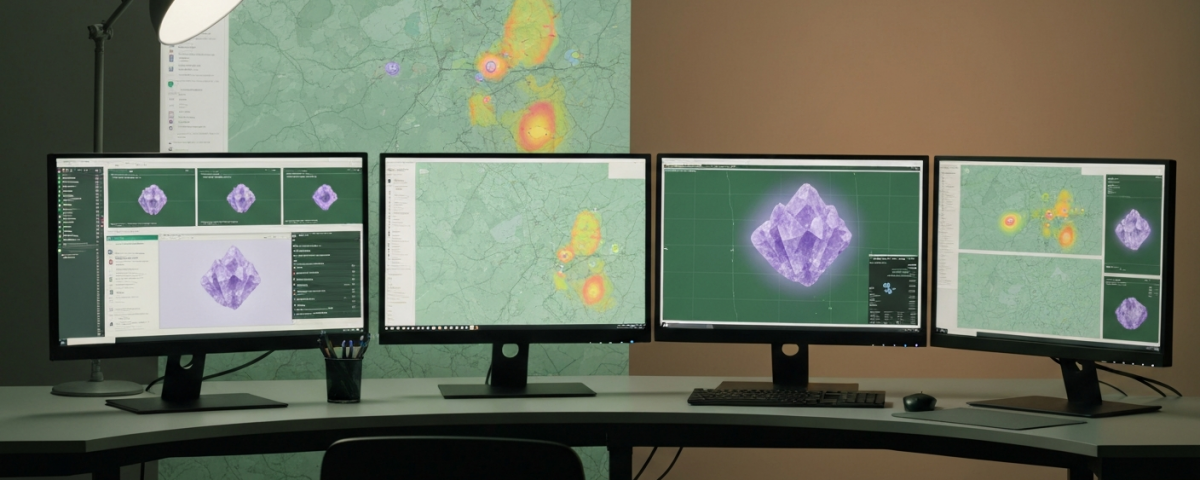
When data moves faster than geologists
For decades, commodity exploration followed a familiar pattern: geologists collected rock samples, analyzed maps, compared historical drilling data, and formulated a hypothesis. A drill target followed. Then, after several more months, a drilling program. The process often consumed years and significant capital, and in most cases ended without a commercial discovery.
Machine learning is now changing this workflow at one specific point: the analytical step between a mass of raw data and a drilling decision. The geology itself is not being replaced. For investors in small-cap exploration companies, this matters directly, because it affects how capital risk should be assessed in early exploration stages.
Critical metals as a driver for new methods
The timing of this technological shift is not coincidental. Western governments have defined lists of critical minerals whose secure supply they consider a strategic priority. Tungsten appears on these lists because of its use in hard-metal tools, ammunition, and high-temperature applications, and because global production is heavily concentrated in a small number of countries.
That geopolitical prioritization creates real incentives. Governments subsidize exploration, capital flows toward junior explorers focused on critical metals, and pressure builds for faster methods. The adoption of AI in this sector is a response to those market forces, not a trend running parallel to them.
Australia, Canada, and the United States are all actively backing critical mineral exploration projects. On the ASX, several small-cap companies have recorded substantial share-price movements in recent quarters tied directly to announcements of AI-assisted target identification. The market now treats methodological innovation at the early stage as a standalone value driver.

What “AI-assisted target generation” actually means
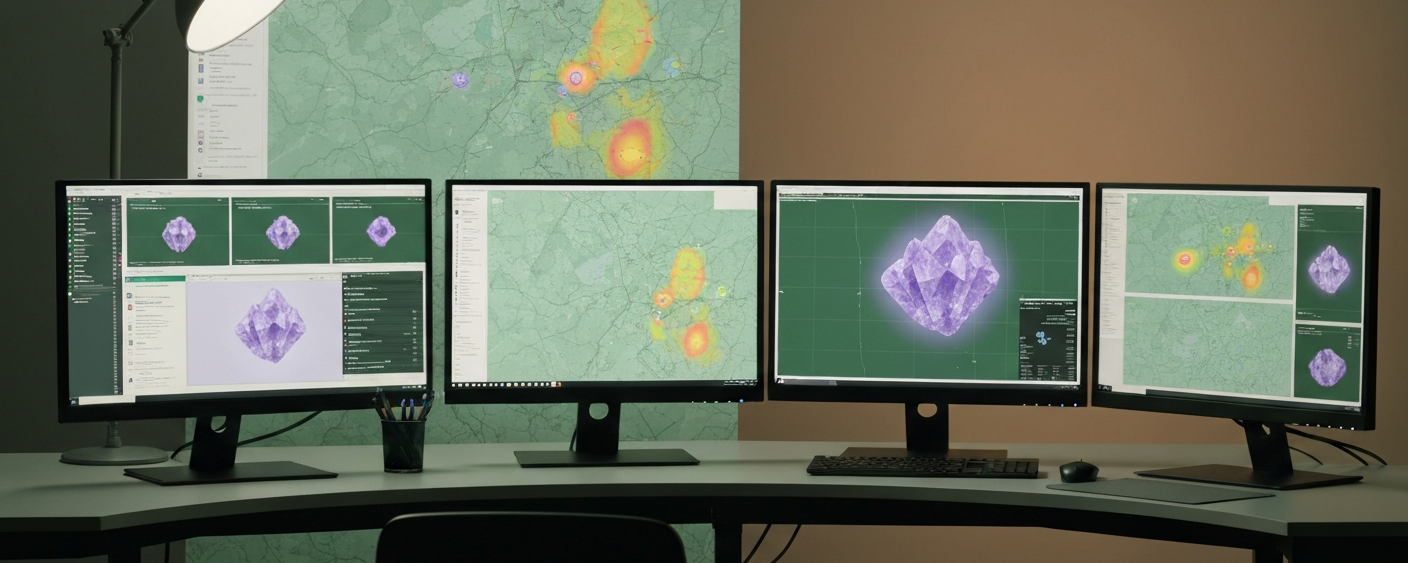
The term deserves scrutiny before marketing claims can be separated from genuine added value. In exploration, it typically refers to machine-learning algorithms that process large volumes of geological and geophysical data simultaneously, where a geologist working manually would have to move through those sources sequentially over months.
In practice, a model might analyze historical drilling data from a region alongside satellite remote-sensing data, aeromagnetic surveys, geochemical results from stream sediments, and topographic models, then identify which areas most closely match the signatures associated with known economic mineralization. Those areas get ranked. The geologist then decides which ones are worth putting a drill rig on.
The practical advantage over classical approaches is speed and data density. What a team of geologists might spend months working through, a well-configured model can process in hours. That compresses the time between receiving a dataset and making a drilling decision. The output, however, is only as good as the underlying data. Feed a model incomplete or biased historical records and the prioritization will reflect those flaws.
How this changes the valuation logic for junior explorers
Junior explorers typically finance themselves through multiple capital rounds. Each phase costs time and money. AI-assisted prioritization can compress the early stage, allowing a company to reach the next, more capital-generative phase sooner, which in theory reduces dilution pressure on existing shareholders.
The historical success rate for initial drilling on new targets is low. Early exploration discovery rates have frequently come in below 10%, according to figures from the Geological Survey of Canada and Geoscience Australia, though the methodology varies between studies and no single consolidated industry-wide number exists. AI-assisted prioritization aims to screen out the geologically weakest targets before the drill rig moves. Whether it actually improves hit rates depends heavily on data quality, and completed campaigns with published before-and-after comparisons remain scarce.
One underappreciated asset in this context is historical data. A company sitting on a large dataset from earlier drilling programs or government geological surveys can extract considerably more from these methods than one starting from scratch. That makes historical data collections a strategic asset comparable to the land package itself.
| Exploration Method | Time Horizon to Drill Target | Data Volume Processable |
|---|---|---|
| Classical geological mapping | 12–36 months | Limited (manual) |
| Geophysical surveys alone | 6–18 months | Medium |
| AI-assisted multi-source analysis | Weeks to a few months | High (multi-dataset) |
Reading AI announcements as an investor
The share-price movements triggered by AI announcements in ASX small caps follow a pattern familiar from other sectors: markets react to innovation news faster than to its verification.
The useful question is whether a company is using AI methodology as a communications exercise or whether it produces measurable operational progress. Does the company drill sooner? Does it hit mineralization at a higher rate than its previous programs? Are there targets that classical methods would have missed?
When 3D seismic technology entered the oil industry in the 1990s, many early successes were attributed heavily to the new technique. Over time it became clear that the technology improved efficiency but could not compensate for weak underlying geology. The same applies here. A good algorithm applied to a poor land package is still a poor land package.
Investors reading press releases on AI-assisted target generation can ask a few pointed questions: What data foundation did the model use? Was the methodology externally reviewed? And do target announcements translate promptly into drilling programs with published results?
Key terms in AI-assisted exploration
- Target generation
- Identifying and prioritizing drill-worthy areas within a land package. AI accelerates this step by processing large geospatial datasets far faster than manual analysis allows.
- Machine learning (ML)
- A subfield of AI in which algorithms identify patterns in historical datasets and apply them to new data. In exploration, ML models are often trained on known mineralization to find analogous structures elsewhere.
- Aeromagnetic survey
- An airborne geophysical measurement of Earth’s magnetic field. Magnetic anomalies indicate specific rock types and can point toward mineralization.
- Critical minerals
- Raw materials designated by governments as strategically important for supply security. The lists typically include tungsten, rare earths, lithium, and cobalt. Exploration projects targeting these materials sometimes receive regulatory and financial priority.
- Pre-discovery stage
- The early exploration phase before the first economically relevant drill discovery. Capital-intensive and statistically the least likely to succeed, it also carries the highest potential upside if a discovery is made.
- Multi-source data analysis
- The simultaneous processing of several geospatial data sources, including geochemistry, geophysics, remote sensing, and historical drilling records, within a single model. Combining multiple data layers is what gives AI-based prioritization any meaningful advantage over analyzing those sources one at a time.
- Drilling success rate
- The proportion of drill holes that intersect economically relevant mineralization. In early exploration, this figure typically sits well below 20% across the industry. AI prioritization aims to improve it through better target selection, though systematic documentation of improvements remains rare in published project data.
⚠️ Important notice: This article is for informational and educational purposes only. It does not constitute investment advice, a recommendation, or a solicitation to buy or sell any security. Investments in small-cap exploration and mining companies carry a high risk, including the potential total loss of capital. Before making any investment decision, consult a registered financial advisor and conduct your own analysis. Boersen Post Team is not responsible for decisions taken based on the content published here.