Geopolitics as Project Value: U.S. Lithium Security and Junior Explorers
August 13, 2026
State-Owned Giants Hunting Junior Miners: What It Means for Small-Cap Investors
August 13, 2026
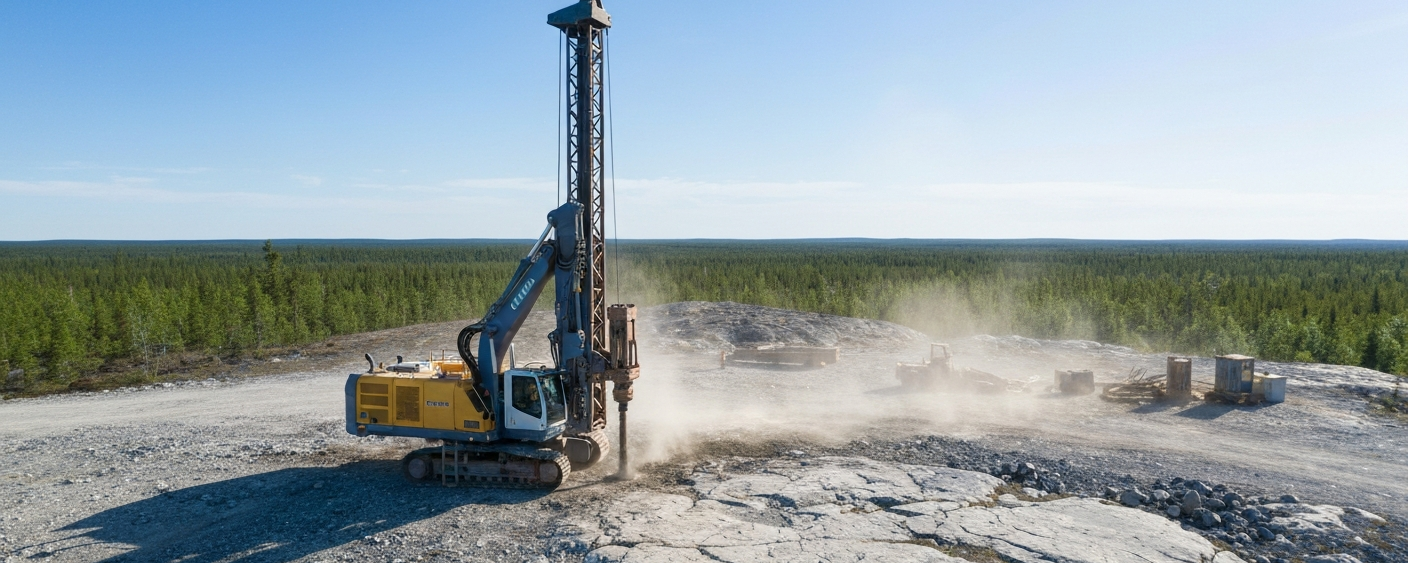
When drill bits and calendars set the pace together
For anyone new to junior mining stocks, news about a summer drilling campaign can read like administrative filler. “Phase 2, 10,000 meters, two drill rigs” — what is that supposed to tell you? Quite a lot, once you understand why these programs are built the way they are. Summer drilling in Canada is not default scheduling. The ground is passable, crews are available, and frost is gone — but only for a few months. That window, roughly June through September at northern latitudes, is when work actually happens. An active program means the project is moving, that geological data is coming in, and that the company has enough conviction and cash to keep going.
Quebec has become one of the more sought-after addresses for lithium exploration in North America. The geology helps, but so does the regulatory environment and the relative proximity to processing infrastructure. The legal system is also one that investors from outside Canada can actually navigate. Projects in Eeyou Istchee, the traditional territory of the Cree, carry specific consultation obligations with Indigenous communities — obligations that have real consequences for permitting timelines and when programs can run.
From assay result to NI 43-101 resource: a long road
A positive assay result is not a confirmed resource. Understanding why requires some familiarity with how Canadian mineral standards actually work. NI 43-101 sets strict requirements for classifying what a company may call a “resource,” and the distinctions between categories matter enormously for how you read a press release.
| Resource category | Data density | Geological confidence |
|---|---|---|
| Inferred resource | Low (wide drill spacing) | Low — high uncertainty |
| Indicated resource | Medium (tighter drill grid) | Moderate — usable for economic studies |
| Measured resource | High (dense, systematic network) | High — basis for reserve calculation |
| Proven/probable reserve | Very high + feasibility study | Very high — economically demonstrated |
A single drill hole delivers one data point: an assay, meaning a chemical analysis of the extracted core. That is it. Only when many such points are arranged in a defined pattern, and an independent qualified person (QP) has validated the underlying data, does a classified resource under NI 43-101 exist.
When reading press releases from junior explorers, the first question should always be: where is this project in the sequence? Early indications from grab samples or a handful of drill holes are a different animal from a dense, systematic dataset capable of supporting a classified resource estimate.

How resource building actually works, step by step
Phased drilling programs follow an industrial logic, though the transitions in practice are rarely clean.
Early on, widely spaced drill holes give a first rough picture of the mineralization corridor. This phase produces the headline numbers that move share prices — the dramatic individual intercepts — but nothing resembling a reliable resource. Price swings on these announcements can be sharp and short-lived in either direction.
Once there is something worth defining, the work shifts to understanding the geometry of the deposit. Where does the lithium-bearing zone end? How deep does it extend? Does it thicken or pinch out at depth? This phase is capital-intensive and rarely glamorous: many holes, modest individual results, but substantially less geological uncertainty when it is done.
Tightening the drill grid further is what allows an inferred resource to be upgraded to indicated or measured. That upgrade matters because it is the prerequisite for economic studies — a Preliminary Economic Assessment (PEA) or a preliminary feasibility study — that tell you whether any of this is worth developing.
The underlying principle is simple: the denser and more systematic the data, the more defensible the volume estimate. Wide spacing gives you indications. It does not give you a foundation.
What to actually look at in assay announcements
Monitoring drilling programs in the small-cap space is a real information challenge, because the quality of an announcement cannot be judged from the headline grade alone.
Width matters more than peak values. A single hole with a very high lithium grade over a short interval is less meaningful than several consistent intercepts spread across greater length and width. A spectacular individual result may point to a localized enrichment that says nothing about the broader project.
Drill spacing determines the resource category you can claim. When holes are far apart, mineralization continuity between points cannot be reliably interpolated. The result is an inferred resource with high uncertainty. A company that systematically closes its drill spacing is building toward upgrade potential, which is worth tracking differently than a company chasing headlines with widely spaced step-out holes.
Program scope also needs context. A 10,000-meter program can represent a meaningful proportion of what is needed to define a resource, or it can be a modest addition to a much larger geological system. That depends entirely on what data already exists and how this program was designed relative to previous phases. Individual assay values say little when the sampling plan is absent or the drill grid is too coarse to demonstrate continuity — and that context rarely appears in the headline.
What phased exploration can and cannot do
The capital logic behind phased drilling is straightforward: define milestones, deploy money incrementally, and let results justify the next decision. For a junior explorer, positive results at each phase make follow-on financing through private placements more achievable, because the data has improved and some of the geological risk is off the table.
But drilling generates costs, not revenue. Without production or cash flow, junior explorers depend entirely on external capital. The credibility of reported results and the quality of program design directly affect the terms on which that capital can be raised. A mediocre program at inflated cost does not go unnoticed by the funds and individuals who write the checks.
Early exploration results also tend to produce lopsided share price reactions: positive surprises push the price up, while weak drill results often attract little immediate selling pressure. That gap can persist for some time — until an economic study makes the absence of a real resource base impossible to overlook. Assay news only makes sense read within the full sequence of what has been drilled, not as a string of independent announcements.
Reference terms
- Assay
- A chemical laboratory analysis of a drill core segment that indicates the grade of specific minerals or metals. Assays are the raw data from which resource estimates are constructed.
- NI 43-101
- Canadian regulatory standard for public disclosure on mineral projects. All resource and reserve estimates must be validated by an independent qualified person (QP).
- Inferred resource
- The lowest resource category under NI 43-101. Based on limited data, it permits rough volume estimates, but substantial geological uncertainty remains.
- Indicated resource
- The intermediate category. A tighter drill grid reduces uncertainty enough that economic preliminary studies such as a PEA can be built on it.
- Reserve (proven / probable)
- The portion of a resource considered extractable after comprehensive technical and economic studies. Reserves form the basis for production decisions and project financing.
- Li₂O (lithium oxide)
- The standard unit of measure for lithium grade in hard-rock exploration projects (pegmatites). A higher Li₂O percentage indicates richer mineralization, but economic viability depends on many additional factors.
- Qualified person (QP)
- An independent expert — typically a geologist or engineer with relevant professional credentials — required under NI 43-101 to take responsibility for and sign off on technical reports and resource estimates.
- Spodumene pegmatite
- A lithium-rich rock type in which the mineral spodumene (LiAlSi₂O₆) occurs. It is the principal hard-rock source of lithium globally, alongside lithium-rich salt lake brines.
⚠️ Important notice: This article is for informational and educational purposes only. It does not constitute investment advice, a recommendation, or a solicitation to buy or sell any security. Investments in small-cap exploration and mining companies carry a high risk, including the potential total loss of capital. Before making any investment decision, consult a registered financial advisor and conduct your own analysis. Boersen Post Team is not responsible for decisions taken based on the content published here.