Capital Rotation in a Gold Bull Market: How the Cycle Works
June 8, 2026
The Namibia Effect: How ASX Juniors Are Opening New Markets
June 8, 2026
When Every Meter Drilled Counts: The Dilemma of Small Explorers
Anyone operating in mineral exploration knows the basic math: capital is scarce, risks are high. For a junior explorer on the TSX-V or ASX, a single failed drill hole can hurt the share price substantially. Major mining conglomerates can absorb setbacks. Smaller companies cannot.
Over the past few years, junior explorers have started turning to machine learning and algorithmic analysis to pick drilling targets before any ground work begins. This is not futurism — it is a practical approach to making exploration cheaper. The mechanism is worth understanding if you invest in the small-cap mining space, because it is shifting how people think about capital deployment in a difficult fundraising environment.
Capital Scarcity Meets Rising Exploration Costs
The financing climate for junior explorers has turned harsh. Private placements, the standard way small mining companies raise money, face headwinds as interest rates stay high and institutional investors grow cautious. Meanwhile drilling costs have climbed due to expensive logistics, energy prices, and tight labor supply.
The result is a squeeze: more capital is needed to move projects forward, but less is available. Under these conditions, anything that lifts the hit rate — the share of drill holes that actually intersect economic-grade mineralization — becomes valuable.
Exploration was historically a data-heavy but analytically constrained pursuit. Geologists examined drill cores, geochemical samples, and geophysical surveys by hand. Patterns were inevitably missed. The human mind has limits when working with hundreds of variables at once.
What Machine Learning Actually Does in Exploration
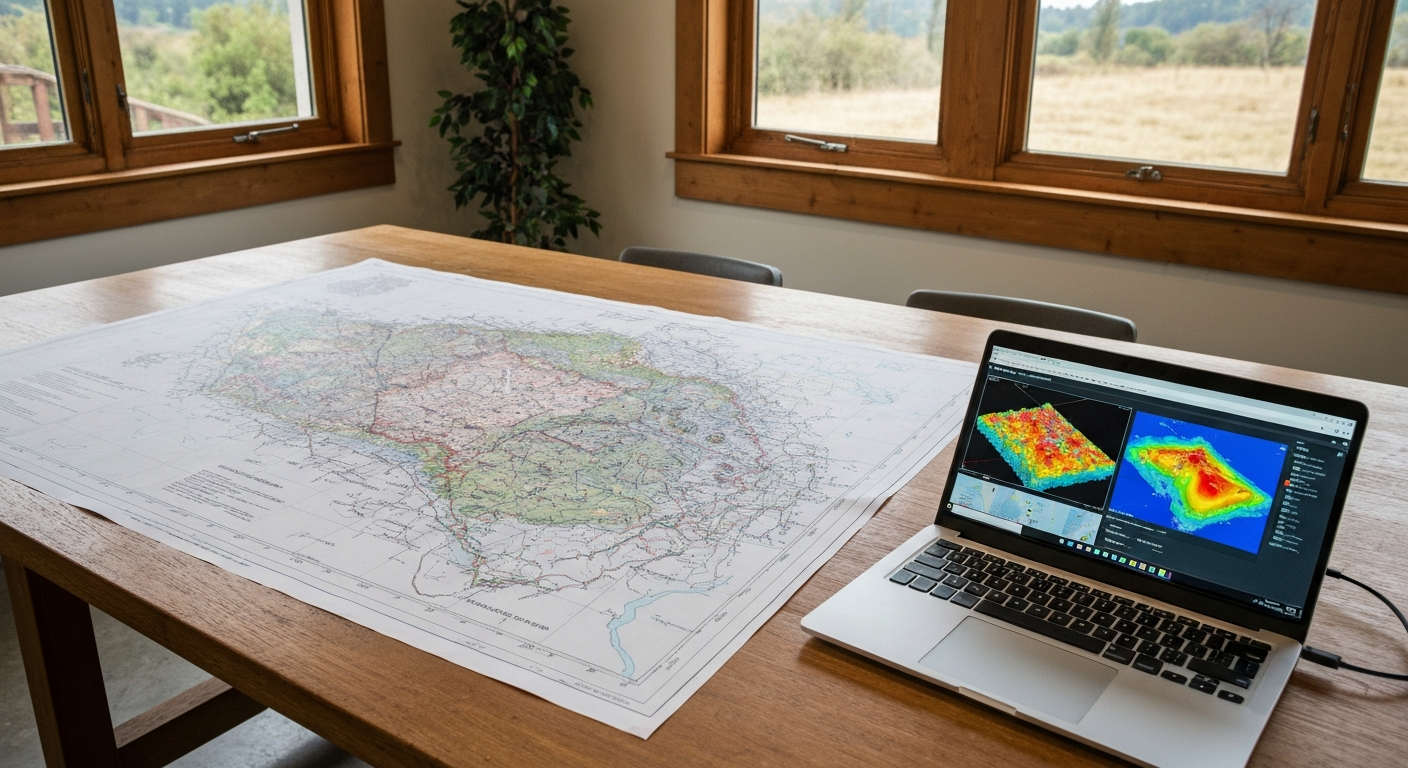
The approach is straightforward. A model is trained on historical datasets: geological maps, satellite imagery, gravity and magnetic measurements, geochemical assays, past drill logs. It learns which combinations of features have historically pointed to economically viable deposits.
The model then ranks unexplored zones by likelihood, creating a probability map of drilling targets. Geologists use this to concentrate resources on the most promising ground.
A concrete example: a junior holds tenure in a known gold belt. Drilling a full 500-square-kilometer area uniformly is financially impossible. A model examines which zones show the structural geology, soil chemistry, and magnetic signatures consistent with gold. The drilling program narrows to five or six targets instead of twenty, cutting costs sharply.
The same logic applies to copper, lithium, and rare earths. These commodities have geopolitical demand behind them, attracting fresher capital. Less wasteful drilling means better returns per dollar spent.
| Exploration Method | Strength | Weakness |
|---|---|---|
| Traditional geological mapping | Ground truth, experienced interpretation | Cannot process large data volumes efficiently |
| Geophysical surveys (airborne/ground) | Detects anomalies across wide areas | Interpretation often remains ambiguous |
| Machine learning target selection | Recognizes patterns across multiple data types | Depends entirely on historical training data quality |
The Technology Has Real Limits
Machine learning in exploration sounds promising. Investors should be clear-eyed about the constraints.
Bad data produces bad results. A model is only useful if trained on solid historical information. In areas with little prior exploration — much of Africa, Central Asia — pattern data is thin and predictive power declines. A junior working in a well-mapped district has an advantage over one in unmapped terrain.
Models don’t find deposits. A model can rank targets, but it cannot prove an economic resource exists. Physical drilling and lab work are still required. The technology reduces risk; it does not remove it.
Marketing can obscure reality. When junior companies trumpet “AI-driven exploration” in press releases without explaining methodology, you cannot easily tell overstatement from genuine innovation. Ask which data were used and how the model was tested. Treat this with the same skepticism you would apply to a resource estimate.
What This Means for Small-Cap Investors
The adoption of machine learning in exploration is not a technical detail. It changes how you assess capital efficiency in small mining companies. When financing rounds tighten and investors become selective, companies that extract more geological value per dollar deployed gain relative strength.
This does not mean technology-forward juniors are automatically better investments. It means you have a new lens: how efficiently does a company use capital before drilling starts? A company spending six months on data analysis rather than rushing to drill is signaling something about its risk culture and discipline.
For the small-cap mining sector broadly, one rule applies: technology cannot replace sound geology, favorable jurisdiction, or experienced management. It is one tool available to management. Without the right team wielding it, it is worthless. Investors who learn to distinguish real technological advantage from pure marketing will improve their overall judgment of the sector.
Key Terms at a Glance
- Target Generation
- The process of evaluating geological, geochemical, and geophysical data to identify and rank potential drill targets. Increasingly done with algorithmic assistance.
- Hit Rate
- The proportion of drill holes that intersect economically significant mineralization. Higher hit rate means better capital use.
- Private Placement
- A capital raise in which new shares go directly to a small group of investors without public offering. The standard financing for junior explorers.
- Geophysical Survey
- Measurement of subsurface physical properties (magnetics, gravity, electromagnetics) from the air or ground, used to map anomalies that may signal ore deposits.
- Training Data
- Historical datasets used to teach a model to recognize patterns. In exploration, these include drill cores, assay results, and maps from previous campaigns.
- Capital Efficiency
- The return or informational gain per unit of capital deployed. In exploration, this means geological value gained per dollar of spending.
- Mineralization
- The presence of metals or minerals in rock at concentrations that could potentially be mined.
⚠️ Important notice: This article is for informational and educational purposes only. It does not constitute investment advice, a recommendation, or a solicitation to buy or sell any security. Investments in small-cap exploration and mining companies carry a high risk, including the potential total loss of capital. Before making any investment decision, consult a registered financial advisor and conduct your own analysis. Boersen Post Team is not responsible for decisions taken based on the content published here.