Major Meets Junior: How Accelerator Programs Are Reshaping Mining
May 8, 2026AI & Muon Imaging: How Technology Is Rewriting Mineral Exploration
June 8, 2026
When Small Stocks Suddenly Go Big
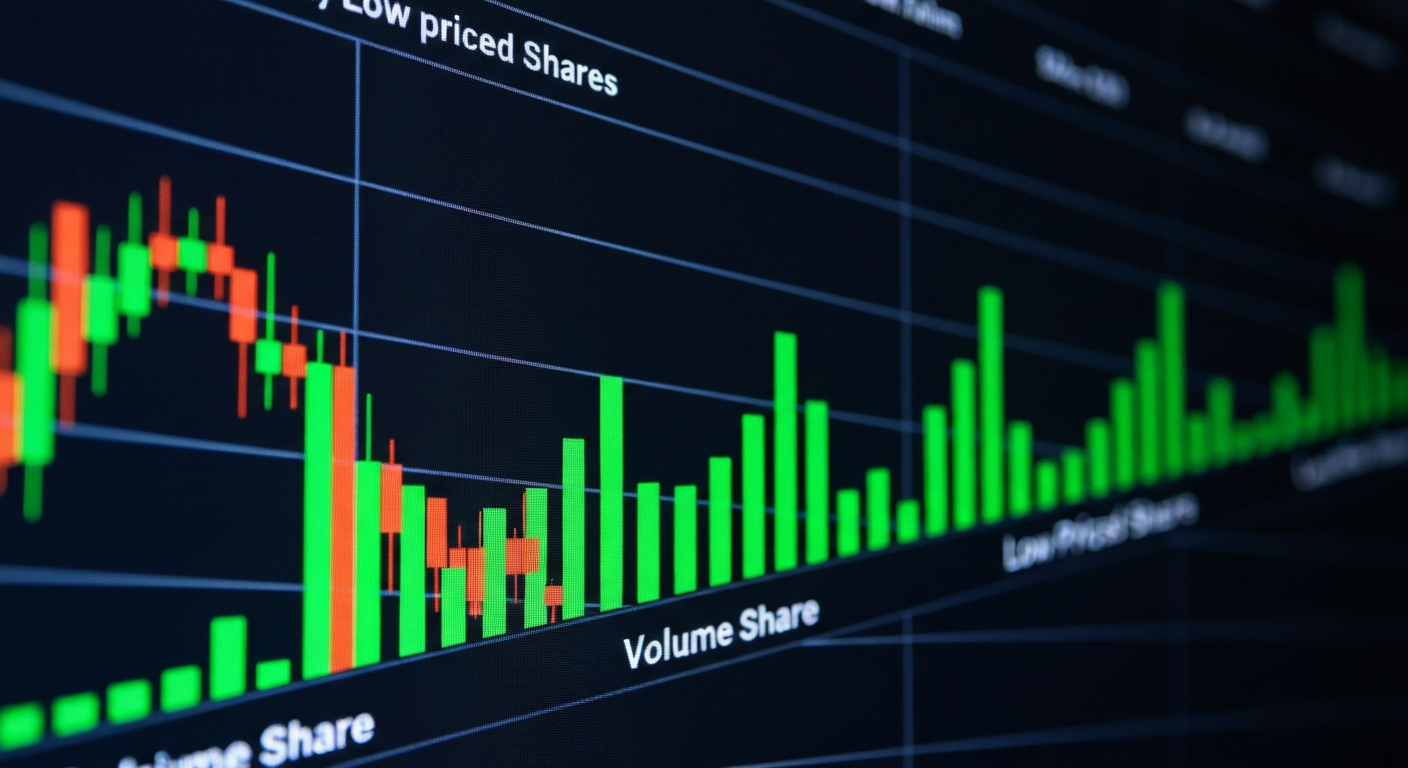
It happens rarely, but when it does, it is hard to miss: stocks that traded for just a few cents for months multiply in value within a matter of weeks. On the TSX Venture Exchange (TSX-V) — Canada’s specialized exchange for small-cap commodities and exploration companies — such phases tend to cluster during specific market cycles. Observers are once again noting rising trading volumes and growing interest in so-called penny stocks: shares that typically trade below one Canadian dollar.
For beginners entering the world of small-cap commodity stocks, this signal cuts both ways. On one hand, these phases can trigger short-term price moves unlike anything seen in other market segments. On the other hand, low-priced exploration stocks carry risks that are fundamentally different from those of larger companies. This article explains how penny stock phases develop, what mechanisms drive them — and why a clear-headed understanding is more valuable here than excitement.
The TSX-V Ecosystem: Small, Volatile, Cyclical
The TSX Venture Exchange is no ordinary stock exchange. It was explicitly designed to give young companies in capital-intensive industries — primarily mining and exploration — easier access to risk capital. Its listing requirements are significantly lower than those of the main TSX exchange, which means many listed companies have no revenues, no production, and sometimes have not even completed an initial geological assessment of their project.
This structure makes the TSX-V a highly sensitive early indicator of sentiment shifts in the commodities sector. When the gold price rises, when central banks ease monetary policy, or when a particular metal gains geopolitical importance, TSX-V stocks often react faster and more sharply than large-cap companies — both to the upside and the downside.
Adding to this is the natural cycle of commodity markets: extended dry spells with little capital inflow are sometimes followed by short, intense periods of elevated activity. In such moments, stocks that were long ignored begin attracting attention again. That appears to be exactly what is taking shape right now.
Why Penny Stocks React So Strongly to Sentiment Shifts
The price of a stock trading at CAD 0.05 can double to CAD 0.10 on a single piece of positive news — mathematically, a gain of 100 percent. This arithmetic principle explains part of the fascination, but it simultaneously obscures the underlying dynamics.
Three mechanisms are particularly responsible for driving penny stock phases on the TSX-V:
- Liquidity pull: When institutional or retail investors begin paying closer attention to a specific segment of the TSX-V, capital flows into areas that were previously barely traded. Because available trading volume in many of these stocks is very thin, relatively small buy orders are enough to move the price noticeably.
- Narratives and thematic booms: Penny stocks benefit strongly when a broad theme captures investors’ imagination — such as the expansion of battery supply chains, the energy transition, or a shift in monetary policy. A small exploration company with a lithium project will be valued very differently in that environment than in a period when battery metals attract no interest.
- Momentum and herd behavior: Once initial price gains become visible, more buyers follow — often without deeper analysis. This self-reinforcing pattern can drive prices far above fundamentally justified levels before a correction sets in.
A useful analogy: imagine a market stall at a flea market. As long as no one is looking, the price stays low. The moment one person stops and shows interest, and others notice, a crowd forms — and the seller raises the price before anyone has actually checked whether the item is worth it. Momentum in the penny stock space works in much the same way.
| Characteristic | Penny Stock (TSX-V) | Large-Cap Mining Stock |
|---|---|---|
| Typical market capitalization | Under CAD 50 million | Over CAD 5 billion |
| Daily trading volume | Often under 100,000 shares | Millions of shares |
| Price swings on news | +/− 30–100% | +/− 3–10% |
| Analyst coverage | Low to none | Extensive |
| Production revenues | Usually none | Regularly present |
What Investors Can Take Away from Penny Stock Phases
Understanding the mechanisms puts investors in a better position — not to chase quick gains, but to make informed observations and avoid the mistakes most common among beginners.
First, it is worth taking volume data seriously. Rising trading volume without a discernible fundamental catalyst — no drill results, no new financing round, no regulatory progress — is a warning sign. It points to speculative buying that can reverse just as quickly.
Second, bid-ask spreads are an underappreciated measure of risk. In illiquid stocks, the gap between the buying price and the selling price can be several percentage points wide. This means that someone who buys a stock and immediately tries to sell it again has already lost money through the spread alone — before the price has even moved.
Third: periods of heightened attention are not permanent states. The history of the TSX-V repeatedly shows the same pattern — a theme heats up, capital flows in, prices rise, latecomers buy — and when momentum turns, there is not enough liquidity for an orderly exit. This is not a problem unique to the TSX-V; it is a general feature of all markets with low market depth.
A helpful analogy: imagine a narrow mountain stream. A single small boat moves through it easily on the current. But when ten boats try to navigate it at the same time, they collide — and getting out becomes the problem. Illiquid markets behave in much the same way: entering is usually easier than exiting.
Key Terms: TSX-V and Penny Stocks
- Penny Stock
- A stock that typically trades below one dollar (or one euro). On the TSX-V, many exploration stocks are permanently in this range. The low nominal price alone says nothing about the quality of the underlying company.
- TSX Venture Exchange (TSX-V)
- The Canadian exchange segment for small and mid-sized companies, primarily in the commodities and exploration space. Listing requirements are lower than those of the main TSX exchange, but so are regulatory standards.
- Market Capitalization
- The total value of all outstanding shares of a company at the current price. For penny stocks, this is frequently below CAD 50 million — making the company vulnerable to sharp price swings on even modest capital inflows.
- Bid-Ask Spread
- The difference between the highest buy offer (bid) and the lowest sell offer (ask) for a stock. The more illiquid a stock, the wider the spread — and the more costly trading becomes for the investor.
- Trading Volume
- The number of shares traded within a given period. High volume can indicate increased interest, but it is not an indicator of fundamental quality.
- Momentum
- The tendency of a security to continue an existing price move. Particularly pronounced on the TSX-V, where a small number of market participants and low liquidity favor trend amplification.
- Market Depth (Liquidity Depth)
- A measure of how many buy and sell orders exist at various price levels in the order book. Low market depth means that even moderate orders can move the price significantly.
- Junior Explorer
- A small mining company in the exploration stage that typically generates no production revenues. Its valuation is based almost entirely on the potential discovery of economically viable mineral deposits.
⚠️ Important notice: This article is for informational and educational purposes only. It does not constitute investment advice, a recommendation, or a solicitation to buy or sell any security. Investments in small-cap exploration and mining companies carry a high risk, including the potential total loss of capital. Before making any investment decision, consult a registered financial advisor and conduct your own analysis. Boersen Post Team is not responsible for decisions taken based on the content published here.