Polymetallic Discoveries: What Silver Is Worth Inside Gold Systems
July 7, 2026
District-Scale Systems: What Strike Length Means in the Athabasca Basin
July 8, 2026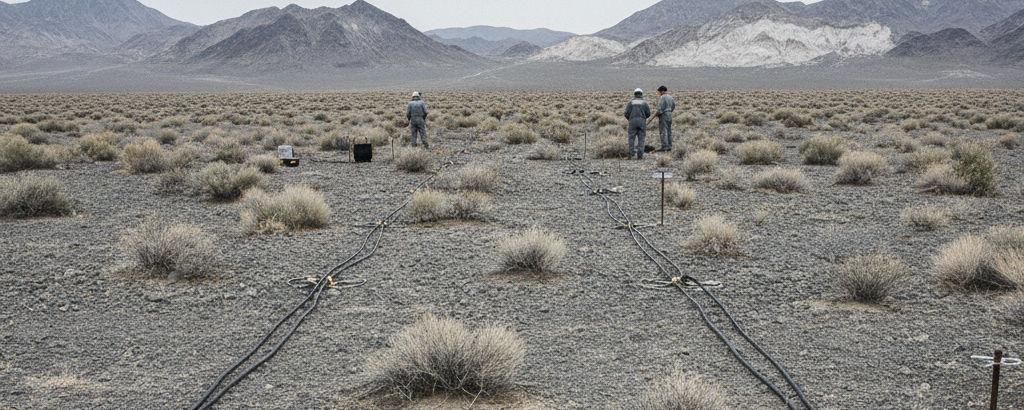
When the subsurface responds: geophysics as a decision-making tool
Finding silver underground takes more than a good instinct for geology. Before a drill rig touches the ground, junior explorers today spend real money on geophysical surveys. One method is drawing particular attention in Nevada right now: the IP survey, short for Induced Polarization. Two silver companies are using it to define drillable targets, which makes the technique worth a closer look — what it actually measures, and what role it plays in the exploration cycle.
Nevada: why the state draws silver explorers
Nevada’s reputation among junior explorers is not accidental. The permitting system is predictable, mining infrastructure is already in place, and the state’s geological track record speaks for itself — from the Comstock Lode in the 19th century to modern large-scale projects. For small companies, that translates to lower regulatory risk, familiar geology, and short distances to drilling contractors and geophysical labs.
Two small silver exploration companies have independently conducted IP surveys in the state — one at the Claudia project, the other in the Tuscarora district. The projects are at different stages: one is already drilling, while the other has announced an initial 3,000-meter program. The parallel is worth noting because it shows what the path from survey to drill hole actually looks like when a junior works through it step by step.

The physics behind an IP survey: chargeability as an indicator
The measurement principle is straightforward. Geologists pass an electrical current into the ground and measure how long the rock takes to release it. That property is called chargeability. Rocks with high sulfide mineralization — minerals such as pyrite or argentite — typically show elevated chargeability values.
A chargeability anomaly tells you that the rock at a given location behaves electrically differently from its surroundings. It does not tell you why. Clay minerals and graphitic schists produce comparable signals without any economically relevant metals present. What lies behind the anomaly can only be resolved by drilling.
| Exploration step | Method | What it delivers |
|---|---|---|
| Step 1 | Satellite imagery / mapping | Geological structures, alterations |
| Step 2 | Geochemical sampling | Metal content at surface |
| Step 3 | IP survey | Chargeability anomalies in the subsurface |
| Step 4 | Drilling program | Direct rock samples with assay results |
From anomaly to drill target: what the data reveal
When an IP survey turns up a large, near-surface chargeability anomaly, it matters to a junior explorer for two reasons. Shallow means less drilling depth, which protects a limited budget. And a spatially extensive anomaly suggests a potentially larger mineralized body — relevant for resource definition later, if the anomaly turns out to be economic.
The explorer then selects priority drill targets from the IP data and builds them into a drilling program. A Phase 1 program — such as the 3,000-meter program planned in the Tuscarora district — is designed to test whether actual mineralization sits behind the anomaly and to generate enough data to decide whether further work is warranted.
Why most anomalies never become a deposit
IP surveys have clear limits. Pyrite generates IP signals without being economically mineable. Certain clay minerals and graphitic schists produce similar readings. Most drill targets, even after thorough geophysical preparation, turn out to be uneconomic — that is simply the reality of early-stage exploration.
IP surveys help reduce the risk of drilling in the wrong place. They do not eliminate it. A positive IP result justifies committing capital to a drilling phase, but nothing beyond that. On the cost side, an IP survey is modest compared to a full drilling program, which is why small companies can afford to test several target areas before putting steel in the ground.
What structured exploration means for small-cap investors
The sequence from mapping to IP survey to drilling program follows a logic that is readable without geological expertise. Knowing where a company sits in that sequence gives you a more grounded view of its risk. A company still planning an IP survey is in a very different position from one presenting assay results from its first drill hole — not inherently worse, just earlier.
A few questions worth asking when sizing up a project: What data underpin the drill target — geochemistry alone, or IP as well? Is this a first-pass program or a resource-defining infill campaign? Was the anomaly described by an independent geophysicist? Those questions help place a project’s actual state of knowledge in perspective, whatever language the company chooses in its press releases.
Nevada at least makes such assessments somewhat easier. The regulatory framework is well understood, historical reference data are available, and the established mining industry on the ground provides benchmarks that are harder to find elsewhere.
Key terms at a glance
- IP survey (Induced Polarization)
- A geophysical method that measures the electrical chargeability of the subsurface. Used to identify sulfide mineralization as potential drill targets.
- Chargeability
- A measure of how long a rock stores an applied electrical current before releasing it. High chargeability often indicates sulfide mineralization.
- Anomaly
- A measurement that deviates significantly from background values. In geophysics, an indication of geological features — not proof of a deposit.
- Phase 1 drilling program
- The first drilling phase of an exploration project, typically designed for initial testing. The goal is to determine whether a geophysical or geochemical anomaly contains mineralized grade.
- Assay
- A laboratory analysis of a rock or drill sample to determine metal content. Results are reported in grams per tonne (g/t) or percent.
- Sulfide mineralization
- The occurrence of metal sulfide minerals in rock (e.g., pyrite, argentite). Often associated with economically relevant metals, but not necessarily mineable.
- Junior explorer
- A small mining company without its own production, focused on the exploration and resource definition of early-stage projects. High risk, with correspondingly high upside if a discovery proves out.
⚠️ Important notice: This article is for informational and educational purposes only. It does not constitute investment advice, a recommendation, or a solicitation to buy or sell any security. Investments in small-cap exploration and mining companies carry a high risk, including the potential total loss of capital. Before making any investment decision, consult a registered financial advisor and conduct your own analysis. Boersen Post Team is not responsible for decisions taken based on the content published here.