Share Exchange Deals: How Juniors Bundle Critical Minerals
June 8, 2026
Tax Reforms and Their Impact on Exploration Capital
June 8, 2026

When the Map Is Redrawn: Africa’s Role in Global Gold Mining
Mining regions don’t follow a fixed map. What was considered too remote or too risky twenty years ago can today be a sought-after exploration target. Rising commodity prices, better infrastructure, and the simple fact that fewer easily accessible deposits remain in established mining districts all play a part. This is happening now across parts of Africa: countries such as Namibia and Côte d’Ivoire are attracting capital from publicly listed junior exploration companies.
For investors new to small-cap mining stocks, this is worth understanding. It shows how geological potential, political frameworks, and capital markets interact — and why early discoveries in frontier regions can move share prices significantly. But opportunity comes with specific risks that need scrutiny.
Frontier Markets in the Commodities Sector: Why the Shift Happens
Exploration priorities move into new regions for clear reasons. In classic mining countries such as Canada, Australia, or the United States, the easy finds are mostly behind us. Over recent decades, near-surface, easily extractable gold deposits have been discovered. Anyone searching there today competes with dozens of other explorers on ground that is heavily worked. The cost to find an ounce of gold keeps rising.
A high gold price also changes what makes economic sense. Deposits that were uninteresting at lower prices can become viable when gold trades above US$2,000 per ounce, including projects in logistically difficult regions. West African projects that couldn’t have secured financing ten years ago suddenly work on the numbers.
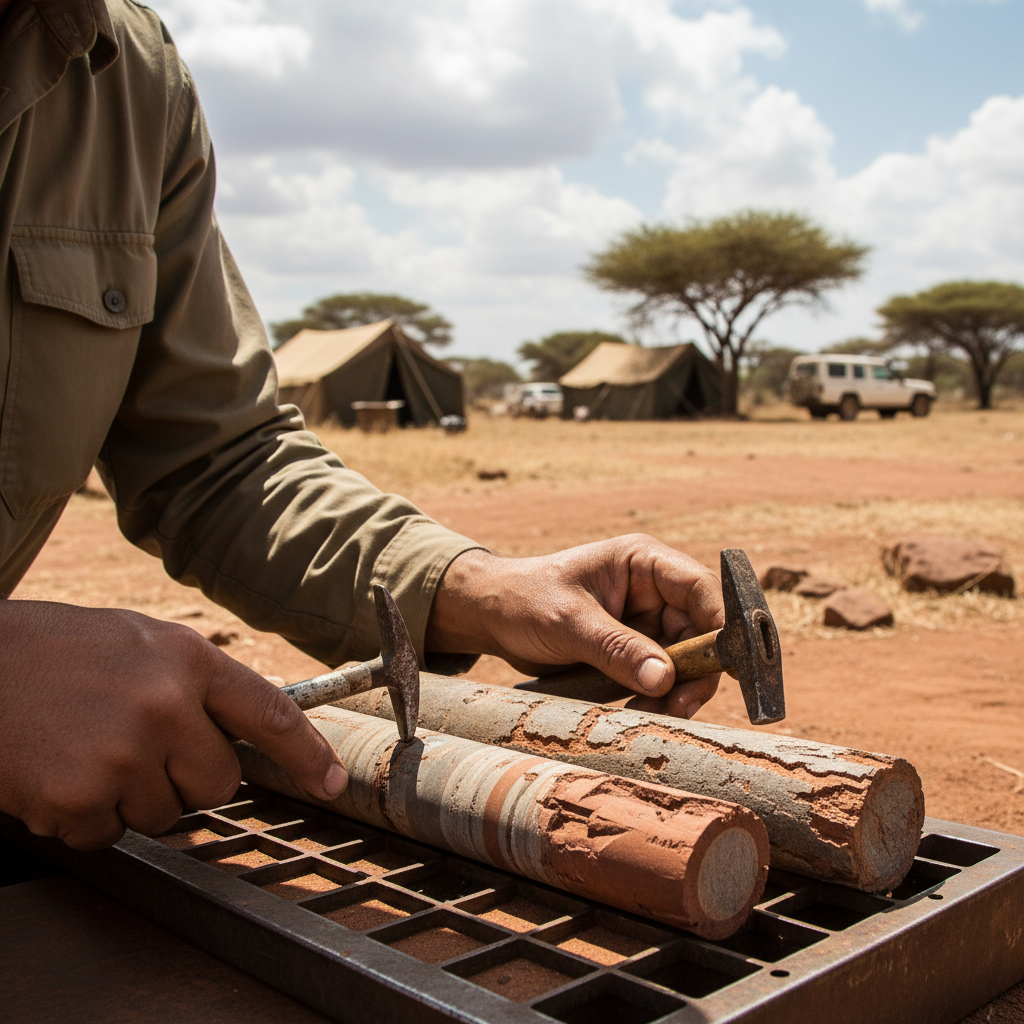
Parts of West Africa sit on the Birimian Greenstone Belt, an ancient rock formation geologically comparable to the gold-rich Archean belts of Canada or Australia. Namibia displays structural similarities to copper- and gold-rich zones that have historically produced significant finds. Geologists describe such regions as “underexplored” — areas with high discovery potential where relatively little modern exploration work has occurred.
How a Resource Estimate Moves a Junior’s Share Price
A key event in an exploration company’s life is the first Mineral Resource Estimate (MRE). This is when geological assumptions become a concrete number: so many millions of tonnes of rock, so many grams of gold per tonne, yielding a total quantity in ounces.
Markets often respond to an MRE because it replaces uncertainty with data. Before the estimate, investors are betting on something invisible. After a solid MRE, the company has a defined resource that can be valued. If the number comes in larger than expected, share prices can move within days.
Consider a simple comparison: someone buys an old barn hoping valuable antiques are stored inside. As long as no one has looked, the barn’s value is speculative. The moment an appraiser says the contents are worth $500,000, the valuation basis shifts. An MRE works the same way for a mining company.
What matters for investors is context. An MRE in the “Inferred” category is the least certain. The available data justifies an estimate, but not yet a reliable economic assessment. Only when resources are upgraded to “Indicated” or “Measured” does reliability improve meaningfully.
| Resource Category | Data Basis | Economic Reliability |
|---|---|---|
| Inferred | Limited, incomplete | Low — estimate only |
| Indicated | Sufficient for planning purposes | Medium — basis for preliminary studies |
| Measured | Dense, reliable | High — basis for feasibility studies |
Political Risk in Frontier Markets: The Invisible Price Tag
Africa is not a homogeneous block. Botswana has been regarded as one of the world’s most stable mining jurisdictions for decades. Other regions carry histories of nationalizations, regulatory reversals, or violent conflict. Côte d’Ivoire, following political instability in the 2000s, has made substantial progress in institutional stabilization and is attracting foreign mining capital again. Namibia is known for a reliable legal framework and a long tradition of mining activity.
For investors, political risk is always priced into a stock. The question is whether it’s priced correctly. When a junior explorer in a politically stable jurisdiction like Namibia announces a significant discovery, the risk premium embedded in the stock’s price may be lower than for a comparable project in a less stable neighboring country. This differential is called the Country Risk Premium and affects valuation.
Two properties illustrate this: a condominium in a quiet, well-connected residential neighborhood and an identical one in an area with unclear property rights and frequently changing tenancy laws. The second will sell for less, even if the construction is identical. Mining projects face the same logic across different countries.
What This Means for Investors
The growing interest in African exploration targets follows a coherent logic rooted in geology, commodity prices, and capital markets. At the same time, investors new to junior explorers with an African focus are entering territory considerably more complex than a diversified ETF or a large-cap mining company.
Several things matter. Exploration momentum builds where geological potential meets an improving political environment, and that is currently happening in parts of Africa. Resource estimates move share prices because they replace uncertainty with numbers, but the quality of those numbers varies. Political risk operates on a spectrum rather than as a simple binary choice, and that spectrum is reflected in valuation.
Grasping these mechanisms helps investors interpret news from the sector more clearly, whether they are observing from the sidelines or making their own bets.
Key Terms for Getting Started
- Frontier Market
- A region that is less developed and less liquid than classic emerging markets. In mining: countries with historically low exploration activity but growing investor interest.
- Mineral Resource Estimate (MRE)
- An estimate of the quantity of ore present in the ground, prepared according to international standards (e.g., NI 43-101 or JORC). Forms the basis for economic assessment of a project.
- Inferred Resource
- The least certain category of a resource estimate. Data density is limited; figures can change substantially with additional drilling.
- Birimian Greenstone Belt
- An ancient rock formation in West Africa (principally Ghana, Côte d’Ivoire, Guinea, Mali) that is geologically comparable to the gold-rich Archean belts of Canada.
- Country Risk Premium
- The valuation discount that investors apply to account for political, legal, or operational uncertainties in a given country. The higher the perceived risk, the larger the discount.
- Junior Explorer
- A small, publicly listed mining company focused exclusively on searching for and evaluating mineral deposits, without any production of its own. Typically financed through equity raises.
- Underexplored
- A term describing a geologically promising region where little modern exploration tooling (geophysics, deep drilling, geochemical analysis) has been deployed to date.
- Warrant
- An instrument frequently used in the mining sector. In an equity raise, investors receive warrants alongside shares, giving them the right to purchase additional shares at a set price within a defined period.
⚠️ Important notice: This article is for informational and educational purposes only. It does not constitute investment advice, a recommendation, or a solicitation to buy or sell any security. Investments in small-cap exploration and mining companies carry a high risk, including the potential total loss of capital. Before making any investment decision, consult a registered financial advisor and conduct your own analysis. Boersen Post Team is not responsible for decisions taken based on the content published here.