Athabasca Basin: What High-Grade Uranium Really Means
June 8, 2026
Rare Earths: How Geopolitics Is Driving Junior Explorers to the ASX
June 8, 2026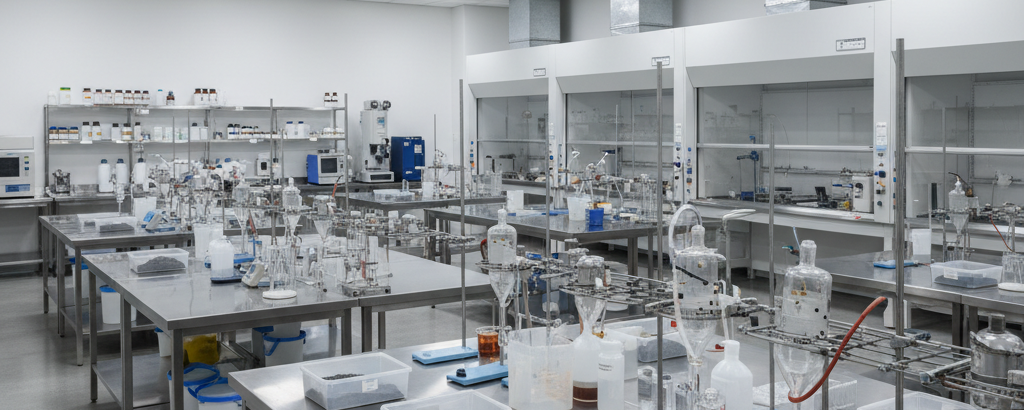
Metallurgical processing: the business case between ore and battery
Lithium exploration brings to mind drilling rigs hauling rock samples from depth. What gets less attention is what happens next: between a promising lithium discovery and an operating mine sits a step the market often overlooks, metallurgical processing. This is the work of converting lithium from ore or mineral rock into a product you can actually sell.
Newcomers may see this as a technical detail. Experienced small-cap investors recognize it differently. Metallurgical test results often decide whether a project makes economic sense. Optimized processing methods—called flowsheet optimizations—can reshape a project’s unit economics long before any feasibility study is written.
From ore to battery: what processing methods do
Lithium occurs in two main forms: as a mineral in hard rock (spodumene in pegmatites, primarily) or dissolved in salt brines under deserts and salt lakes. Processing methods vary sharply depending on deposit type.
Hard-rock projects require ore to be crushed, then treated chemically or physically to yield lithium concentrate. The flowsheet maps the entire sequence—crushing, flotation, chemical leaching, and related steps. Three numbers matter most:
- Recovery Rate: What portion of the lithium in the ore ends up in the final concentrate?
- Concentrate Quality: How pure is the product, and does it meet battery makers’ specs?
- Energy and Reagent Costs: How much does processing cost per tonne of concentrate?
A simple comparison helps. A bakery works with flour containing ten percent impurities. One baker filters out 60 percent of those impurities; another develops a new method and removes 90 percent. Both use the same flour, but the second baker gets a better product at lower cost. This is what happens in a junior company’s metallurgical lab when engineers optimize flowsheets.

Why metallurgical milestones move markets
Lithium juniors follow a set development path: initial resource estimate, then Pre-Feasibility Study (PFS), then bankable Feasibility Study (FS). Each stage needs solid data from the one before. Metallurgical test results feed directly into the PFS.
Markets reward these milestones because they shrink uncertainty. A junior without published metallurgical data trades at a risk discount—no one knows whether the resource can actually be processed profitably. Once positive results come out, that uncertainty vanishes and the stock price typically moves higher.
Think of it this way: a house with an unknown foundation sells for less than an identical house whose structural integrity an engineer has verified. The building hasn’t changed, but buyer risk has fallen, so the price rises.
The effect is sharper for small caps. Large mining companies hold diversified portfolios and can weather individual project failures. A junior with one flagship project lives or dies by each new data point. Positive metallurgical results can shift valuation noticeably in weeks.
| Development Stage | Central Question | Most Important Data Point |
|---|---|---|
| Exploration | Is there a resource? | Drilling results, resource estimate |
| Scoping Study | Does further work make sense? | Initial cost estimate, preliminary metallurgy |
| Pre-Feasibility (PFS) | Is the project economically viable? | Flowsheet optimization, recovery rate |
| Feasibility Study (FS) | Can it be built and financed? | Bankable cost and revenue models |
Limitations and risks
Optimized metallurgical results can look promising, but investors need to know the gaps. Laboratory tests run in controlled conditions and don’t always scale to an industrial plant. The jump from lab through pilot scale to full production carries real risk.
Metallurgical results also tell you nothing about infrastructure, permitting, water supply, or offtake deals. A project with excellent metallurgy in a remote area with no road access may still be uneconomical.
One more thing beginners miss: the junior company commissions these studies from external labs, but those labs still work for a paying client. The independence of the assessment—and its credibility with lenders and investors—is worth checking when evaluating announcements.
What investors should take away
Metallurgical test results matter in the real world of lithium project development. Investors who understand what a flowsheet optimization answers, and what it leaves open, evaluate company announcements far more sharply than those who watch only drilling results.
The point: project value comes not just from bigger resources, but from proving those resources convert into a marketable product at reasonable cost. Juniors that deliver this proof early can move toward financing faster. That is what separates an exploration project from a fundable mine.
Watch for these words in press releases: recovery rate, lithium concentrate specification, reagent consumption, pilot plant, flowsheet validation. They show where a project actually stands technically.
Key Terms Explained
- Flowsheet
- A schematic of all process steps needed to turn raw ore into saleable concentrate or finished product. It shows the sequence, methods, and operating conditions of the processing circuit.
- Recovery Rate
- The percentage of a metal or mineral in mined ore that actually gets recovered. Higher recovery lowers per-unit production cost and improves project returns.
- Pre-Feasibility Study (PFS)
- A preliminary feasibility study using validated technical and economic data to assess a project’s profitability. It is required before a bankable Feasibility Study can proceed.
- Bench Scale Test
- Metallurgical testing at laboratory scale with small sample volumes under controlled conditions. It gives early process signals but needs larger pilot tests to confirm before industrial use.
- Spodumene
- The main lithium-bearing mineral in hard-rock deposits. Spodumene pegmatites are rock formations with high lithium content and the starting point for many hard-rock projects.
- Concentrate Specification
- Quality requirements (purity, lithium content, impurity limits) that a lithium concentrate must meet to be accepted by processors or battery makers.
- Pilot Plant (Pilot Scale)
- An intermediate stage between laboratory testing and industrial production. A pilot plant processes larger sample volumes under realistic conditions and provides data needed to scale to full production.
⚠️ Important notice: This article is for informational and educational purposes only. It does not constitute investment advice, a recommendation, or a solicitation to buy or sell any security. Investments in small-cap exploration and mining companies carry a high risk, including the potential total loss of capital. Before making any investment decision, consult a registered financial advisor and conduct your own analysis. Boersen Post Team is not responsible for decisions taken based on the content published here.