Downstream Stages: What Refinery Concepts Mean for Lithium Juniors
June 15, 2026
Non-Brokered Placements: How Juniors Raise Equity in Tranches
June 15, 2026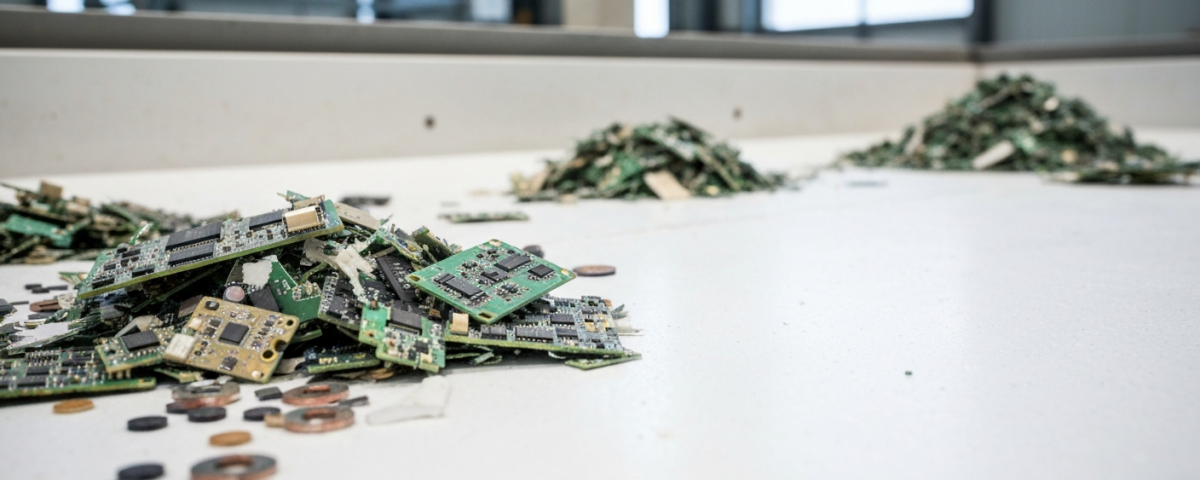
When scrap becomes a strategic commodity
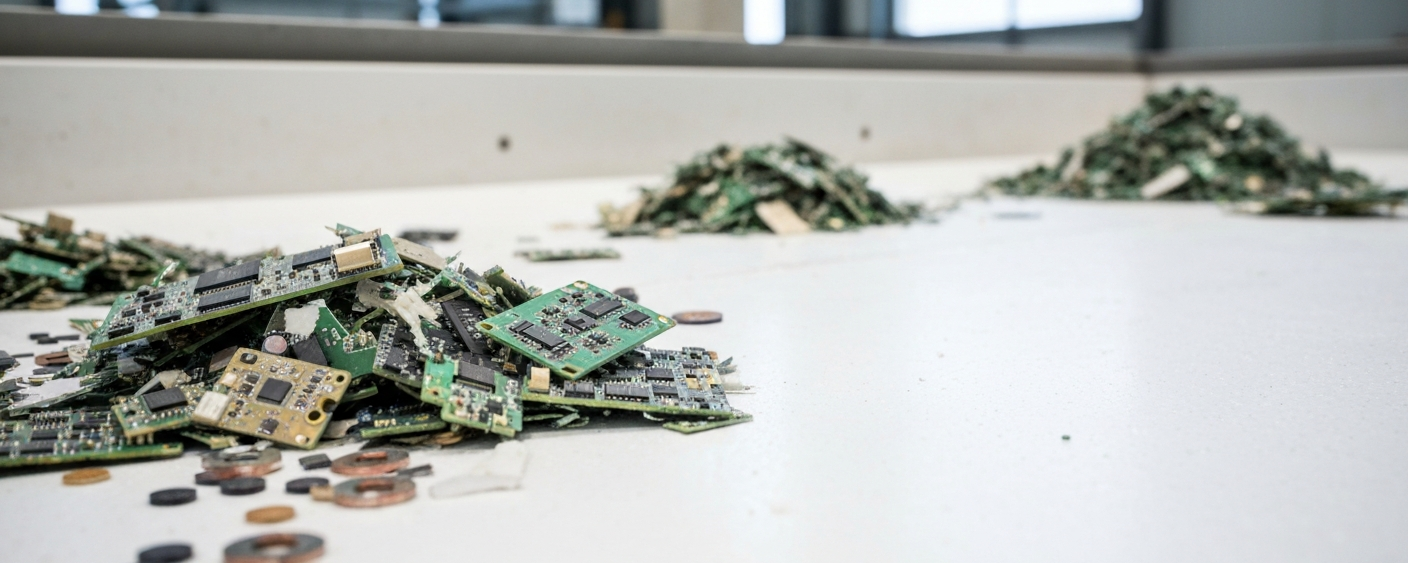
A worn-out electric motor, a container of old magnets stripped from wind turbines, a pile of broken hard drives. What looks like rubbish contains trace amounts of metals over which governments and corporations have quietly built serious dependencies. Dysprosium, a heavy rare earth element, is one of them. It gives permanent magnets their heat resistance and has no practical substitute in EV drivetrains, wind power generators, or certain defense applications.
That this metal can be recovered at rates above 93% from U.S. electronic waste using a hydrometallurgical process is not merely a technical footnote. It shows that circular economy thinking has moved beyond environmental rhetoric and into commodity strategy. For investors who track small-cap companies outside conventional mining, the mechanics behind this shift are worth understanding.
Dysprosium: demand rises, supply stays tight
China controls over 85% of global rare earths processing, according to the International Energy Agency. Dysprosium is no exception. Western governments have responded with policy instruments: the U.S. Critical Minerals Executive Order, the European Critical Raw Materials Act, and funding programs for domestic processing capacity.
Meanwhile, demand is climbing. The global permanent magnet market is expanding alongside electric mobility and wind energy, and dysprosium appears in nearly all of these magnets. The supply problem differs from a chip shortage in one important respect: lead times for rare earths are longer and workarounds are scarcer. When a bottleneck develops, it tends to persist.
This is where companies focused on secondary raw material sources become relevant. The United States generates roughly 6.9 million metric tons of electronic waste each year, and a meaningful portion of it contains permanent magnets from electric motors, hard drives, and speakers. Most of these magnets still end up in landfills or get shipped to low-wage countries for informal processing. That is beginning to change as recovery technologies reach economic viability.

How process validation moves valuations
The path from a laboratory proof-of-concept to a financeable technology follows a recognizable logic in the commodities sector. In recycling, the milestones just carry different names. Rather than NI 43-101 resource estimates and scoping studies, the key document is a Techno-Economic Assessment (TEA): a study that models process costs, throughput rates, and margins under realistic operating conditions.
A preliminary-level TEA occupies roughly the same position on the capital market timeline as a PEA does in mining. It gives investors the first concrete numbers on capital expenditure, operating costs, and potential margins. Companies that reach this milestone with credible figures become accessible to institutional investors who previously had no adequate data to work with.
The underlying chemistry is well established. Hydrometallurgical processes, in which metals are dissolved from a solid feedstock and then selectively precipitated, have been used in mining for decades. The real question here is selectivity: how cleanly does the process separate dysprosium from the other rare earths present, and at what chemical cost? A recovery rate above 93% for dysprosium, alongside rates above 96% for neodymium and praseodymium from the same feedstock, is technically strong and gives a cost model something solid to rest on.
| Process Step | Relevance to Economic Viability |
|---|---|
| Feedstock Sourcing (E-Waste) | Dependent on collection infrastructure and regulatory framework |
| Mechanical Pre-Processing | Determines quality and homogeneity of input material |
| Hydrometallurgical Dissolution | Core step: selectivity and chemical input determine OpEx |
| Selective Precipitation / Separation | Purity of end product influences achievable market prices |
| Wastewater and Residue Treatment | Regulatory requirements; ESG-relevant cost factor |
What this means for small-cap investors
Companies with proprietary recycling processes for critical metals operate in a regulatory environment that broadly favors them right now. But the risks differ from those of a classic junior explorer, and it is worth being precise about that.
The most direct risk is process scale-up. A junior explorer worries that additional drilling will downgrade the resource estimate. For a recycling company, the equivalent question is whether the process holds up at industrial throughput as reliably as it does in the lab. Scale-up losses are a known problem in hydrometallurgy and can only be demonstrated through pilot plant operation, not laboratory reports.
Feedstock security is a separate issue, and often underestimated. No process generates value without a secured supply of input material. The ability to sign long-term supply agreements with e-waste collectors or electric motor manufacturers matters to valuation in the same way offtake agreements do in conventional mining.
The regulatory picture cuts both ways. The U.S. and EU are actively funding domestic capacity for critical metal recovery, and companies that meet environmental requirements for wet-chemical processing can access grants and government offtake guarantees. That is a concrete advantage over conventional mine investments. At the same time, those environmental standards are strict, and compliance is not cheap.
Five years ago, lithium recycling was a niche. Today those companies are embedded in battery supply chains. Rare earth recycling is moving in the same direction, but it is considerably earlier in that process.
The circular economy as an investment thesis
High recovery rates from real-world electronic waste are a meaningful result. But between a validated lab process and a commercially profitable facility lie substantial technical and financial hurdles. Moving a TEA to pre-feasibility level narrows the uncertainty range and improves a company’s capital market readiness, which is why that milestone matters to analysts watching this space.
When evaluating companies of this type, the questions worth asking are whether published process parameters have been confirmed by independent parties, whether feedstock access is concretely arranged rather than assumed, and whether management has verifiable industrial experience. Without those elements, the investment case rests on a technology story without much underneath it.
Key terms at a glance
- Dysprosium (Dy)
- A heavy rare earth element that gives permanent magnets their heat resistance. Has no practical substitute in electric vehicle motors and wind power generators. Over 85% of global processing takes place in China.
- Hydrometallurgy
- A wet-chemical process for metal recovery: metals are dissolved from a solid (e.g., ground electronic waste) into an aqueous solution and then selectively precipitated or extracted.
- E-waste (electronic waste)
- Discarded electrical and electronic equipment. In addition to base metals such as copper, it contains precious metals and critical materials including rare earths, sometimes in concentrated form.
- Techno-Economic Assessment (TEA)
- A study linking technical process parameters (recovery rate, throughput) with economic metrics (CapEx, OpEx, margins). In the recycling sector, it is the counterpart to a scoping study or PEA in mining.
- Pre-Feasibility Study (PFS)
- A more detailed economic viability study with a higher level of specificity than a preliminary assessment. Forms the basis for investment decisions and institutional capital.
- Feedstock
- The input material for a processing operation. In e-waste recycling, this includes permanent magnets from electric motors or hard drives. Secured feedstock supply is a central valuation criterion.
- Circular economy
- An economic model that keeps materials in use as long as possible. In the commodities context, this means recovering critical metals from end-of-life products rather than relying solely on primary extraction.
- Recovery rate
- The percentage of a metal actually recovered from the input material. Rates above 90% indicate strong process efficiency and improve the economics of a commercial facility.
⚠️ Important notice: This article is for informational and educational purposes only. It does not constitute investment advice, a recommendation, or a solicitation to buy or sell any security. Investments in small-cap exploration and mining companies carry a high risk, including the potential total loss of capital. Before making any investment decision, consult a registered financial advisor and conduct your own analysis. Boersen Post Team is not responsible for decisions taken based on the content published here.