Marine SMR Reactors: Why Radiation-Hardened Chips Are the Key Component
June 17, 2026
Brokered Placement Explained: How Uranium Juniors Structure Capital
June 18, 2026
The invisible foundation of the AI age
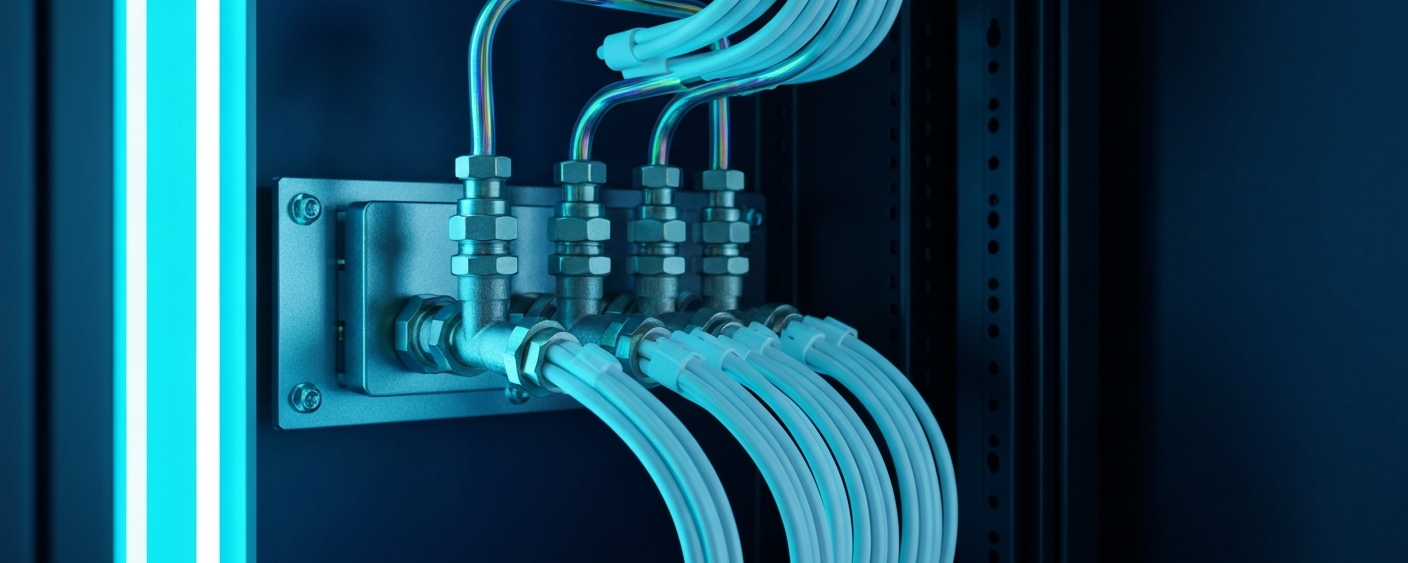
When people think about the artificial intelligence boom, they think of Nvidia or Microsoft, companies worth trillions. Yet behind every language model and every real-time data analysis lies a physical infrastructure made up of thousands of individual components: server racks, cooling systems, specialized materials. That infrastructure is not built by mega-caps alone. It comes from a sprawling network of suppliers, and this is where Australian small caps listed on the ASX are increasingly appearing, largely unnoticed by institutional investors so far.
The core idea for beginners: growth trends like the AI boom create winners not only at the surface level but all along the supply chain, often with more interesting economics in the less-watched segments. Learning to read these structures is what this article is about.
How semiconductor supply chains actually work
The semiconductor industry splits broadly into several layers: chip design, wafer manufacturing, materials supply (specialty chemicals, noble gases, substrate materials), and application infrastructure such as data centers, cooling, and power. The top layer, designing large chips, is dominated by a handful of global players. Further down, the environment becomes increasingly fragmented.
There is a well-worn analogy from the California Gold Rush: it was not only the gold miners who made money, but the people selling shovels and jeans. For the AI boom, that means the most reliable growth stories may not lie with AI model providers at all, but potentially with companies developing specialized cooling technology for high-performance data centers, building EDA software (Electronic Design Automation) for chip engineers, or supplying cleanroom-compatible materials.
Australian small caps on the ASX have traditionally had strong roots in commodities. In recent years, though, a second wave has formed: small and mid-sized technology companies positioning themselves as suppliers of digital infrastructure, through specialized cooling technologies for densely packed GPU servers, proprietary software for data center management, or materials for advanced chip packaging.

Why small niche providers sometimes benefit more than the big players in a boom
The reasons are concrete and come from market structure.
Oligopolistic niches with high switching barriers: When a company is the sole or one of very few sources for a critical component, pricing power follows. In the semiconductor space, this applies to certain process gases such as neon or krypton for EUV lithography, or to highly specialized substrates. An ASX small cap occupying such a niche can hold a stable margin structure despite its small size.
Valuation gap relative to mega-caps: Nvidia or TSMC trade at revenue multiples that already price in a great deal of growth. Smaller suppliers further down the chain often trade at a significant discount, simply because they have less analyst coverage and appear too small for institutional capital. One important point for beginners: this discount can narrow when the company comes into focus, but there is no guarantee it will.
Lower dependence on the model competition: A company selling cooling systems for data centers does not depend on which AI model wins out. The infrastructure gets built regardless. That changes the risk calculation for such a provider compared to a pure AI platform bet, without eliminating risk entirely.
| Supplier type | Example niche | Dependence on AI model competition |
|---|---|---|
| Cooling system provider | Liquid cooling for GPU clusters | Low (all models require cooling) |
| EDA tool provider | Software for chip design | Medium (chip design is rising broadly) |
| Materials supplier | Cleanroom chemicals, specialty substrates | Low to medium |
| Data center management | Energy and process monitoring | Low (applies to all data centers) |
What investors should watch when looking at ASX technology small caps
The appeal of niche providers in the AI environment is real, but their risk profile differs from that of classic junior miners, and a few dimensions deserve closer attention.
Scalability of the business model: Technology suppliers split broadly into two types: hardware-driven (revenue per unit sold, cyclical) and software- or IP-driven (recurring license revenues, more scalable). This distinction matters a great deal for valuation. A company with Software-as-a-Service components typically trades at a higher multiple than a pure hardware supplier of the same size.
Customer base and concentration risk: For small suppliers, reliance on a few large customers is common. If a single hyperscaler accounts for 60 percent of an ASX small cap’s revenue, the company’s fortunes are heavily tied to that one partner’s purchasing decisions. That can mean rapid growth, but also an abrupt decline.
Liquidity on the ASX: The Australian Securities Exchange has a well-developed small-cap culture, but for micro-caps below AUD 50 million in market capitalization, daily trading volume is often low. Price swings can be disproportionate in both directions, and retail and institutional investors alike have to account for that.
Specialty chemicals providers for the battery industry often stayed under the radar despite the lithium boom, yet held stable margin structures throughout. Semiconductor suppliers on the ASX can play a similar role. The key question is not just whether the market is growing, but who in the supply chain actually benefits when volumes land, and who was only along for the ride.
Infrastructure as an investment thesis
Data center capacity is growing worldwide, AI workloads are rising, and thermal management has become a real constraint on how densely operators can pack compute. The demand for specialized solutions along this chain is not short-term, regardless of which AI platform dominates next year.
Whether individual ASX small caps benefit depends on very specific factors: technological edge, customer access, management quality, use of capital. Sitting in a growing niche does not protect against company-specific mistakes. For beginners, understanding supply chain structure is a useful starting point. It shows where to look. It does not do the stock picking for you.
These providers barely appear in mainstream media because they are small and unspectacular. That tends to keep their valuations behind actual demand. Whether any specific company closes that gap is a separate question, and one worth asking before taking a position, not after.
Key terms for getting started
- Enabler
- A company that helps other companies deliver their core output without being the end product itself. In the AI context: suppliers of cooling systems, materials, or software tools for data centers.
- EDA (Electronic Design Automation)
- Software tools that help chip engineers design integrated circuits. EDA providers are central to any chip development effort but benefit indirectly from the broader semiconductor boom.
- Hyperscaler
- Large-scale cloud infrastructure operators such as Amazon Web Services, Google Cloud, or Microsoft Azure. These companies run thousands of data centers and are the primary customers for data center suppliers.
- Market capitalization (market cap)
- The total value of all outstanding shares of a company (share price multiplied by number of shares). Small caps typically fall below AUD 300 million; micro-caps below AUD 50 million.
- Valuation multiple
- The ratio between a company metric (revenue or EBITDA, for example) and its market capitalization. A price-to-sales ratio of 10 means the market pays $10 for every $1 of annual revenue. The higher the multiple, the more future growth the price already reflects.
- Oligopolistic niche
- A market segment with very few providers, which tends to produce high switching barriers and strong pricing power. Common in specialty chemicals and highly specific chip components.
- Liquidity (stock trading)
- A measure of how easily a stock can be bought or sold without moving its price significantly. For ASX micro-caps, daily trading volume is often low, which can amplify price swings in either direction.
- Supply chain
- All stages of production and distribution, from raw material to finished product. In the semiconductor industry, this runs from materials extraction through chip design, manufacturing, packaging, and system integration.
⚠️ Important notice: This article is for informational and educational purposes only. It does not constitute investment advice, a recommendation, or a solicitation to buy or sell any security. Investments in small-cap exploration and mining companies carry a high risk, including the potential total loss of capital. Before making any investment decision, consult a registered financial advisor and conduct your own analysis. Boersen Post Team is not responsible for decisions taken based on the content published here.