From Explorer to Producer: The Critical Transition for Silver Juniors
July 27, 2026
Staged Development: How Uranium Developers Manage Capex Risk
July 29, 2026
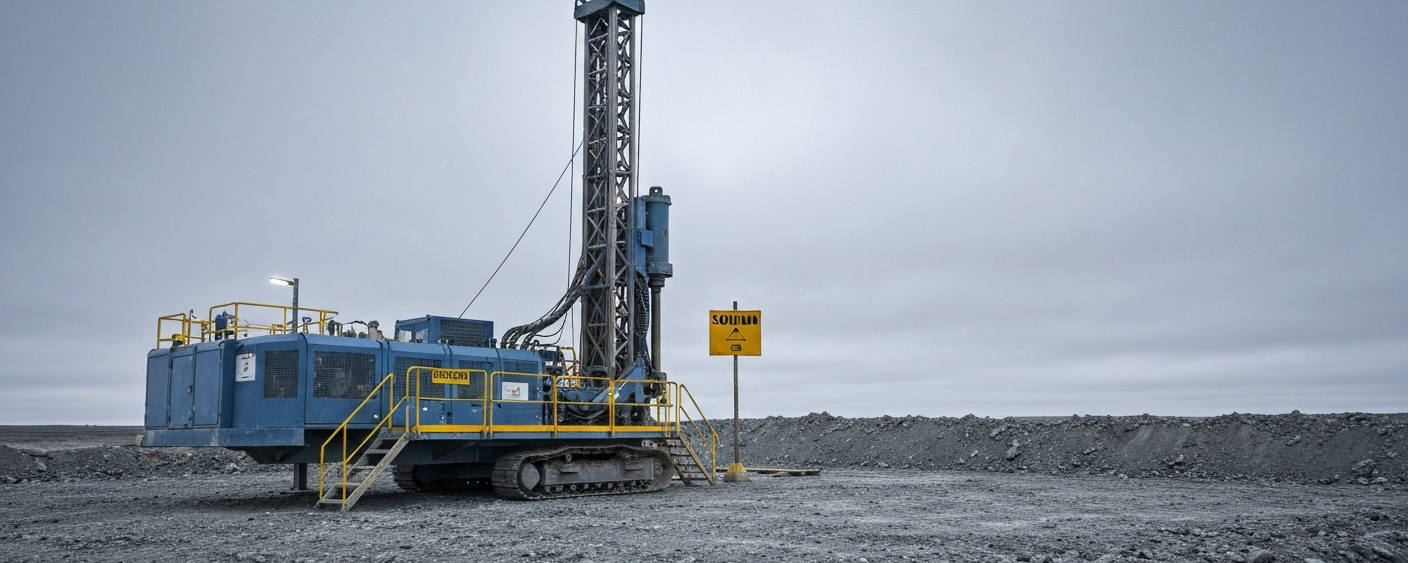
When the paper becomes the drill
In uranium exploration, there is a moment that never shows up on any balance sheet but that experienced investors watch for anyway: the day a junior explorer receives its official drill permit. Several companies have hit this point in recent days. One has secured permits for what will be a first-ever drilling program on its U.S. ground; another has started a confirmation program in an established uranium belt; a third has pushed a known uranium structure onto newly accessible ground roughly 600 meters to the south. None of these companies were named in the announcements we reviewed.
These notices tend to read as dry and technical. But if you want to understand how value is built in early-stage exploration, it is worth looking at what a drill permitting process actually involves, and why a permit can shift market attention before a single result exists.
Regulatory risk before the first meter
Before a junior drills anything, it has to work through multiple permitting processes at once. In most uranium jurisdictions that means dealing with environmental agencies, mining regulators, and land-use authorities in parallel — and in some locations, formal indigenous consultation adds time that cannot be compressed. Canada, Australia, and the United States each run their own versions of this process, and none move quickly.
A junior holding a current drill permit has already spent months — sometimes considerably longer — on that administrative groundwork. It has demonstrated that the program meets environmental requirements, that the geological targets are clearly defined, and that the company can run the operation safely.
The closest analogy is a building permit. An architect can produce detailed drawings, but without planning approval the project stays on paper. Exploration works the same way: the permit is what lets the geological thesis meet actual ground.

Confirmation drilling vs. inaugural drilling
Not every drilling campaign is chasing the same thing, and the distinction matters when you are trying to read risk. Three types are worth separating out:
| Type | Objective | Risk profile |
|---|---|---|
| Inaugural drill | Test a geological hypothesis for the first time | Higher — no historical drill data |
| Confirmation drilling | Verify earlier results, refine the resource | Lower — historical anomalies are known |
| Step-out drilling | Extend a known mineralization into adjacent ground | Medium — geological trend known, geometry uncertain |
A confirmation program — where an explorer re-drills historical intersections with modern methods — tends to produce usable data relatively fast. The question is not whether something is there, but whether the old assay results hold up under fresh scrutiny and whether the data meet the current standard for a resource estimate. In Canada, that standard is NI 43-101.
A structural extension onto newly accessible ground, as with the Australian uranium project being pushed roughly 600 meters to the south, follows a different logic. The geological trend is known; what remains open is whether it continues past the previously drilled area. The answer depends heavily on how the geology has been interpreted and how reliable the preliminary geophysical data are.
Why the market reacts to permits
For investors new to junior mining, it can be puzzling why a permit announcement — no drill results attached — generates any trading activity at all. The short answer is that the permit removes one category of uncertainty and also shows the company has cleared administrative and regulatory hurdles that many projects never get past. Beyond that, an active drilling program means there is a timeline: first assay results should arrive within weeks, and the market starts pricing in possible outcomes before they do.
Those are expectations, not facts. Results are still weeks away at minimum, and that is the nature of early-stage exploration. Good drill results can change a project’s value sharply; poor ones can do the same in the other direction. The permit itself guarantees neither.
Where the permit fits in the sequence
A drill permit is a real step forward, but one step in a long chain. Before it come prospecting, geophysical surveys, and the review of historical data. After it come the drilling itself, laboratory assaying of core samples, geological interpretation, and — if results justify it — a formal resource estimate. Most projects never reach that last stage.
The current run of permit announcements in the uranium sector is tied directly to the recovery in uranium prices. Many juniors had permitting processes that sat idle through the long bear market. With capital now available, those projects are moving again. Whether the ground delivers will only be known once the assay results are in hand.
Key terms at a glance
- Drill permit
- An official regulatory authorization allowing an exploration company to drill at a defined location. Without it, no drilling program can legally begin.
- Confirmation drilling
- A drilling program designed to verify historical results using modern methods, often as a step toward a resource estimate that complies with NI 43-101.
- Step-out drilling
- A drilling strategy aimed at extending a known mineralization beyond its current boundaries. The goal is resource growth rather than a new discovery.
- Regulatory risk
- The uncertainty over whether a project will receive all necessary permits to advance. One of the central risks in early-stage exploration, and one that a granted permit resolves.
- NI 43-101
- The Canadian regulatory standard for public disclosure on mineral projects. It draws a strict line between resources (geological estimate) and reserves (economically confirmed extractable quantities).
- Assaying
- Laboratory analysis of drill core samples to determine the grade of target minerals. Assay results are the basis of any resource evaluation.
- Newsflow catalyst
- An announcement or event that opens a predictable window of new information — for example, upcoming drill results. Can increase trading volume before any actual result is published.
⚠️ Important notice: This article is for informational and educational purposes only. It does not constitute investment advice, a recommendation, or a solicitation to buy or sell any security. Investments in small-cap exploration and mining companies carry a high risk, including the potential total loss of capital. Before making any investment decision, consult a registered financial advisor and conduct your own analysis. Boersen Post Team is not responsible for decisions taken based on the content published here.