Understanding Antimony: When a Metal Becomes a Strategic Question
August 31, 2026
From 3D Model to Drill Permit: Geological Target Generation at Copper Juniors
September 1, 2026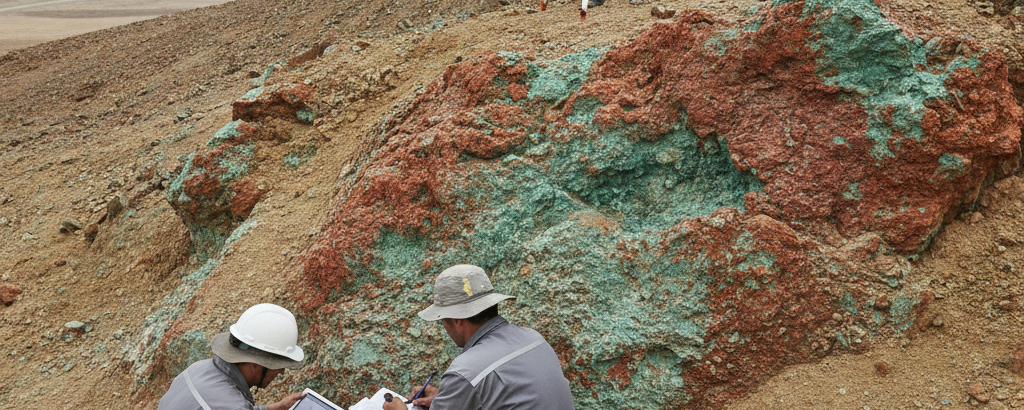
When data comes before the resource
There is a moment in commodity exploration that regularly puts investors under pressure: a junior company publishes its first exploration data, but no formal resource under JORC or NI 43-101 yet exists. The share price moves anyway. Several copper juniors are currently at exactly this stage, using different methods in different parts of the world: deep drilling in VMS systems in one place, surface mapping with rock sampling in another.
Both approaches pursue the same goal: to define the extent and quality of a copper mineralization as precisely as possible. But they start from completely different points of departure. Anyone who wants to understand how such early data influences the market value of a junior company must first grasp the mechanics of these methods.
VMS deposits and outcrop samples: what lies behind them?
A Volcanogenic Massive Sulphide (VMS) system is an ore deposit formed by hydrothermal processes on ancient seafloors. Hot, mineral-rich fluids vented from the earth’s interior, cooled, and precipitated sulphide minerals — sulphur-bearing compounds of copper, zinc, and lead, often with gold — packed into compact ore lenses. VMS systems are attractive exploration targets because they can concentrate high metal grades within a comparatively small area.
Exploring a VMS system at depth requires a drilling program. Drill cores are extracted, chemically analyzed, and the results are fed into geological models. For evaluation purposes, what matters is not only the copper or gold grade, but also the spatial extent of the mineralized zone: whether the mineralization remains open to the east, west, or at depth.
A different approach is outcrop mapping: geologists examine rock surfaces that have been naturally exposed by erosion, river courses, or mountain formations. When massive sulphides appear at surface and can be traced over hundreds of meters, this suggests the mineralization continues at depth. Samples from these outcrops allow initial quality assessments — for example copper grades that can significantly exceed the industrial average in individual samples.
Why early data moves markets, and why that is risky
As long as it remains unclear whether a project has economic potential, junior shares are priced accordingly low. Once initial assay results or mapping data send positive signals, the horizon of expectations can shift rapidly.
Something similar played out across West African projects in the early 2000s, when high-grade drilling results pushed certain junior shares sharply higher before any resource estimate existed. A comparable dynamic is running through the copper sector now, with electricity demand from grid expansion outpacing the supply of new, developable projects.
The risk is real: early exploration data are selective. Companies typically publish their best results first, which can distort the overall picture. Individual high-grade samples or drill intercepts often bear little resemblance to what an entire project might deliver. A mineralization that appears at surface over 200 meters says little about how deep or continuous it is below ground.
Geological context therefore matters more than any individual data point: what structure hosts the project? Are there comparable deposits in the region? Does the deposit type match known, economically mineable systems? Without those questions answered, an investor is essentially buying a press release.
| Exploration Method | Strengths | Limitations |
|---|---|---|
| VMS Drilling Program | Depth extent quantifiable, resource base can be built up | High cost, time-intensive, results are selective |
| Outcrop Mapping & Assays | Rapid initial assessment, cost-effective, reveals near-surface structures | Limited representativeness, no indication of depth |
What this means for small-cap investors
The volume of exploration announcements in the copper sector right now is not accidental. Junior companies time their communications to capital market needs: assay releases accompany planned capital raises or are meant to keep existing shareholders engaged. This is legitimate, but it calls for sober assessment.
Before making an investment decision, it is worth asking at least two questions that go beyond the published numbers. Were all drill holes and samples reported, or only selected highlights? Is the mineralization open in multiple directions, or do structural limits already constrain how far the resource can grow? There is also a factor that tends to get underestimated at early stages: management quality. Experienced geologists with a coherent exploration plan can matter more than a single high-grade intercept.
Jurisdiction counts too. Projects in politically stable countries with established mining law operate under very different conditions than those in regions with regulatory or geopolitical uncertainty. That does not show up in an assay result, yet it can be the deciding factor in whether a project ever gets built.
Getting from initial assay data to a bankable resource estimate takes years and substantial capital. The odds are not favorable. Early exploration data show what might be there — nothing about what will be.
Key terms for beginners
- VMS Deposit (Volcanogenic Massive Sulphide)
- An ore deposit formed by hydrothermal processes on ancient seafloors. Characterized by dense accumulations of sulphide minerals such as copper, zinc, lead, and gold in a compact form.
- Assay
- A chemical analysis of a rock or drill core sample to determine its metal content. Results are typically reported in percent (%) or grams per tonne (g/t).
- Outcrop
- Naturally exposed rock at the earth’s surface that provides geological information about the structure and mineralization in the subsurface.
- Inferred Resource
- The lowest confidence category of a mineral resource under JORC or NI 43-101. It is based on limited data and must not be equated with a reserve, which requires a higher level of certainty.
- Strike
- The horizontal extent of a geological structure or mineralized zone along its length. An important measure of the potential size of a deposit.
- Massive Sulphide
- A rock type with a very high proportion of sulphide minerals (above 50%), indicating intense hydrothermal mineralization and frequently containing high metal grades.
- Drill-Ready Status
- An exploration status in which a target area has been sufficiently prepared through prior mapping, geophysics, or sampling to justify launching a drilling program.
⚠️ Important notice: This article is for informational and educational purposes only. It does not constitute investment advice, a recommendation, or a solicitation to buy or sell any security. Investments in small-cap exploration and mining companies carry a high risk, including the potential total loss of capital. Before making any investment decision, consult a registered financial advisor and conduct your own analysis. Boersen Post Team is not responsible for decisions taken based on the content published here.