Copper Junior Resource Categories: What Indicated Really Means
October 7, 2026
Polymetallic Deposits: When One Project Carries Multiple Metals
October 7, 2026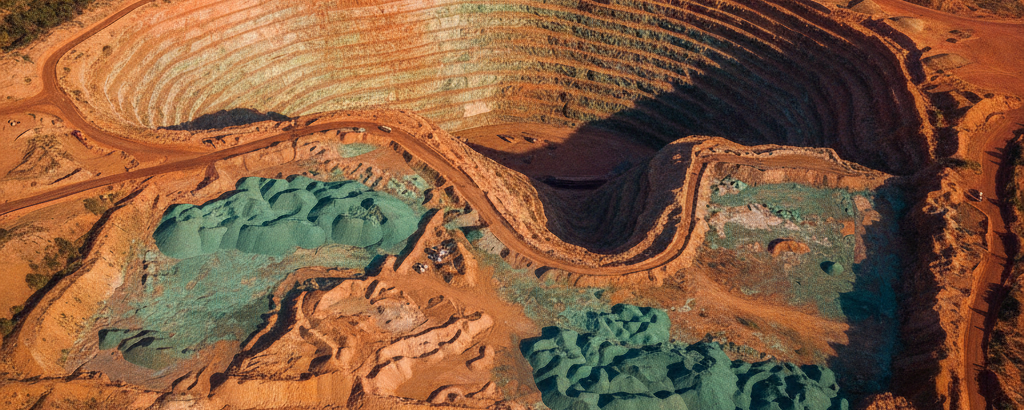
When a mining region suddenly comes back into focus
In junior exploration, there are periods when announcements multiply — not from a single company, but from several, all drilling in the same region at once. This is rarely coincidence. It follows a logic worth understanding before capital starts moving.
Australia’s Murchison District in Western Australia is a working example. Long associated with gold, it is now drawing attention in the copper sector. Several ASX-listed explorers have published drilling results in quick succession, each pointing to copper-bearing structures. The pattern — many companies, one region, overlapping activity — is known in the industry as the district effect.
Geological advantage and economic gravity
Why do explorers cluster in the same region? The answer starts with geology. Mineral deposits don’t form evenly across the Earth’s crust; they occur in metallogenetic belts, geological zones where tectonic and hydrothermal processes have concentrated ore minerals. When a company finds a deposit within such a belt, it implicitly signals something about the surrounding area.
Market dynamics reinforce this. When an explorer reports a strong drill hit, investors and geologists go looking for adjacent ground. Land prices rise. Neighboring companies see their share prices move. Additional drilling programs get permitted. This mechanism repeats across commodity cycles, which makes it worth watching for before the majority of players have already positioned themselves.
A useful historical reference: when several uranium explorers in Canada’s Athabasca Basin reported high-grade hits within a few months of each other, share prices rose across virtually every company holding ground in the region — including those that hadn’t turned a drill yet. The market was pricing in district validation before individual companies had produced their own data.
How the market prices in district validation
The dynamics tend to move through recognizable phases, though in practice they overlap and rarely arrive on schedule.
It starts with an anchor discovery: an explorer reports strong results — high metal concentration or a mineralized zone far thicker than earlier estimates suggested. This first hit sets the benchmark against which everything else in the district gets measured.
Investors who find the anchor credible then go looking for additional exposure in the same area, ideally before neighboring companies publish their own results. This buying drives share prices up even before a single drill hole at an adjacent property has been completed.
When neighboring programs do return results, the market sorts quickly. Companies with positive data can hold their gains. Those with disappointing results often fall harder than the initial run-up would suggest, because valuations had already moved well ahead of the evidence.
| Phase | Market reaction | Risk for investors |
|---|---|---|
| Anchor discovery | Strong price surge at the first mover | Entering after the announcement is often expensive |
| Anticipatory buying | Broad price appreciation across the cluster | Higher valuations without supporting data |
| Confirmation / disillusionment | Differentiation between winners and losers | Sharp correction risk when results disappoint |
What to look at before buying into a cluster district
The district effect gives you a useful frame for reading market moves. It does not do the stock selection for you.
Start with the ground itself. Does the company hold acreage that is geologically comparable to the anchor discovery, or are these more distant, less favorably positioned blocks? Property maps and geological reports filed with the exchange are a reasonable starting point.
Then look at the financing position. Can the company fund its own drilling from existing cash? Without enough working capital, an explorer may catch a short-term lift from district sentiment but never produce its own validated results — and without those results, share-price gains tend not to hold.
It’s also worth reading the technical report carefully, particularly the resource categories. Inferred resources, the least confident category, are not the same as proven reserves that could be used in a feasibility study. JORC-compliant reports disclose this distinction explicitly. It is regularly ignored.
Timing matters too, and district cycles can be short. The copper boom patterns seen in parts of South America, or the Pilbara lithium period, both showed how quickly euphoria gives way to a consolidation phase — often faster than even skeptical observers had expected.
District logic as an analytical frame
The district effect runs on a combination of geological correlation and market psychology. It explains why news from one project so often moves the prices of neighboring companies, and it shows how an entire district can trade as a loosely connected unit rather than as a collection of independent stocks.
When reading a district situation, the questions that actually matter are: which company in the cluster has ground closest to the anchor? Who has the cash to drill without raising more equity first? How does the geology actually compare? The volume of coverage a district receives answers none of these.
Key terms
- District effect
- The phenomenon whereby positive exploration results in one area simultaneously influence the market value of neighboring companies, driven by geological correlation and capital moving into the region ahead of individual company results.
- District anchor
- The first material discovery in a district, which becomes the valuation reference point for adjacent projects and draws capital into the region.
- Metallogenetic belt
- A geological zone with an elevated concentration of specific mineral deposits, formed through tectonic and hydrothermal processes over geological timescales.
- Inferred resource
- The least assured resource category under NI 43-101 and JORC: mineral quantities estimated with limited confidence from sparse drill data. Not interchangeable with reserves.
- Working capital
- The short-term operating cash available to a company. For exploration companies, which typically generate no revenue, this determines whether they can fund a drilling program at all.
- Cluster (stock cluster)
- A group of companies holding geographically adjacent ground within a district, exposed to similar geological and market impulses.
- JORC Code
- The Australian standard for reporting mineral resources and reserves (Joint Ore Reserves Committee). Like Canada’s NI 43-101, it distinguishes between resources (inferred, indicated, measured) and reserves (probable, proven).
⚠️ Important notice: This article is for informational and educational purposes only. It does not constitute investment advice, a recommendation, or a solicitation to buy or sell any security. Investments in small-cap exploration and mining companies carry a high risk, including the potential total loss of capital. Before making any investment decision, consult a registered financial advisor and conduct your own analysis. Boersen Post Team is not responsible for decisions taken based on the content published here.