Antimony & Tungsten: How Defense Demand Revalues Exploration Projects
June 8, 2026
ISR Method: How Infill Drilling Adds Value to Uranium Projects
June 8, 2026

Replanning mid-campaign — an unusual signal
Geologists working in exploration have a saying: “The program follows the drill core.” The logic is straightforward. The best decisions happen in the field, not in conference rooms. When a junior company expands its drilling program mid-campaign by a significant margin, that is not a planning error. It is a signal.
Across the Athabasca Basin in Saskatchewan and uranium regions of Wyoming, several junior explorers have raised their meter targets. Some have increased them by more than a third. The question for investors is simple: why spend more when capital is tight? And what does that reveal about the project?
Exploration programs and drilling costs in the uranium basin
The Athabasca Basin in northern Saskatchewan ranks among the world’s highest-grade uranium regions. Its geological structures—deep fault zones, hydrothermal alteration corridors, complex unconformity zones—are both valuable and hard to access. Diamond core drilling in this terrain costs two or three times what it costs in shallower jurisdictions. Expanding a program from 4,000 to 5,500 meters is a serious commitment for a company with limited funds.
Such expansion requires either available cash, fresh capital from a private placement, or both. When that happens alongside increased drilling activity, it follows a recognizable pattern: management sees sufficient merit to invest more, and investors are willing to back that decision.
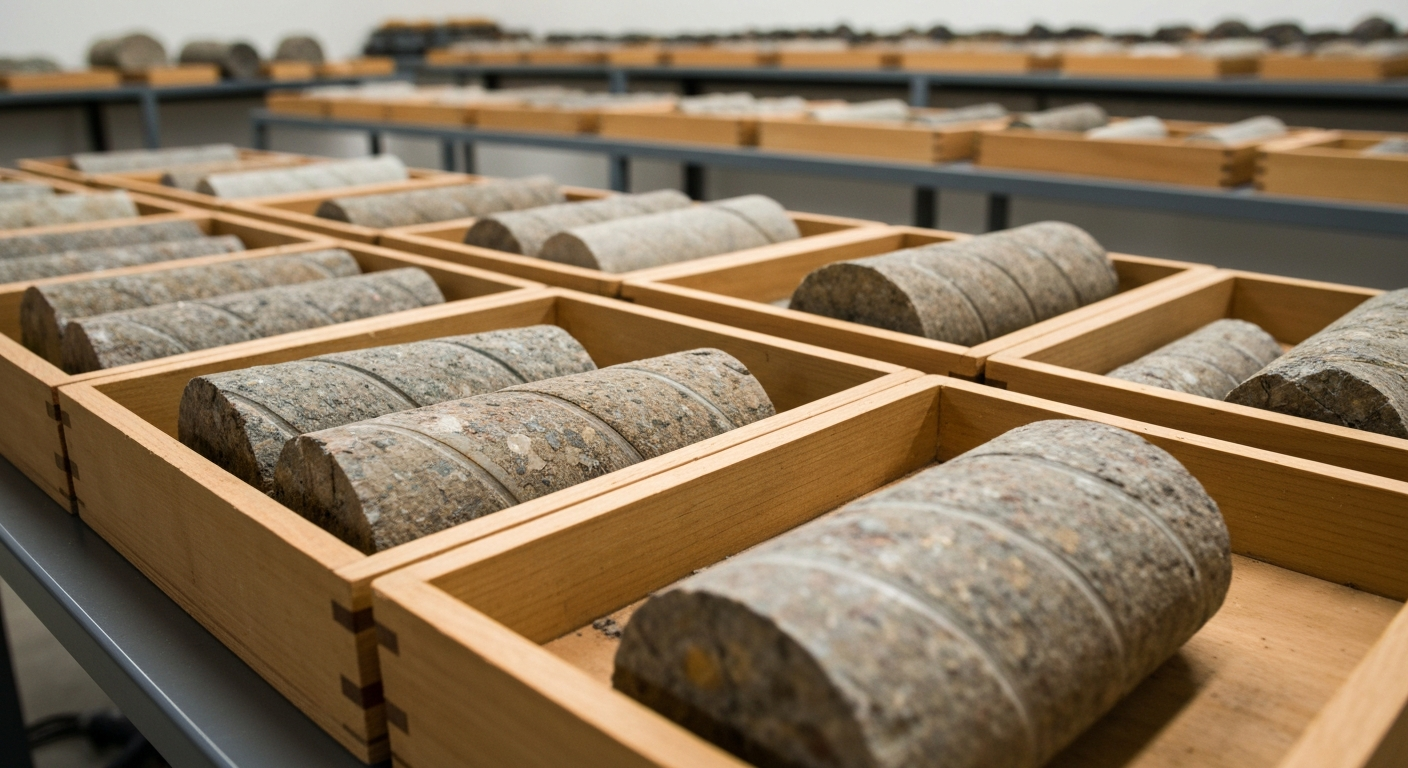
From indicator to resource: how drilling results accumulate
Understanding the phases of exploration knowledge is essential, particularly under Canadian mining regulations.
The Canadian standard NI 43-101 sets out a hierarchy. Geologists begin with a mineral anomaly or target. Once drilling provides enough data, a Mineral Resource emerges—divided into three tiers: Inferred, Indicated, and Measured. The step after that, a Mineral Reserve (Probable or Proven), requires extensive additional data and economic work, since it represents ore that can actually be mined.
When a company drills infill holes (placed between known intercepts) to confirm that mineralization is continuous, this matters for resource classification. Infill results help upgrade Inferred Resources into Indicated or Measured categories, improving confidence in the estimate. A simple comparison: you can spot a city on a map (Inferred) or study its road network, building permits, and utility systems (Measured). Infill drilling does the latter work.
| Phase in the knowledge-building process | Geological basis | NI 43-101 category |
|---|---|---|
| First anomaly, target definition | Geophysics, geochemistry, historical data | No formal status |
| Initial drill intercepts, alteration present | Few drill holes, structural indications | No formal status or early Inferred |
| Consistent mineralization established | Multiple consistent drill holes | Inferred Resource |
| Infill drilling confirms continuity | Close-spaced drill grid | Indicated or Measured Resource |
| Economic study completed | PEA, PFS, or FS available | Mineral Reserve (Probable or Proven) |
The Powder River Basin in Wyoming operates under different conditions. Most projects there use ISR (in-situ recovery), where uranium is leached underground rather than mined conventionally. This approach tends to be cheaper and easier to permit. When infill drilling delivers strong results, those feed into updated resource estimates that increase the proportion of Indicated Resources and signal project maturity.
What program expansions mean for small-cap investors
For investors tracking junior mining stocks, these moves deserve attention across several angles.
Management confidence as a soft signal: When a company commits more money to its drilling, it shows management believes in the geology. This “soft signal” cannot be quantified but hints at internal assessments. That confidence can prove wrong. Exploration remains probabilistic by nature.
Dilution from capital raises: Expansions require funding, usually through private placements that issue new shares. Existing shareholders see their percentage ownership diluted. Whether that trade-off makes sense depends on how quickly the drilling creates value.
Timeline implications: A mid-campaign expansion delays the next resource estimate or economic study. Patient, long-term investors may shrug. Those seeking near-term catalysts need to adjust their expectations.
Price swings in small caps: Junior mining stocks move sharply on news. Program expansions can trigger outsized gains or losses depending on market mood and uranium spot prices. Small-cap uranium plays track the commodity closely, and positive exploration news can amplify price reactions.
Patience, data, and the long game
Program expansions in the Athabasca Basin or Wyoming are neither guarantees of discovery nor empty marketing. They fit into the methodical work of moving exploration projects forward. Each phase demands data, and data demands drilling.
For newcomers to the space, the key point is this: progress in exploration seldom looks dramatic. It lives in technical details—drill core descriptions, alteration patterns, resource category upgrades. Understanding these signals reveals where a junior company sits in its project cycle and which announcements carry real weight.
The Athabasca Basin is a significant region for uranium supply. Demand from nuclear power expansion in several countries has drawn investor interest to exploration news from the area. Whether that interest sustains depends on consistent drilling results and advancing project data over time, not any single announcement.
Key terms around drilling programs and resources
- Infill drilling
- A drill hole placed between known drill holes to confirm that mineralization is continuous and to upgrade the resource category.
- Inferred resource
- The lowest category of mineral resource under NI 43-101. Based on limited drilling data with considerable geological uncertainty about quantity and grade.
- Indicated resource
- The middle category of mineral resources. More drill points provide a more reliable estimate of grade, quantity, and distribution.
- Mineral reserve
- The technically and economically confirmed portion of a resource that can be mined under defined conditions. Categories are Probable and Proven. Not the same as Mineral Resource.
- ISR (in-situ recovery)
- A mining method where a solution is pumped into the subsurface, leaches the uranium, and brings it back to the surface without conventional mining.
- Hydrothermal alteration
- The modification of rocks by hot, mineral-rich fluids. In the Athabasca Basin, alteration is an important indicator of nearby uranium mineralization.
- Private placement
- Capital raised by issuing new shares directly to selected investors, without a public offering. Commonly used by junior mining companies to finance drilling.
- Dilution
- The reduction of existing shareholders’ percentage ownership when a company issues new shares. Even if overall value increases, each shareholder’s relative stake decreases.
⚠️ Important notice: This article is for informational and educational purposes only. It does not constitute investment advice, a recommendation, or a solicitation to buy or sell any security. Investments in small-cap exploration and mining companies carry a high risk, including the potential total loss of capital. Before making any investment decision, consult a registered financial advisor and conduct your own analysis. Boersen Post Team is not responsible for decisions taken based on the content published here.