Definitive Feasibility Study: How Niche Metals Become Bankable
June 16, 2026
Interest Rates & TSX Venture: How Monetary Policy Shapes Junior Miner Valuations
June 16, 2026
The material nobody talks about
In any conversation about battery raw materials, lithium comes up first, then cobalt or nickel. Graphite is usually an afterthought — odd, since it accounts for the largest share by weight in a lithium-ion cell. A rough rule of thumb: each kilowatt-hour of battery capacity requires more than a kilogram of natural or synthetic graphite as anode material. Without it, there is no energy storage.
Western governments have registered this dependency. The EU, the United States, and Canada have all placed graphite on their official critical materials lists. The problem is straightforward: over 80% of global graphite production runs through China, including the processing and refining steps that actually determine battery-grade quality. Against that backdrop, a Canadian junior launching an early exploration program at a known graphite deposit is stepping into a supply-chain argument that has been running in policy circles for years.
Québec’s graphite geology and why it matters now
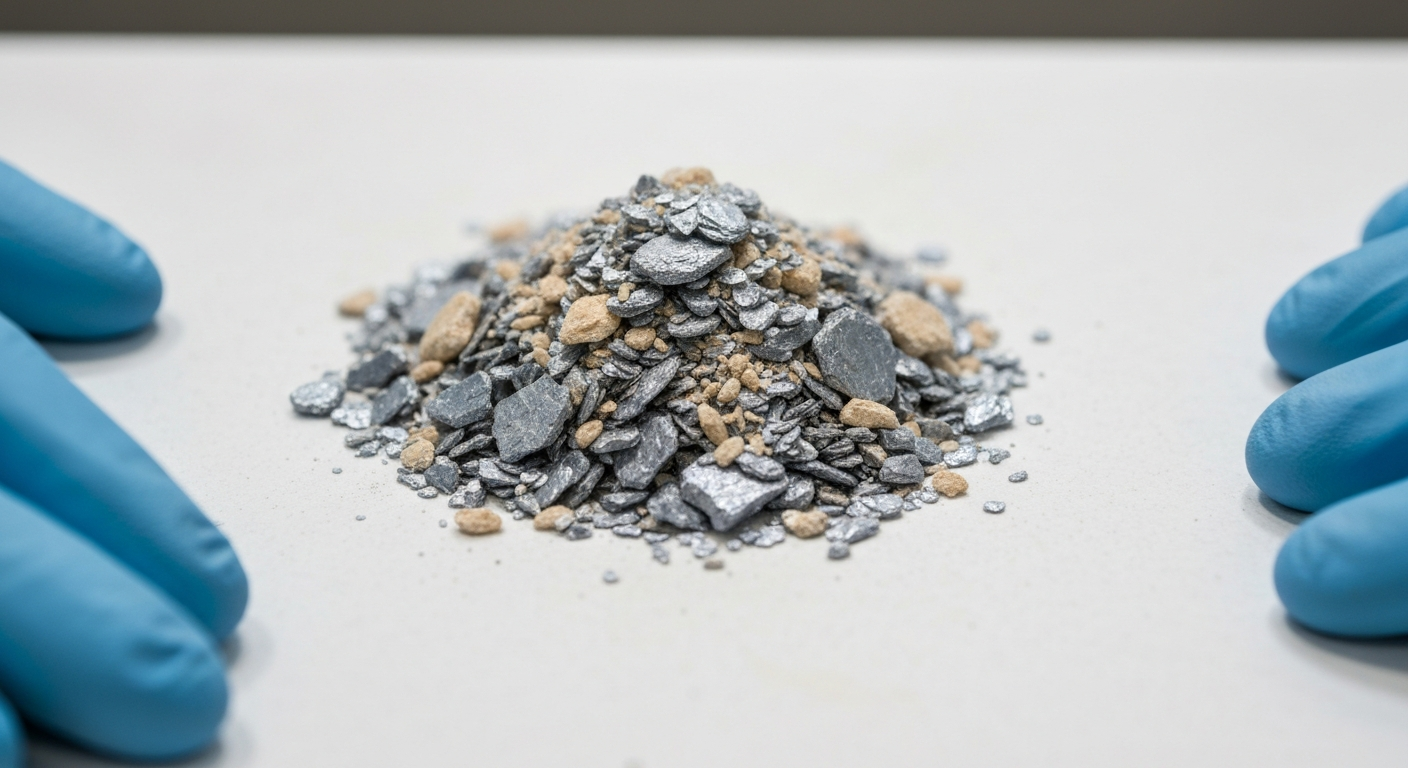
Geologically, Québec is one of the more interesting graphite regions outside Asia. The crystalline schist formations there tend to carry high flake grades with large individual flake sizes, which is what battery manufacturers want. Large-flake graphite fetches higher prices and is better suited to producing spherical graphite, the form actually used inside battery cells.
The regulatory environment helps too. Québec has a functioning mining framework, a stable legal system, and targeted support programs for critical material projects. The province is openly working to attach itself to the North American battery supply chain. That political backing matters in practical terms: a project in a well-governed jurisdiction carries a different risk profile than a comparable one somewhere less predictable.
For investors following small-cap miners, that context is worth keeping in mind when reading project announcements.
What an early exploration program actually delivers
In mining finance, a newly launched exploration program sits at the earliest defined stage of a project. The goal is not to build a mine. It is to test geological hypotheses with real data, through geophysical surveys, surface sampling, geological mapping, and initial scout drilling.
What such a program can do is shift geological conviction in one direction or the other: either evidence emerges that an economically relevant deposit exists, or it doesn’t. Positive results create the data foundation for a resource estimate under the Canadian NI 43-101 standard. The terminology matters here. Only once sufficient drill data are in hand can official Resources be calculated, whether Inferred, Indicated, or Measured. These are categorically different from Reserves (Proven or Probable), which require an economic feasibility analysis on top of the geology.
At this stage, there is no statement on economic viability. Between a first drilling campaign and a bankable feasibility study, the gap is typically measured in years and in capital rounds that haven’t happened yet. Investors who treat geological potential as though it were economic readiness are making a predictable early-stage error.
| Project stage | Typical activity | What it means for investors |
|---|---|---|
| Exploration | Geophysics, mapping, initial drilling | High risk, potential assessment |
| Resource estimate | NI 43-101 resource (Inferred/Indicated) | First quantifiable data baseline |
| PEA / scoping study | First economic viability test | Initial capital cost and NPV estimate |
| PFS / FS | Feasibility and bankability study | Reserve classification becomes possible |
| Permitting & construction | Permitting, engineering, construction | Highest capital outlay, lower exploration risk |
How to think about valuation at this stage
The land buyer: Someone purchases a plot on the city’s edge because zoning might change. The price reflects possibility, not current use. A junior explorer’s market value works the same way — it prices the statistical chance that geological promise turns into something economically extractable, not anything resembling current cash flow.
The film screenplay: An exploration program is the script. It defines the idea and the direction. Whether the financing, the shoot, and the distribution follow is a separate question entirely. No serious producer greenlights a budget on a screenplay alone.
The supply chain gap: Automakers building battery cells in Europe or North America need refined graphite that doesn’t come through China. A project that could theoretically fill part of that gap does carry strategic weight, the way a port gains value when a new shipping route opens. The investor’s question stays the same regardless: can this specific project grow into that role, and on what timeline?
What remains after the announcement
Graphite exploration in politically stable regions like Québec addresses a genuine supply problem. The Western battery industry does not have a sufficient raw material base outside Asia. That is not speculation; it is the stated rationale behind the EU’s Critical Raw Materials Act, the U.S. Inflation Reduction Act’s sourcing requirements, and Canada’s 2022 Critical Minerals Strategy.
None of that makes early-stage project selection straightforward. The underlying thesis, reducing Chinese supply dependence while building domestic chains, is grounded in real policy. But a grounded thesis says nothing about whether any particular exploration project delivers on it. Deposit quality matters: flake size and purity grades as disclosed in published technical reports. So does the track record of the project team, dilution risk across future capital raises, and whether the company has a credible path to downstream partnerships.
An exploration launch is one data point. The process takes years and produces many more before the picture becomes clear.
- Anode material
- The negative electrode of a lithium-ion battery, where lithium ions are stored during charging. Natural and synthetic graphite are the dominant materials used.
- Flake graphite
- A naturally occurring form of graphite with a layered structure. Large-flake graphite commands higher market prices and is particularly well-suited for battery applications.
- NI 43-101
- A Canadian regulatory standard for the disclosure of mineral resources and reserves. Technical reports must be signed off by a Qualified Person (QP).
- Inferred resource
- The lowest confidence category in a mineral resource estimate under NI 43-101. Based on limited sample data; not a basis for economic calculations.
- Reserves vs. resources
- Resources (Inferred / Indicated / Measured) describe geologically estimated quantities without economic evaluation. Reserves (Proven / Probable) require demonstrated economic extractability and a supporting feasibility study.
- Spherical graphite
- An intermediate graphite product shaped through milling and spheronization, used in battery anodes. It is produced from processed flake graphite through multiple refining stages.
- Downstream integration
- The extension of value creation beyond raw material extraction toward processing, refining, or materials manufacturing. Often pursued strategically by junior miners, but capital-intensive.
- Critical raw material
- A government classification for materials deemed economically indispensable whose supply is considered at risk. Graphite appears on the critical materials lists of the EU, the United States, and Canada.
⚠️ Important notice: This article is for informational and educational purposes only. It does not constitute investment advice, a recommendation, or a solicitation to buy or sell any security. Investments in small-cap exploration and mining companies carry a high risk, including the potential total loss of capital. Before making any investment decision, consult a registered financial advisor and conduct your own analysis. Boersen Post Team is not responsible for decisions taken based on the content published here.