Why Dozens of Junior Miners Are Drilling at the Same Time
May 3, 2026
Drilling Metres as a Signal: What Exploration News Reveals and What It Hides
May 7, 2026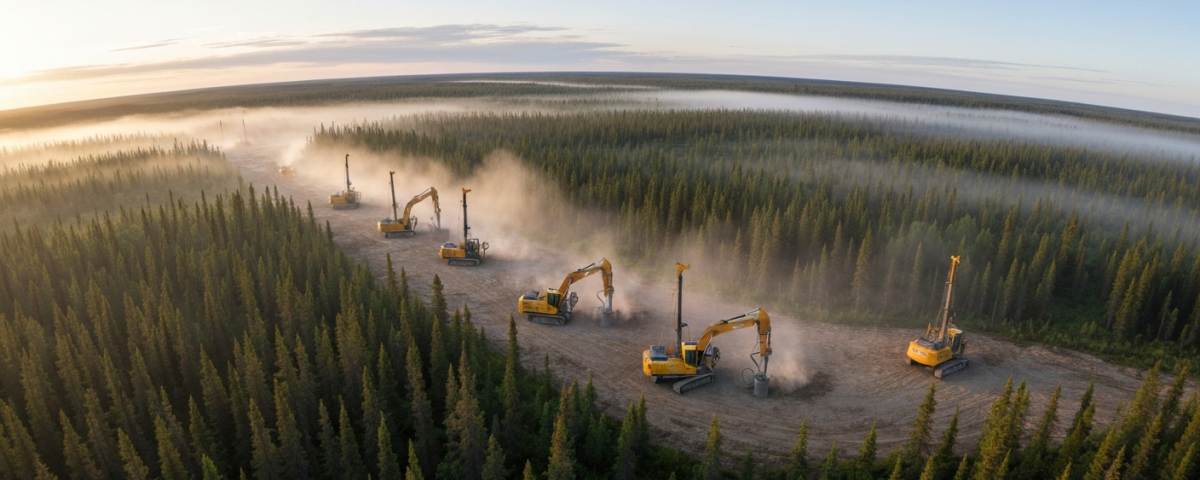
Record-Scale Drilling Programs: A Sector on the Move
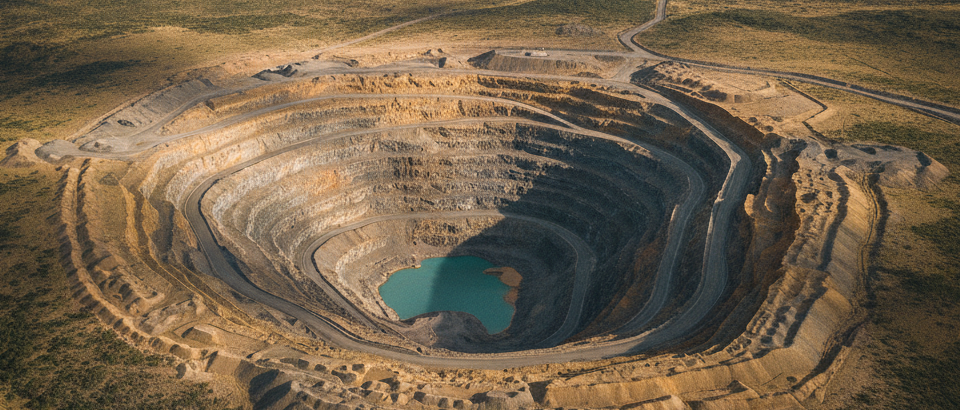
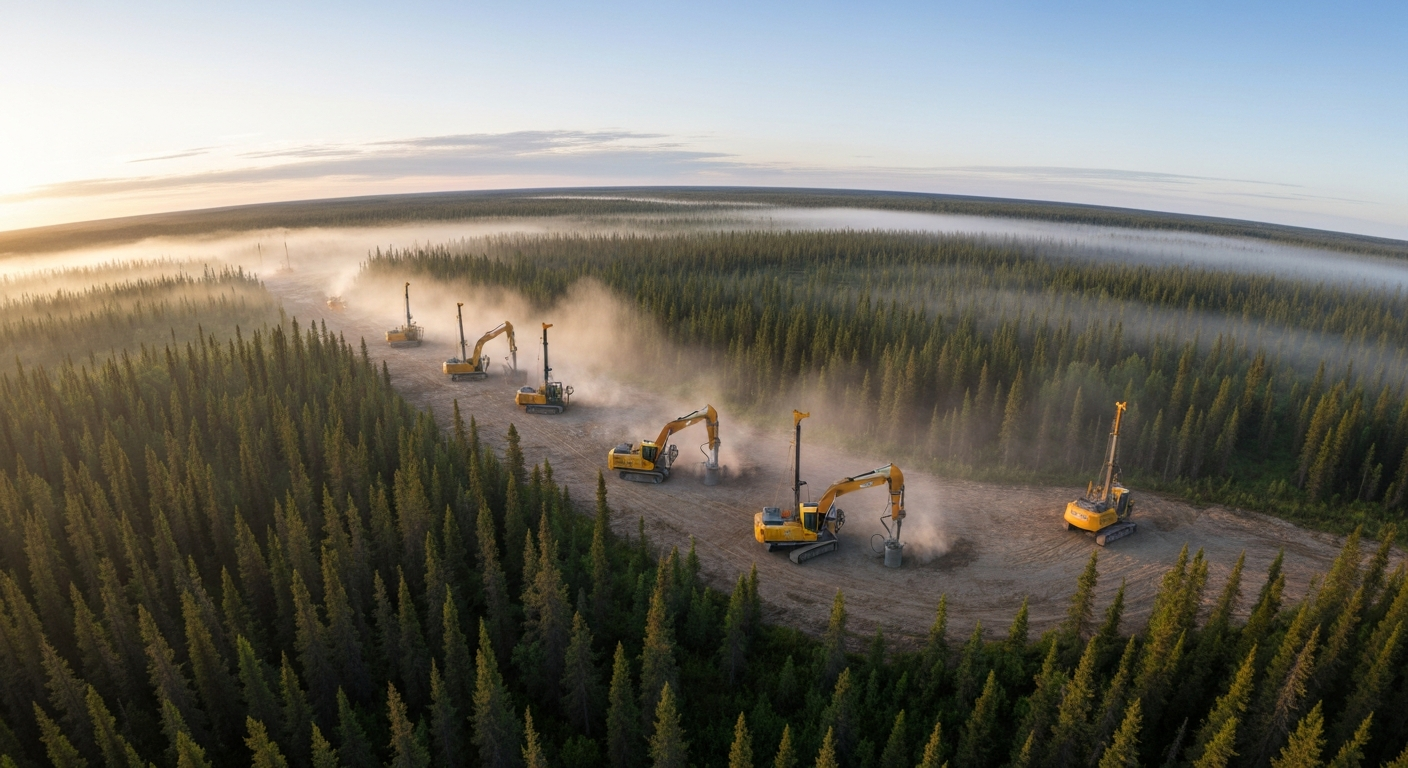
Spring 2026 is bringing a striking shift in junior gold exploration: several small mining companies are announcing drilling campaigns that far exceed the norm in scope and ambition. Programs measuring tens of thousands to hundreds of thousands of meters, multiple rigs running simultaneously, and fully funded exploration plans — these are not isolated cases but a recognizable pattern. For investors new to the world of small-cap mining stocks, the natural question is: what is driving this trend, and what can it teach us about how the market currently works?
Junior explorers are small, typically publicly listed companies whose primary goal is the discovery and initial assessment of commodity deposits. They generally do not yet produce any metals — they search for them. Their business model is high-risk but high-potential, and the scale of their drilling programs is one of the most important indicators of how confident the market currently is.
High Gold Prices as Fuel for the Exploration Engine
To understand the current boom, one must look at the commodities market. Gold has been trading at historically elevated price levels for some time. This has a direct effect on junior explorers: when the gold price rises, so does the potential value of an undeveloped deposit — and with it, investors’ willingness to commit capital to exploration projects.
This mechanism is fundamental to understanding the sector. Junior companies finance their drilling programs primarily by issuing new shares (known as private placements) or through public capital raises. When capital market conditions are favorable and investors show an appetite for risk, these companies can raise money more easily and on better terms. The result: more cash on hand, larger drilling programs.
Beyond gold, the copper market is also showing strength, driven by global demand for electrification infrastructure. Even uranium explorers are reporting well-funded programs. The current trend is therefore not a purely gold-driven phenomenon — it reflects a broader risk appetite across the entire commodities sector.
What Drill Meters Really Tell You — and What They Don’t
When a junior explorer announces plans to drill 50,000 or even 160,000 meters of drill core, it sounds impressive. But what does it actually mean? Drill meters describe the total length of all boreholes to be drilled within a given program. The more meters drilled, the more rock samples can be analyzed — and the more precisely the extent of a potential deposit can be mapped.
At the same time, program costs rise with program size. Diamond drilling in remote terrain can cost between $150 and $400 per meter, depending on the terrain, infrastructure, and depth. A 160,000-meter program can therefore carry costs in the tens of millions of dollars. This makes one thing clear: only companies with a solid financial foundation can credibly announce campaigns of this scale.
Another factor is operational complexity. Running multiple drill rigs simultaneously demands logistics, qualified personnel, functioning supply chains, and experienced management. For beginners, it is therefore worthwhile not only to look at the meter count, but also to ask: does the company have the team and the track record to actually execute a program of this size?
| Program Size (Drill Meters) | Typical Classification | Approximate Cost Range |
|---|---|---|
| Up to 5,000 m | Small initial program, target area test | $0.5–2M USD |
| 5,000–20,000 m | Mid-size infill or expansion program | $2–8M USD |
| 20,000–60,000 m | Large resource definition program | $8–25M USD |
| Over 60,000 m | Exceptionally large, rare for junior explorers | $25M+ USD |
What the 2026 Drilling Trend Means for the Junior Sector as a Whole
Looking at the current announcements as a whole, a coherent picture emerges: the junior exploration sector is in a phase of heightened activity, supported simultaneously by several factors. High commodity prices make deposits more valuable. Institutional and private investors are willing to deploy capital. And companies are using this window to advance their projects — before market sentiment potentially turns again.
Geographically, the activity is broadly distributed: from Canadian mining regions to Latin American mountain ranges to Arctic exploration zones. This underscores that the trend is not confined to any single region but has a genuinely global character.
From an educational standpoint, this moment is particularly instructive because it makes several core principles of commodities investing visible at the same time: the relationship between commodity prices and exploration activity, the role of capital market financing for junior companies, and the significance of drilling programs as a value-creation step within what is known as the exploration pyramid.
Key Terms for Getting Started in the World of Exploration
- Junior Explorer
- A small, typically publicly listed mining company that specializes in the discovery and initial assessment of commodity deposits but does not yet conduct commercial production.
- Drill Meters
- The unit of measurement for the total scope of a drilling program — the sum of all planned or completed borehole depths in meters.
- Diamond Drilling
- A drilling method in which a diamond-tipped drill bit extracts a cylindrical rock core from the subsurface. This core is analyzed geologically to determine metal grades and rock structures.
- Private Placement
- A non-public issuance of new shares to selected investors in order to raise capital. A common financing instrument for junior mining companies.
- Fully Funded
- A designation for an exploration program whose total costs are already covered by funds on hand. Reduces the risk of near-term share dilution.
- Dilution
- The reduction in the percentage ownership of existing shareholders resulting from the issuance of new shares. A central risk when investing in capital-intensive junior companies.
- Exploration Pyramid
- A conceptual model depicting the various stages of commodity exploration — from early geological prospecting through drilling programs and resource estimation, to feasibility studies and ultimately production.
- TSX-V (TSX Venture Exchange)
- A Canadian stock exchange for small-cap and growth companies, particularly those in the commodities and mining sector. Regarded as the most important listing venue for junior explorers worldwide.
⚠️ Important notice: This article is for informational and educational purposes only. It does not constitute investment advice, a recommendation, or a solicitation to buy or sell any security. Investments in small-cap exploration and mining companies carry a high risk, including the potential total loss of capital. Before making any investment decision, consult a registered financial advisor and conduct your own analysis. Boersen Post Team is not responsible for decisions taken based on the content published here.