When Resource Policy Reshapes the Exploration Portfolio
May 2, 2026
Gold Price Meets Capital Market: How Junior Explorers Fund Their Programs
May 4, 2026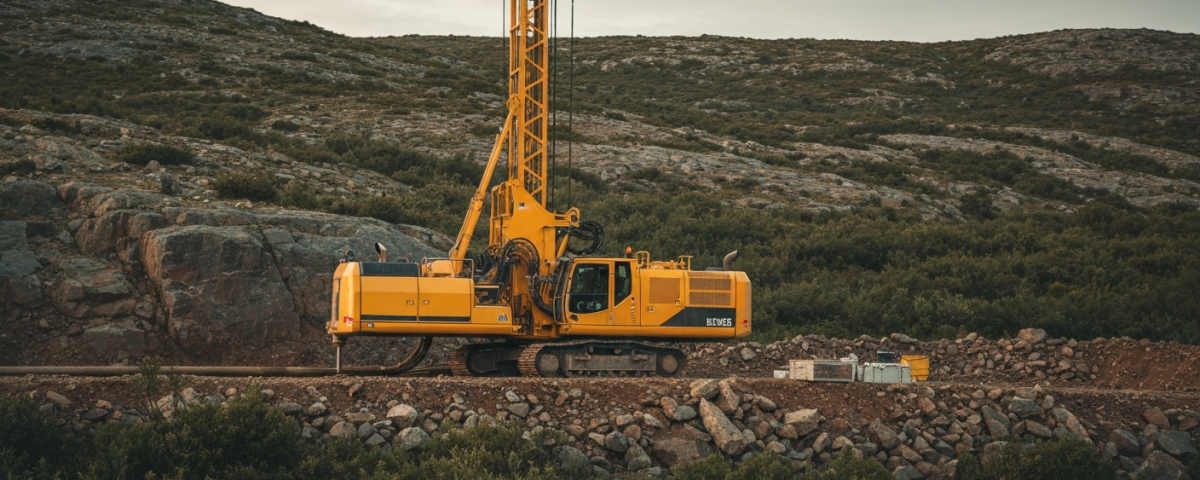
Introduction
Anyone following the news in the junior mining sector over recent weeks will notice a striking pattern: an unusually high number of small exploration companies are announcing new or significantly expanded drilling campaigns. The scale is remarkable — individual programs range from several thousand to more than one hundred thousand meters of drilling. At the same time, new drill platforms are being built, additional rigs are being mobilized, and exploration areas on multiple continents are being opened up. For beginners, the central question is: what does such a boom mean, and what structural forces underlie it?
Context
Junior exploration companies — often called “junior miners” for short — are small, typically publicly listed companies whose primary purpose is to search for economically viable commodity deposits. They do not produce commodities themselves; instead, they invest in geological exploration: drilling programs, rock analysis, and the evaluation of deposits. Their business model is built on making a discovery that can either be developed further or sold to a larger producer.
Drilling campaigns are the cornerstone of this activity. Every meter drilled costs money — depending on the region and terrain, between $100 and over $400 per meter. A program covering 50,000 meters can therefore quickly consume several million dollars. The fact that many companies are launching such programs simultaneously is no coincidence; it is the result of a favorable combination of several factors.
First, commodity prices have reached levels in recent years that make exploration attractive. High gold, copper, and uranium prices increase the potential economic viability of new discoveries — and with it, investors’ willingness to provide capital. Second, the financing environment for junior miners has improved: Sprott funds, streaming companies, and private investors are showing increased interest in commodity-related assets. Third, demand for critical minerals — copper, lithium, uranium, and rare earths — driven by the global energy transition, is noticeably accelerating exploration activity in these segments.
Geographically, current drilling activity is widely distributed: projects in North America, South America, and other regions are active. The range of commodities is equally diverse — alongside traditional gold and copper, critical minerals and energy commodities such as uranium are increasingly coming into focus.
Analysis
What does a drilling campaign boom specifically mean for the valuation and risk profile of junior miners? Several aspects are particularly relevant for beginners.
Exploration risk remains high. Even when many companies are drilling simultaneously, the statistical success rate remains low. Most drill holes do not yield economically significant results. The general rule of thumb holds: only a small fraction of all exploration companies actually make a meaningful discovery. An extensive drilling program is therefore not a guarantee of success — it is simply a sign of increased activity.
Capital consumption and dilution. Large drilling programs are often financed through share issuances. This means existing shareholders are diluted — their percentage ownership in the company decreases. Beginners should always examine how a company is financing its exploration and how its capital reserves (cash) compare to the planned scope of the program.
Signal effect for the sector. A coordinated increase in drilling activity signals that capital is flowing into the sector. This can be an early indicator of an upswing in the commodity cycle. Historically, junior mining sectors exhibit cyclical behavior: periods of intense exploration are often followed by consolidation phases in which underfunded projects are suspended.
Varying program sizes. The range of current programs is enormous — from a few thousand meters of drilling for smaller projects to six-figure meter counts for more ambitious campaigns. The latter require multiple rigs operating simultaneously and the corresponding logistics. It is important for investors to understand that the sheer size of a program alone does not indicate anything about the geological quality of a property.
Critical minerals as a growth driver. A notable trend within the boom is the share of projects targeting so-called critical minerals — raw materials required for battery technology, electric mobility, or the expansion of renewable energy. Governments in North America and Europe have classified these materials as strategically important, which has triggered government incentives and increased investor demand.
Full funding as a quality indicator. A particularly positive signal is when a company discloses that its drilling program is “fully funded.” This means the required capital is already in place and no immediate dilution risk exists. Investors should watch for this disclosure in press releases.
Conclusion
The current drilling campaign boom in the junior mining sector is a multifaceted phenomenon driven by high commodity prices, improved financing conditions, and strategic demand for critical minerals. For beginners, this trend offers a valuable opportunity to understand the fundamental mechanics of the exploration cycle: When does capital flow into the sector? How do investors evaluate drilling programs? What risks are associated with exploration?
One point remains essential: an active drilling program alone is not an investment thesis. The quality of the property, management experience, financing structure, and the macroeconomic environment must always be assessed together. The boom demonstrates that the sector is alive — but it says nothing about which of the ongoing programs will actually lead to an economic discovery. Education and critical thinking remain the most important tools for any beginning investor.
Glossary
- Junior Miner
- A small, publicly listed exploration company with no production of its own, focused on searching for and evaluating commodity deposits. Often listed on junior exchanges such as the TSX Venture Exchange.
- Drilling Campaign (Drill Program)
- A systematic program in which drill holes are sunk into the ground to extract rock samples and analyze them for mineralization. Program size is expressed in meters drilled.
- Meters Drilled
- The unit of measurement for the scope of an exploration program. It indicates the total number of meters to be drilled — a measure of program intensity and cost.
- Critical Minerals
- Raw materials classified as strategically important for technology, the energy transition, and national security — for example, lithium, cobalt, copper, and rare earths.
- Dilution
- The reduction of existing shareholders’ percentage ownership through the issuance of new shares, commonly used to finance exploration programs.
- Commodity Cycle
- A recurring pattern of boom and bust phases in the commodities sector, driven by supply, demand, and investor sentiment.
- TSX-V (TSX Venture Exchange)
- Canada’s junior stock exchange, where many small mining and exploration companies are listed. It is regarded as the global hub for junior mining financing.
- Infill Drilling
- Drilling within a previously identified mineralization zone to increase the density of data points and refine the resource estimate.
⚠️ Important notice: This article is for informational and educational purposes only. It does not constitute investment advice, a recommendation, or a solicitation to buy or sell any security. Investments in small-cap exploration and mining companies carry a high risk, including the potential total loss of capital. Before making any investment decision, consult a registered financial advisor and conduct your own analysis. Boersen Post Team is not responsible for decisions taken based on the content published here.