Social Licence to Operate: The Hidden Value in Defense Commodity Projects
June 8, 2026
Anchor Investors in Uranium Juniors: What Bought Deals Really Signal
June 8, 2026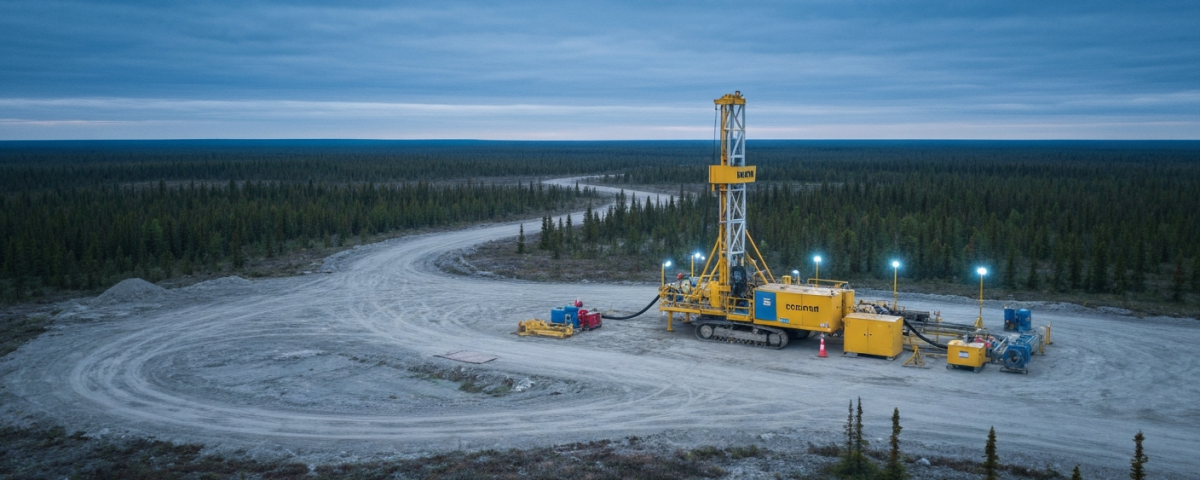
When 5,000 meters means more than just depth
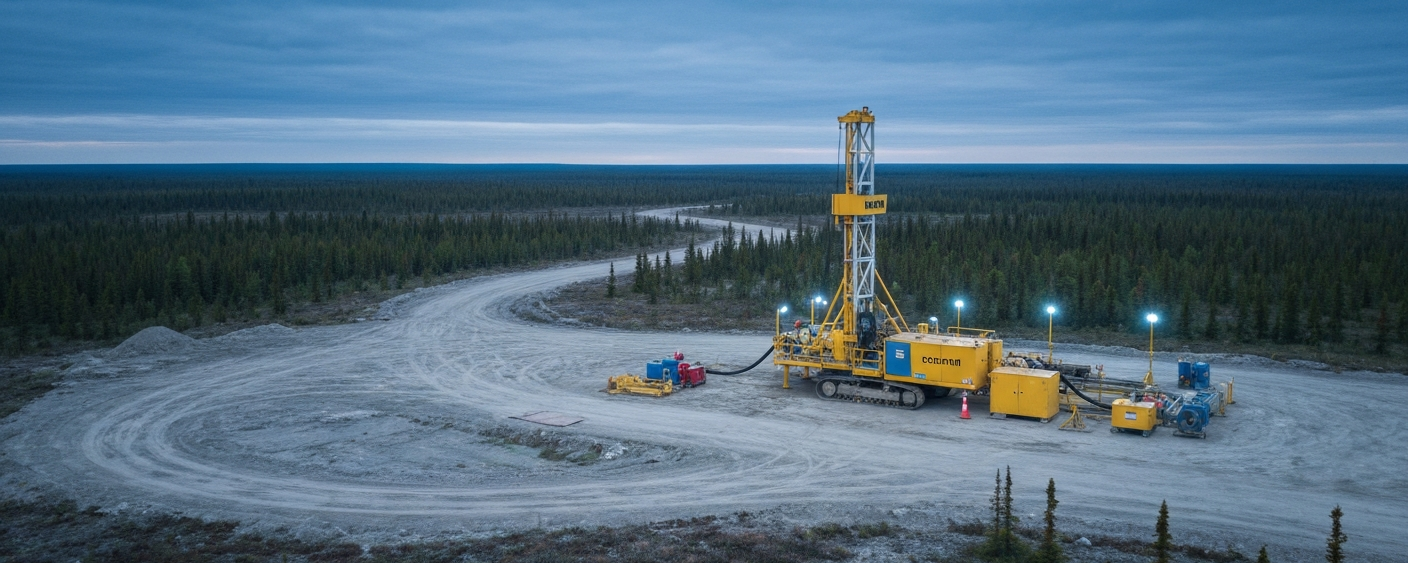
In northern Saskatchewan, not far from Uranium City, two small publicly listed companies are running a joint drilling program. They plan to test up to 25 priority targets across neighboring projects in a single field season, with funding already in place. The structure matters more than the headline meter count. What appears as routine operations is actually worth studying for how it manages exploration capital on a tight budget.
Saskatchewan ranks among the world’s most stable uranium jurisdictions. The northern edge of the Athabasca Basin contains high-grade uranium at shallow to moderate depths. This combination attracts junior explorers who need maximum drilling reach per dollar spent. The question is how to organize that when capital is limited.
Saskatchewan as a coordinate: what sets the Athabasca edge apart
The Athabasca Basin is geologically unusual. A sedimentary layer sits atop Precambrian basement rock, creating the right conditions for unconformity-type uranium deposits. These deposits can achieve very high grades in relatively small volumes, which makes them economically attractive compared to other uranium types.
The northern edge of the basin, where sediment meets crystalline basement, has hosted significant discoveries for decades. Projects in this belt draw investor and geologist attention because they resemble known deposits in structure. Historical drilling data from the region reveal geological patterns that modern geophysics can now map more precisely.
For investors, geography is critical. Projects in established mining zones use existing infrastructure, tap a qualified local workforce, and operate under tested regulatory frameworks. Operating costs stay lower, and the time from discovery to resource estimate typically shortens.

The cooperation model: more targets, shared risk
The program’s core lies not in geology but in financial structure. Two companies coordinate drilling so that shared infrastructure—drill crew, equipment, logistics—serves multiple targets. This has real economic consequences.
Imagine two real estate investors using the same development infrastructure for adjacent plots instead of one investor building alone. Fixed costs per project drop. Exploration works similarly. Mobilization, camp logistics, and equipment rental spread across multiple drill targets, reducing cost per target.
The second advantage is risk diversification. Most drill holes yield nothing economically relevant. Testing 25 targets instead of five increases the odds of a significant result, provided targets are well selected. Small-cap investors get more data from one joint program than from two separate programs.
Joint-venture models have worked in uranium before, especially when equity capital was scarce or expensive. The fact that this program is fully pre-funded shows the companies completed planning before drilling started, not raising capital speculatively as happened in earlier cycles.
| Feature | Solo program | Cooperation program |
|---|---|---|
| Drill targets per season | 5–10 | 20–25 |
| Fixed-cost allocation | One company bears everything | Split between both partners |
| Statistical hit probability | Lower (fewer tests) | Higher (more tests per dollar) |
| Capital requirement per company | Fully self-funded | Reduced through cost-sharing |
| Operational complexity | Lower | Higher (coordination required) |
What to examine in a cooperation program
Treat cooperation programs as a separate evaluation point for small caps. A joint-venture drilling program reveals capital efficiency and strategic maturity. Has management coordinated similar ventures before? How do partners split costs and discoveries? These details won’t appear in press releases but show up in company presentations and technical reports.
Timing also matters. Exploration at northern latitudes is seasonal: drill sites are reachable in summer (after thaw) or winter (when frozen ground supports equipment). A program announced for early summer signals full use of the short season. This time pressure can explain share price moves around results.
Full pre-funding means the current program doesn’t require new capital, reducing near-term dilution risk for existing shareholders. It doesn’t mean no future raises will happen; it just means this program won’t trigger one. The distinction matters for your analysis.
Efficiency as a benchmark in a tight capital market
This pattern isn’t unique. In today’s environment—with selective institutional capital, higher interest rates, and a constrained small-cap market—operational efficiency matters more as an evaluation criterion. Companies achieving more with less capital stand out.
Northern Saskatchewan along the Athabasca Basin remains geologically sound for high-grade uranium discovery. The real question isn’t whether the geology works. It’s whether the companies testing it operate efficiently and coherently. Cooperation structures are a step in that direction.
For the small-cap learner, remember this: the drilling program is the surface. The structure underneath—who pays, how results are shared, how it’s financed—is where analysis happens.
Key terms for beginners
- Unconformity-type deposit
- Uranium concentrated at the boundary between older crystalline basement and younger sedimentary rock. Athabasca Basin deposits of this type are known for very high uranium grades.
- Priority target
- An area selected on the basis of geophysical data, historical drilling, and geological models and ranked as promising for drilling. The prioritization determines drilling order.
- Fully funded program
- An exploration program with necessary funds in place before work begins, without needing to raise additional capital to complete it.
- Dilution risk
- The risk that a company issues new shares to raise capital, reducing the percentage ownership of existing shareholders. Fully funded programs reduce this risk in the near term.
- Field season
- The period of the year when exploration fieldwork can be carried out, dependent on climate, access, and permits. In northern Canada, this is often limited to summer or winter months.
- Joint venture (JV)
- A contractual arrangement between two or more companies in which costs, risks, and potential returns of a shared project are divided according to a predetermined formula.
- Inferred resource / Indicated resource
- Categories of resource estimation under NI 43-101 (the Canadian standard). An Inferred Resource is based on limited data with higher uncertainty; an Indicated Resource is better supported by data. Neither constitutes a reserve.
⚠️ Important notice: This article is for informational and educational purposes only. It does not constitute investment advice, a recommendation, or a solicitation to buy or sell any security. Investments in small-cap exploration and mining companies carry a high risk, including the potential total loss of capital. Before making any investment decision, consult a registered financial advisor and conduct your own analysis. Boersen Post Team is not responsible for decisions taken based on the content published here.